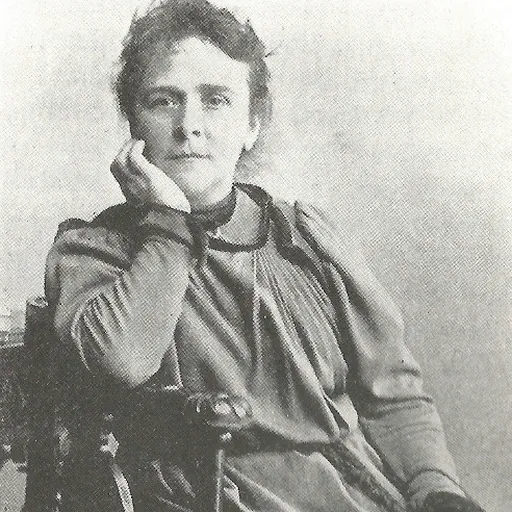
About Harriet Fisher Mole
Lived 1841 – 1912 (aged 70). Harriet Fisher Mole was a British trade unionist.
Harriet Fisher Mole (née Jones; 2 May 1841 – 15 April 1912), known as Jeannie, was a British socialist, feminist, and trade union organiser in Liverpool. Arriving there in 1879, Mole was instrumental in bringing socialism to Liverpool, as well as setting up a number of societies to encourage trade unions amongst Liverpool's female workforce. She supported strikes to improve the workforce's conditions, especially to remove fines.
Mole was also a supporter of dress reform, set up a socialist food van and advocated at a coroner's investigation for the family of a woman killed in an industrial accident, ensuring the family received compensation and encouraging the jury to recommend safety improvements as part of the verdict.
Biography Harriet Fisher Jones was born on 2 May 1841 in Warrington to her father, Evan Jones, a tinsmith, and his wife, Harriet Jones. As she and her mother shared the same name, she became better known as Jeannie. In 1860, she married a fruit merchant, Robert Willis, and the couple travelled to New York City, where she took an interest in the black rights movement. On her return to England, she and her husband settled in London and had a son, Robert Frederick Evan Willis, better known as Fred. Willis spent some time helping the poor in the slums of London.
In the late 1870s, Willis divorced her husband and remarried. Her new husband was another fruit merchant, William Keartland Mole, who was also the son of a wealthy Liverpool jeweller.
Mole suffered a heart attack in 1896, likely due to excessive work and the ensuing illness lead to her taking a step back from organisational work the following year. the first socialist society in Liverpool. The Brotherhood, despite never achieving great numbers, went on to help form the Liverpool branch of the Fabian Society in 1892. She also focused on more practical solutions for social issues, for example, funding a "socialist food van" at a cost of £55 6s 5d and campaigning for a "people's hall" in Liverpool for the working class.
"Many of [them] rise before five, tidy their little homes, prepare the day's food and pass the factory gate after a walk of two miles before the steam whistle stops shrieking at 6:30... So many of them receive only a few shillings a week, and have to tramp a long way to reach cheap shelter, and are not able to afford out of their wages such food as would give them energy and vigour. Sometimes, then, it happens that a woman hears the dreaded whistle stop when she is quarter of a mile away, and then she knows that some of her hard earned wage will be kept back from her." — Jeannie Mole, describing the plight of women workers in Liverpool They started working with the Women's Protective and Provident League (WPPL), calling for the founding of a local branch, and in January 1889, the group set up the Liverpool Workwomen's Society, representing bookfolders, tailors, and cigar makers, with Mole acting as secretary. Women were over-represented in these poorly paid trades, with four women for every man working in them. Around the same time, the House of Lords launched a select committee on sweating systems, with the ensuing publicity encouraging the group to take further action. In her role, Mole also stepped up inquiries into working conditions for women; for example, when an industrial accident killed a woman at the Old Swan Rope Works in Liverpool, Mole attended the case as secretary of the 'society for inquiring into the conditions of working women'. She ensured that a factory inspector attended, that the jury made recommendations to prevent future accidents, and that compensation was paid to the woman's next of kin. Mole also created and edited the "women's page" of the Liverpool Labour Chronicle newspaper.
Don’t just read it —
keep it.
Full-length biographies made to live with: read them, listen on the way to work, watch them tonight.
- E-book
- Audio
- Video
Instant download · yours to keep · every purchase keeps this site free
Important facts
People in Harriet Fisher Mole's life
Named in this biography and alive at the same time


Related people
Same field, nearest in time


Contemporaries
People whose lives overlapped Harriet Fisher Mole's
Frequently asked questions
Who was Harriet Fisher Mole?
English socialist and women's trade union organizer
When was Harriet Fisher Mole born?
Harriet Fisher Mole was born on 2 May 1841 in Warrington.
When did Harriet Fisher Mole die?
Harriet Fisher Mole died on 15 April 1912 in Paris.
What was Harriet Fisher Mole's occupation?
Harriet Fisher Mole was a trade unionist.
What nationality was Harriet Fisher Mole?
Harriet Fisher Mole was British.
Sources & further reading
· Wikipedia: Harriet Fisher Mole
Cite this page
APA: Biography.guide. (2026). Harriet Fisher Mole. https://biography.guide/harriet-fisher-mole/
MLA: "Harriet Fisher Mole." Biography.guide, https://biography.guide/harriet-fisher-mole/.
Chicago: "Harriet Fisher Mole." Biography.guide. https://biography.guide/harriet-fisher-mole/.
Data last updated: 2026-09-24 · Spot an error? Report a correction.
Portrait: Wikimedia Commons · author & licence
Page generated 2026-10-03 09:37 UTC