
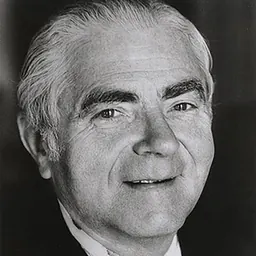
Harold M. Jacobs
Jewish-American civic and religious leader
About Harold M. Jacobs
Lived 1912 – 1995 (aged 82). Harold M. Jacobs was an American community leader.
Harold Milton Jacobs (October 25, 1912 – May 18, 1995) By 1961, it was listed on the American Stock Exchange.
Civic leader Brooklyn Jewish communal life Jacobs was deeply devoted to the importance preserving Orthodox Jewish life in the face of pressures to assimilate. He was committed to the principle that it was possible to simultaneously maintain a religious observant lifestyle and participate in American society. This was no easy task in an era when Blue Laws discouraged Saturday Sabbath observance, few kosher products were available in supermarkets, and kosher restaurants were a rarity, especially outside New York City.
Jacobs served in leadership roles in an array of Orthodox institutions. He was president of Young Israel of Eastern Parkway from 1949 to 1953, president of the Crown Heights Yeshiva from 1953 to 1968,
Beginning in 1952, Jacobs assumed a leading role in the Orthodox community's campaign for the abolition of New York State's Blue Law, which mandated the closing of businesses on Sundays.
Jacobs inherited an organization in difficult financial straits, and devoted much of his early presidential tenure to fundraising. As the OU returned to financial health, he was able to focus on his educational and programming agenda, at the top of which was the goal of expanding outreach to young American Jews with little or no background in Judaism.
This was at a time when outreach efforts by groups such as Chabad and Aish HaTorah were still in their infancy. The OU's National Conference of Synagogue Youth (NCSY) set up chapters around the country, run primarily by the teenagers themselves, which offered educational activities and, in particular, Shabbatons. These weekend experiences, with their strong combination of religious and social appeal, proved extremely successful and helped groom numerous future Jewish community activists, educators, and leaders. Many senior officials of the OU itself started out as NCSY participants.
Jacobs regarded NCSY as a critical component in the process of both preserving and expanding Orthodox Judaism in America. During the years of his precedence, he presided over what one of his colleagues characterized as “the largest growth and expansion of NCSY in its history.” He also participated in many NCSY gatherings around the country, in order to establish a personal rapport with attendees.
During the Jacobs presidency, the OU Center was opened in Israel, and the Zula project was begun to open a drop-in center in Jerusalem for troubled or socially disadvantaged teens.
Struggle over the Synagogue Council of America Jacobs's rise in the OU leadership coincided with a growing conflict over the organization's membership in the Synagogue Council of America. The council had been established in 1925 as a means for the Reform, Conservative, and Orthodox movements to present a united Jewish position to the outside world. In the 1950s the make-up of the American Orthodox community began to change, due to an influx of postwar European immigrants who identified with the more insular, or haredi, sector of the community. As a result, a growing number of Orthodox Jews began urging the OU to withdraw from the council, lest its participation be seen as granting de facto religious legitimacy to the non-Orthodox movements. Manhattanites and out-of-towners tended to favor continuing cooperation with the non-Orthodox groups, while Brooklynites, who were more deferential to haredi rabbinical leaders, tended to favor withdrawing from the council.
Jacobs sympathized with the advocates of withdrawal
At the November 1974 assembly, following what the New York Times called "a stormy debate," Jacobs brokered a compromise whereby the delegates voted to create a 40-man commission to study the issue further. They ultimately recommended staying in the council, and in March 1975, an expanded meeting of the OU board of directors voted 68 to 56 to resume the organization's participation in the Synagogue Council.
Jews and the Democratic Party Jacobs became involved in American politics through the Madison Club, a Democratic Party machine in Brooklyn that addressed local needs while grooming future city and state political leaders. He became close to future New York City mayor Abraham Beame
Leader of Young Israel After his final term as president of the OU in late 1978, Jacobs became active in another national Orthodox Jewish organization, the National Council of Young Israel, and was elected president in June 1981.
Jacobs advocated charging tuition for City University, "which began in 1975." It covers many behind-the-scenes details affecting interactions among several Jewish organizations and how he helped grow internal units such as NCSY.
Jacob's Personal Papers reside at Yeshiva University Archives.
Don’t just read it —
keep it.
Full-length biographies made to live with: read them, listen on the way to work, watch them tonight.
- E-book
- Audio
- Video
Instant download · yours to keep · every purchase keeps this site free
Important facts
People in Harold M. Jacobs's life
Named in this biography and alive at the same time


Related people
Same field, nearest in time




Contemporaries
People whose lives overlapped Harold M. Jacobs's





Frequently asked questions
Who was Harold M. Jacobs?
Jewish-American civic and religious leader
When was Harold M. Jacobs born?
Harold M. Jacobs was born on 25 October 1912.
When did Harold M. Jacobs die?
Harold M. Jacobs died on 18 May 1995.
What was Harold M. Jacobs's occupation?
Harold M. Jacobs was a community leader.
What nationality was Harold M. Jacobs?
Harold M. Jacobs was American.
Sources & further reading
Cite this page
APA: Biography.guide. (2026). Harold M. Jacobs. https://biography.guide/harold-m-jacobs/
MLA: "Harold M. Jacobs." Biography.guide, https://biography.guide/harold-m-jacobs/.
Chicago: "Harold M. Jacobs." Biography.guide. https://biography.guide/harold-m-jacobs/.
Data last updated: 2026-09-20 · Spot an error? Report a correction.
Page generated 2026-09-27 05:22 UTC