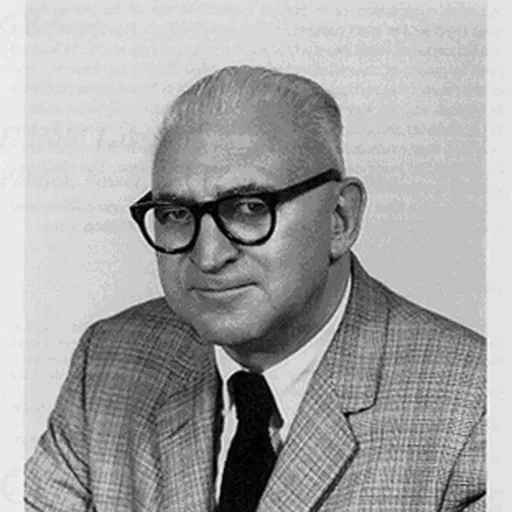
About Harold Lasswell
Lived 1902 – 1978 (aged 76). Harold Lasswell was an American political scientist, academic, sociologist and psychologist.
Harold Dwight Lasswell (February 13, 1902 – December 18, 1978) was an American political scientist and communications theorist. He was a professor of law at Yale University. He served as president of the American Political Science Association, American Society of International Law, and World Academy of Art and Science.
According to a biographical memorial written by Gabriel Almond at the time of Lasswell's death, and published by the National Academies of Sciences in 1987, Lasswell "ranked among the half dozen creative innovators in the social sciences in the twentieth century." At the time, Almond asserted that "few would question that he was the most original and productive political scientist of his time."
Biography
Early life Lasswell was born on February 13, 1902, in Donnellson, Illinois, to a clergyman and a school teacher. An older brother died in childhood.
Teaching career From 1922 to 1938,
Lasswell taught law and political science at Yale University from 1946 to 1970. From 1970 to 1972, he served as a professor of law at the City University of New York's John Jay College. From 1972 to 1976, he served as a distinguished professor at Temple University School of Law, where he retired from teaching.
Lasswell served as president of the American Political Science Association in 1956 and president of the American Society of International Law from 1966 to 1968. He was also involved in the Association for the Advancement of Science, Commission on the Freedom of the Press, Committee for Economic Development, and Rand Corporation. Lasswell has been described as a "one-man university" whose "competence in, and contributions to, anthropology, communications, economics, law, philosophy, psychology, psychiatry and sociology are enough to make him a political scientist in the model of classical Greece."
Lasswell is considered to be a founding father of political psychology and policy sciences and an early proponent of mass communication as a field of scholarly research. He believed universities should become focal centers for the study of communications.
His five-questions model of communication is considered one of the earliest and most influential models of communication. Many consider him the founder of content analysis, having conducted one of the most comprehensive content analysis studies of his time.
Propaganda At the age of 25, Lasswell completed his doctoral dissertation on Propaganda Technique in the World War. In his dissertation, Lasswell noted that propaganda is unavoidable and democracies must adjust to it, rather than fight it.
His study of political and wartime propaganda represented an important early type of communication study. Propaganda analysis has been absorbed into the general body of communication research, though the word propaganda later gained a negative connotation. and its uses in World War II. In 1935, Lasswell published World Politics and Personal Insecurity, a study of international relations using quantitative content analysis. The study included direct observation of the aggressive behavior of welfare clients toward public relief administrators.
His works on political psychology include Psychopathology and Politics, World Politics and Personal Insecurity, and Power and Personality.
Model of communication
His five-questions model of communication, which focuses on "who (says) what (to) whom (in) what channel (with) what effect," led to the emphasis in communication study on determining effects. First published in Lasswell's 1948 book, The Structure and Function of Communication in Society, the model aims to organize the "scientific study of the process of communication." and its lack of relevance due to its linear orientation. Other scholars object to its lack of a feedback loop, The seven stages have been criticized for their construct as a policy cycle or a linear process. He also identified eight "goal values" of policy: wealth, power, respect, rectitude, skill, well being, enlightenment, and affection.
Publications Some of Lasswell's publications include:
Books
Source:
Propaganda Technique in the World War, Ph.D. dissertation (1927) "Personality studies," Chicago: An Experiment in Social Science Research (1929) Psychopathology and Politics (1930) Propaganda and Promotional Activities: An Annotated Bibliography (1935) World Politics and Personal Insecurity (1935) Politics: Who Gets What, When, How (1936) World Revolutionary Propaganda: A Chicago Study (1939) Propaganda, Communication, and Public Opinion: A Comprehensive Reference Guide (1946) World Politics Faces Economics (1945) The Analysis of Political Behaviour: An Empirical Approach (1948) Power and Personality (1948) The Structure and Function of Communication in Society (1948) Language of Politics: Studies in Quantitative Semantics (1949) National Security and Individual Freedom (1950) Power and Society: A Framework for Political Inquiry (1950) Political Writings: Representative Selections (1951) The Policy Sciences: Recent Developments in Scope and Method (1951) "Democratic character," The Political Writings of Harold D. Lasswell (1951) The Comparative Study of Elites (1952) The Comparative Study of Symbols (1952) The Decision Process: Seven Categories of Functional Analysis (1956) Studies in World Public Order (1960) In Defense of Public Order: The Emerging Field of Sanction Law (1961) The Future of Political Science (1963) Law and Public Order in Space (1963) Power, Corruption, and Rectitude (1963) World Handbook of Political and Social Indicators (1964) World Revolutionary Elites: Studies in Coercive Ideological Movements (1965) The Sharing of Power in a Psychiatric Hospital (1966) The Interpretation of Agreements and World Public Order: Principles of Content and Procedure (1967) Political Communication: Public Language of Political Elites in India and the US (1969) "Toward a general theory of directed value accumulation and institutional development," Political and Administrative Development (1969) Peasants, Power, and Applied Social Change: Vicos as a Model (1971) A Pre-View of Policy Sciences (1971) The Search for World Order: Studies by Students and Colleagues of Quincy Wright (1971) Policy Sciences and Population (1975) Values and Development: Praising Asian Experience (1976) The Signature of Power: Buildings, Communication and Policy (1979) Human Rights and World Public Order: The Basic Policies of an International Law of Human Dignity (1980) Propaganda and Communication in World History (1980)
Articles
Source:
"Two forgotten studies in political psychology," American Political Science Review (1925) "Types of political personalities," Proceedings of the American Sociological Society (1927) "Personality system and its substitutive reactions," Journal of Abnormal Psychology (1929) "The study of the ill as a method of research into political personalities," American Political Science Review (1929) "Psychoanalytic interviews as a method of research on personalities," Childs Emotions (1930) "The scientific study of human biography," The Scientific Monthly (1930) "Self-analysis and judicial thinking," International Journal of Ethics (1930) "The measurement of public opinion," American Political Science Review (1931) "Triple-appeal principle: A contribution of psychoanalysis to political and social science," American Journal of Sociology (1932) "Verbal references and physiological changes during the psychoanalytic interview: A preliminary communication," The Psychoanalytic Review (1935) "Certain prognostic changes during trial (psychoanalytic) interviews," The Psychoanalytic Review (1936) "A method of interlapping observation in the study of personality in culture," Journal of Abnormal Psychology (1937) "What psychiatrists and political scientists can learn from one another," Psychiatry (1938) "The garrison state," American Journal of Sociology (1941) "Legal education and public policy: Professional training in the public interest," Yale Law Journal (1943) "The political science of science: An inquiry into the possible reconciliation of mastery and freedom," American Political Science Review (1956) "Political constitution and character," The Psychoanalytic Review (1959) "The qualitative and quantitative in political and legal analysis," Daedalus: Journal of the American Academy of Arts and Sciences (1959) "The identification and appraisal of diverse systems of public order," American Journal of International Law (1959) "The common frontiers of psychiatry and law," American Journal of Psychiatry (1960) "Cooperation for research in psychiatry and law," American Journal of Psychiatry (1961) "Theories about international law: Prologue to a configurative jurisprudence," Virginia Journal of International Law (1968)
Don’t just read it —
keep it.
Full-length biographies made to live with: read them, listen on the way to work, watch them tonight.
- E-book
- Audio
- Video
Instant download · yours to keep · every purchase keeps this site free
Important facts
People in Harold Lasswell's life
Named in this biography and alive at the same time





Related people
Same field, nearest in time



Contemporaries
People whose lives overlapped Harold Lasswell's




Frequently asked questions
Who was Harold Lasswell?
American political scientist (1902-1978)
When was Harold Lasswell born?
Harold Lasswell was born on 13 February 1902 in Donnellson.
When did Harold Lasswell die?
Harold Lasswell died on 18 December 1978 in Manhattan.
What was Harold Lasswell's occupation?
Harold Lasswell was a political scientist, academic, sociologist and psychologist.
What nationality was Harold Lasswell?
Harold Lasswell was American.
Sources & further reading
Cite this page
APA: Biography.guide. (2026). Harold Lasswell. https://biography.guide/harold-lasswell/
MLA: "Harold Lasswell." Biography.guide, https://biography.guide/harold-lasswell/.
Chicago: "Harold Lasswell." Biography.guide. https://biography.guide/harold-lasswell/.
Data last updated: 2026-09-22 · Spot an error? Report a correction.
Portrait: Wikimedia Commons · author & licence
Page generated 2026-09-27 05:02 UTC