
About Harold Anthony Oaks
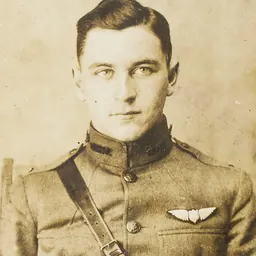
Lived 1896 – 1968 (aged 71). Harold Anthony Oaks was a flying ace and geologist.
Captain Harold Anthony Oaks (1896-1968) was a Canadian-born World War I flying ace credited with 11 confirmed aerial victories. Upon his return to Canada, his extensive pioneering activities as an aviator/geologist earned him an enshrinement in the Canadian Aviation Hall of Fame.
Early life and infantry service Harold Anthony Oaks was born in Hespeler, Canada, and raised in Preston, Ontario. At 18 years of age, he enlisted in the Canadian Expeditionary Force for service in World War I. He transferred to the Royal Flying Corps in 1917.
World War I aerial service
By May 1918, Oaks had been trained and was posted to 48 Squadron as a Bristol F.2 Fighter pilot. He scored his first two aerial victories on 21 May 1918, in two separate combats. At 1815 hours, he drove a German Fokker Triplane down out of control over Carnoy, France. In 1853, he destroyed a second Triplane a mile north of Mericourt. On 10 June, he joined Frank Ransley, Charles Steele, and John Drummond in burning an Albatros D.V fighter in midair over Roye. On 25 June, he drove down a Fokker D.VII out of control. He won twice in separate combats on 2 July 1918; he destroyed one Pfalz D.III over Foucaucourt, and another over Soyecourt.
The new ace scored a double victory on 24 July, sending down two Fokker D.VIIs down out of control. On 3 August, he was credited with the capture of an Albatros reconnaissance machine at Aveluy, France. He completed his victory list with a double win on 5 September 1918, when he burned a Fokker D.VII and drove another down out of battle. Oaks' final tally included two shared wins in the destruction of enemy planes, three others destroyed singlehanded, an opposing plane captured, and five others driven down out of control. He transferred to the unemployed list of the Royal Air Force on 15 April 1919. He was awarded the Distinguished Flying Cross on 3 June 1919 by King George V.
He returned home to Canada and returned to school. He graduated in 1922 from the University of Toronto with a Bachelor of Science degree as a mining engineer. He began using airplanes as an aid to prospecting in Quebec and northern Ontario.
He invented the portable nose hangar for bush pilot use in 1926.
He was also involved in the formation of several airlines, including Oaks Airways Ltd. He participated in several lifesaving mercy flights, including a search and rescue flight of 13 prospectors stranded in the subarctic.
Harold Anthony Oaks died on 21 July 1968 in Toronto. He was inducted into the Canadian Aviation Hall of Fame in 1973.
Don’t just read it —
keep it.
Full-length biographies made to live with: read them, listen on the way to work, watch them tonight.
- E-book
- Audio
- Video
Instant download · yours to keep · every purchase keeps this site free
Important facts
People in Harold Anthony Oaks's life
Named in this biography and alive at the same time




Related people
Same field, nearest in time


Contemporaries
People whose lives overlapped Harold Anthony Oaks's


Frequently asked questions
Who was Harold Anthony Oaks?
Canadian World War One flying ace
When was Harold Anthony Oaks born?
Harold Anthony Oaks was born on 12 November 1896 in Hespeler.
When did Harold Anthony Oaks die?
Harold Anthony Oaks died on 21 July 1968 in Toronto.
What was Harold Anthony Oaks's occupation?
Harold Anthony Oaks was a flying ace and geologist.
Sources & further reading
· Wikipedia: Harold Anthony Oaks
· DBpedia: Harold Anthony Oaks
Cite this page
APA: Biography.guide. (2026). Harold Anthony Oaks. https://biography.guide/harold-anthony-oaks/
MLA: "Harold Anthony Oaks." Biography.guide, https://biography.guide/harold-anthony-oaks/.
Chicago: "Harold Anthony Oaks." Biography.guide. https://biography.guide/harold-anthony-oaks/.
Data last updated: 2026-09-20 · Spot an error? Report a correction.
Page generated 2026-09-27 05:05 UTC