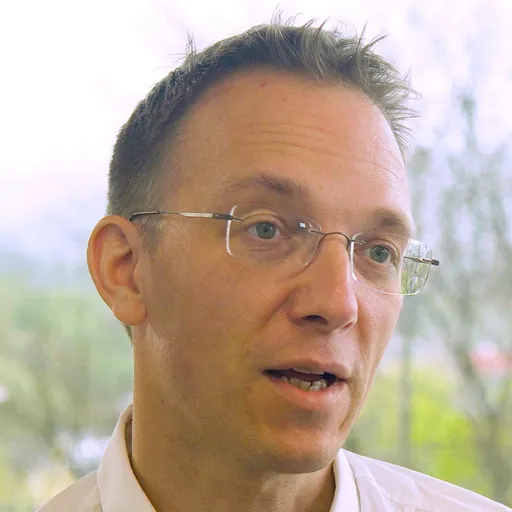
About Harald G. L. Schwefel
Harald G. L. Schwefel was a physicist.
Harald Schwefel is a German-born physicist currently based in New Zealand. He is a professor in the Department of Physics at the University of Otago and a principal investigator in the Dodd-Walls Centre. His research focuses on the interaction of light and matter in dielectric materials, and his speciality is whispering gallery mode resonators (WGMRs), small disks of dielectric which confine and store laser light to facilitate nonlinear interactions. He uses these to generate optical frequency combs and to coherently convert between microwave and optical photons.
Biography Born in Berlin, Schwefel spent his undergraduate years from 1994 till 1998 studying physics and maths at Brandenburg University of Technology (BTU) Cottbus in Germany. During this time he took an active part in student politics as a member and then chairman of the student council StuRa. He organised strikes and demonstrations in response to savings plans proposed by Science Minister Steffen Reiche in a draft of the Brandenburg Higher Education Act that granted unlimited rights to close and merge universities. Schwefel was motivated to maintain the small size of universities in East Germany which offered educational advantages. He encouraged students to be active, enjoy student life and study subjects they found fun. He also ran the Berlin marathon and climbed Mount Elbrus while at BTU.
In 2005 Schwefel joined the Max Planck Research Group at the University of Erlangen as a postdoctoral fellow
Schwefel moved to New Zealand in September 2015 where he has reestablished his research programme as a senior lecturer in the Department of Physics at the University of Otago This includes both theoretical and experimental work in the linear and nonlinear domains. He specialises in whispering gallery mode resonators (WGMRs), small disks of dielectric materials which are used to confine, store and therefore intensify light to facilitate nonlinear interactions. These devices are based on the whispering gallery wave phenomenon, where laser light bounces around the inner surface of a dielectric disc, confined by total internal reflection. Schwefel began research on WGMRs at the Max Planck Institute and has further developed fabrication techniques to achieve high quality factors, Schwefel's group are exploring the use of WGMRs for generating optical frequency combs, coherently converting microwave and terahertz radiation into the optical domain as well as other fundamental investigations.
Quantum computing and communication Schwefel's team have used their WGMRs to coherently convert microwave photons into optical photons. This offers a method for coherent optical telecommunication between individual quantum computers. Some superconducting quantum computers use microwave photons as the qubits for quantum information processing. As microwave photons are lost outside the ultra-cold environment of a cryostat, they cannot be used to communicate through ambient temperatures between quantum computers. Converting microwave signals into the optical domain and vice versa enables the use of conventional optical telecommunications networks for communication. Schwefel and his team have achieved coherent conversion by sending microwave photons into their WGMRs along with an optical signal. The two signals interact producing a third optical output signal that is coherent with the original microwave signal.
They are working with researchers at the Max Planck Institute for the Science of Light to study the quantum properties of light that has been converted from optical to microwave light in a lithium niobate WGMR.
Archeology collaboration Along with other researchers and students at the Dodd-Walls Centre, Schwefel has been working with American archeologist Leslie Van Gelder to develop an LED lamp that mimics the flickering torch light that palaeolithic cave artists worked by many thousands of years ago. The lamps will enable cave art to be seen in a more authentic light and help archaeologists answer questions about palaeolithic people and their techniques for creating cave art.
Awards and honours
Winner of 2017 Bright Ideas Competition sponsored by the Optical Society of America Foundation and Quantel Laser. Elected as an Optica Fellow in 2023.
Don’t just read it —
keep it.
Full-length biographies made to live with: read them, listen on the way to work, watch them tonight.
- E-book
- Audio
- Video
Instant download · yours to keep · every purchase keeps this site free
Important facts
Related people
Same field, nearest in time


Frequently asked questions
Who was Harald G. L. Schwefel?
physicist
What was Harald G. L. Schwefel's occupation?
Harald G. L. Schwefel was a physicist.
Sources & further reading
· Wikipedia: Harald G. L. Schwefel
Cite this page
APA: Biography.guide. (2026). Harald G. L. Schwefel. https://biography.guide/harald-g-l-schwefel/
MLA: "Harald G. L. Schwefel." Biography.guide, https://biography.guide/harald-g-l-schwefel/.
Chicago: "Harald G. L. Schwefel." Biography.guide. https://biography.guide/harald-g-l-schwefel/.
Data last updated: 2026-09-21 · Spot an error? Report a correction.
Portrait: Wikimedia Commons · author & licence
Page generated 2026-09-27 04:59 UTC