
About Hansa Wadkar
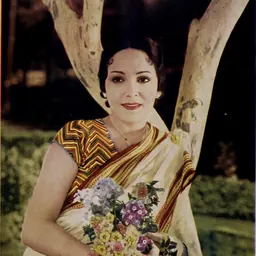
Lived 1924 – 1971 (aged 46–47). Hansa Wadkar was an Indian actor, writer and film actor.
Hansa Wadkar (1923–1971) was a Marathi and Hindi film and stage actress. She started her acting career in Indian cinema at the age of thirteen years, as a heroine in the bilingual film Vijaychi Lagne. Wadkar went on to make a name for herself working in reputable film companies like Bombay Talkies, Prabhat Film Company and National Studios. Her career-defining role was in Vishnupant Damle's Sant Sakhu (1941) where she enacted the role of the female saint Sakhu. Her other memorable roles are in the Tamasha genre films like Lokshahir Ram Joshi (1947), termed as the "Classic Marathi Tamasha musical" and Sangtye Aika (1959), another of Marathi cinema's "best known Tamasha films". The title "Sangtye Aika" (You Ask, I Tell) was used by Wadkar for her autobiography compiled in 1971. The autobiography was initially serialised in the Marathi magazine Manoos helped by journalist Arun Sadhu.
She has been referred to as "one of the most sought after and bohemian actresses of her time". Wadkar underwent personal difficulties in her life, which included marital problems, addiction to alcohol, humiliation at several levels and rape at the hands of a magistrate, when seeking to get out of a troubled relationship. Her marriage ended in a separation and her daughter was kept away from her.
Bhumika (The Role) (1977) directed by Shyam Benegal, is based on Hansa Wadkar's autobiography and has actress Smita Patil playing Wadkar in the film. The film won two National Awards, Best Actress for Smita Patil and Best Screenplay for Satyadev Dubey, Shyam Benegal and Girish Karnad. The film also won the Best Film at the 25th Filmfare Awards.
Early life Wadkar was born Ratan Bhalchander Salgaokar, on 24 January 1923 at Dr. Bhalerao Hospital in Bombay, Maharashtra, India. The family returned to Bombay and Hansa attended an English medium school for two years at Aryan Education Society School. However, she had to leave school when the family faced financial problems. Her father had turned into an alcoholic and there was no money coming in the house. Her mother insisted that Mohan, being a boy, should continue his studies, and thus Wadkar had to find work.
The influence of films was present from an early time. Wadkar's father had three sisters, Kesharbai, Indirabai and Sushilabai. Sushila was married to Master Vinayak, a renowned actor-director of the early era of Indian cinema. Kesharbai and Indira Wadkar were acting in films and Indira was a classical singer as well. Indira acted in several films including Duniya Kya Hai (Resurrection) (1937) and in Vinayak's production company "Hans Films" like Devata (1939) in Marathi. Indira used the surname Wadkar to avoid using the family name Salgaokar, for fear of reprisal from society against women acting in films. Kesharbai, who was working in a film being made by M.G. Rangnekar, suggested that Wadkar work in films to financially sustain her family.
Career In 1936, Wadkar acted in her first role as a heroine in Bapubhai Pendharkar's Vijayche Lagane. A bilingual, made in Marathi and Hindi (Shadi Ka Maamla), it was directed by Mama Warerkar. The film was produced by Pendharkar's Lalit Kala Production, its "first and last" film, as Pendharkar died soon after. When her brother objected to the family name being used in films, her name was changed from Ratan to Hansa, and the surname Wadkar was borrowed from her actress aunt, Indira Wadkar. Her salary at that time was Rs. 250 per month. The film was a success at the box office.
Wadkar worked in a few films after this for different companies, which remained incomplete. She then joined Golden Eagle Movietone and learned Hindi from a Hindi scholar appointed for her by the company. She became proficient in the language, working in several Hindi films at the time like Meena, Prem Patra, Zamana, and Raj Kumar with Chetan Anand.
Marrying in 1937, she had to return to films once again due to a shortage of money. She acted in two stunt films in Bhagwan Palav, having joined Harishchandrarao's company. The films were Bahadur Kisan and Criminal which were released in 1939. In 1938, she was cast in Zamana directed by Ram Daryani, starring Padma Devi who had earlier acted in India's first indigenous colour film, Kisan Kanya. Her co-stars were Dar (Jeevan) Gulab, Ameena and Amirbai Karnataki.
Bombay Talkies
She joined Bombay Talkies, signing a contract for six years. She enjoyed the efficiency and camaraderie of Bombay Talkies. Her first film with them was Navjeevan, directed by Franz Osten and released in 1939. The April 1939 issue of Filmindia commented on the absence of Devika Rani in the film, while mentioning Wadkar, "Bombay Talkies have given a beautiful story as usual, framed in a more beautiful technique. And once again we don't find Devika Rani in the cast. This time, however, a new girl has been introduced in Hansa Wadkar, new in the sense that for the first time she has been allowed to shoulder the heroine's role".
Her next two films were Durga (1939) directed by Franz Osten, and Azad (1940) directed by N. R. Acharya. Following the death of Himanshu Rai in 1940, she asked Devika Rani to release her from her contract. Devika Rani tore up the contract, though she still had three more years.
Prabhat Film Company Wadkar signed a temporary contract with Prabhat Film Company and later wrote that the years she spent at Prabhat "were the most memorable ones of my life".
Wadkar then appeared in Sant Sakhu (1941), directed by Vishnupant Damle, Sheikh Fatelal and Raja Nene. It co-starred Gauri as Sakhu's cruel mother-in-law along with Shankar Kulkarni, Shanta Majumdar and Chhotu. The music was by Keshavrao Bhole. He was not happy with Wadkar's voice, so Vinodini Dixit's voice was used as a playback singer for her. Wadkar was emotionally affected by the role. She said "Sakhu's role has left lasting memories". She immersed herself completely in the role that "I forgot my own existence".
A bilingual made both in Marathi and Hindi by the Prabhat banner, Ram Shastri (1944) was a historical biopic about the 18th-century Chief Justice Ram Shastri. The directors were Vishram Bedekar, Gajanan Jagirdar and Raja Nene. Master Vithal, Lalita Pawar, Keshavrao Bhole also feature with Jagirdar playing the title role. As she did not know dancing, Wadkar had to undergo training for her role as a tamasha dancer.
National Studios Apna Paraya (1942) was directed by Ramachandra Thakur and produced by National Studios. It co-starred Shahu Modak, Urmila and Sankatha Prasad with Wadkar. The story was by Khatib and the music was by Anil Biswas.
Her next film with National Studios was Mera Gaon (1942). Made under the Laxmi Productions' banner it was directed by Prafulla Roy. The cast included P. Jairaj, Chhaya Devi, Agha and K. C. Dey who also composed the music. Wadkar was three months pregnant while shooting for the film. In one of the scenes a horse came charging at her while she lay prone on the ground. A few women were watching the shooting, including actress Miss Moti and they threw themselves on top of her bearing the brunt of the horse's hooves. She was eight months pregnant when the film's shooting ended. She went on to deliver a normal, healthy daughter, her "first living child" after several miscarriages.
Rajkamal Kalamandir Lokshahir Ram Joshi (1947) made in Marathi and Hindi was co-directed by V. Shantaram and Baburao Painter for Rajkamal Kalamandir. Originally directed by Painter, Shantaram was completed after the shooting when Painter fell sick. The film starred Jayaram Shiledar as Ram Joshi and Hansa Wadkar as Baya. It has music by Vasant Desai, with lyrics by Ram Joshi and G. D. Madgulkar. Termed as the "Classic Marathi Tamasha musical", it is a biopic of the poet, kirtan, and lavani performer Ram Joshi (1758-1812) set in the Peshwa period. The "vibrant lavnis" and "sawaal-jawabs" (musical question and answer sessions) became a "trend-setter", while the music and dances "enthralled" the audience.
Later years Pudhache Paool (The Next Step) (1950) directed by Raja Paranjpe for Manik Studios, Pune, is about a young man who runs away from his poverty-stricken family to find a better life for himself. He meets a Tamasha dancer who is only interested in money. The cast includes Wadkar, Kusum Deshpande, Shakuntala Jadave and P. L. Deshpande. The music was composed by Sudhir Phadke. Wadkar acted in the film as her husband, Bandarkar, had signed the contract for her. She stated that from "an artistic point" her role as a tamasha dancer in this film was "superior to that of Baya in Ram Joshi.
Mee Tulas Tuzya Angani (I Am A Tulsi Plant in Your Courtyard) in 1955, was directed by Raja Thakur for Navchitra Films and had Wadkar in a vamp's role. The film won the National Film Award for Best Feature Film in Marathi and Best Director in 1956. Wadkar considered her role as a tamasha dancer in the film as the best.
Sangtye Aika (1959) was directed by Anant Mane and stars Wadkar and Jayshree Gadkar. One of Marathi cinema's most famous Tamasha films, it was a "major hit". The film also gave Jayshree Gadkar one of her first big roles. With story by G. G. Parthi, screenplay by Vyankatesh Madgulkar and songs by Ga. Di. Madgulkar, the film went on to have a hundred and thirty-one week run in Pune.
Bhumika (1977) was Shyam Benegal's fourth film as a director. Based on "Sangtye Aika", the film shows her past in black and white, and her present in colour. This had more to do with financial issues regarding raw colour stock. "To portray the Marathi milieu" he had Girish Karnad to help out with the script and Satyadev Dubey's help for dialogues. The film shows her bound in a patriarchal society, exploited by family, husband, director and Kale. The names used in the film were changed, Hansa was Usha, Bandarkar was Keshav Dalvi, Joshi as Kale, while only Rajan her co-star from films and stage, remains the same. The film went on to garner awards for Best actress, screenplay and Best film.
Don’t just read it —
keep it.
Full-length biographies made to live with: read them, listen on the way to work, watch them tonight.
- E-book
- Audio
- Video
Instant download · yours to keep · every purchase keeps this site free
Important facts
People in Hansa Wadkar's life
Named in this biography and alive at the same time






Related people
Same field, nearest in time



Contemporaries
People whose lives overlapped Hansa Wadkar's



Frequently asked questions
Who was Hansa Wadkar?
Marathi & Hindi fim actress in Indian cinema
When was Hansa Wadkar born?
Hansa Wadkar was born on 24 January 1924 in British India.
When did Hansa Wadkar die?
Hansa Wadkar died in 1971 in Mumbai.
What was Hansa Wadkar's occupation?
Hansa Wadkar was an actor, writer and film actor.
What nationality was Hansa Wadkar?
Hansa Wadkar was Indian.
Sources & further reading
Cite this page
APA: Biography.guide. (2026). Hansa Wadkar. https://biography.guide/hansa-wadkar/
MLA: "Hansa Wadkar." Biography.guide, https://biography.guide/hansa-wadkar/.
Chicago: "Hansa Wadkar." Biography.guide. https://biography.guide/hansa-wadkar/.
Data last updated: 2026-09-25 · Spot an error? Report a correction.
Page generated 2026-09-27 05:12 UTC