
About Hans Ulrich Engelmann
Lived 1921 – 2011 (aged 89). Hans Ulrich Engelmann was a German composer, music educator, university teacher and critic.
Hans Ulrich Engelmann (8 September 1921 in Darmstadt - 8 January 2011) was a German composer.
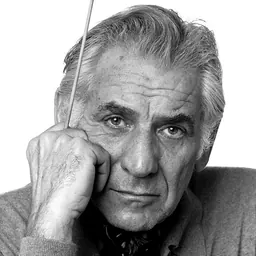
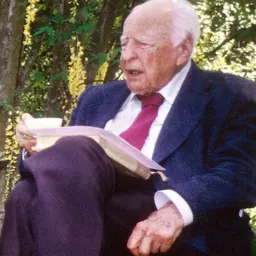
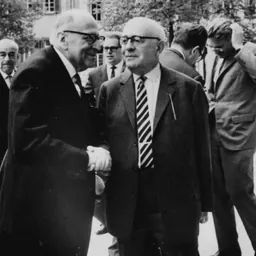
Biography Engelmann studied composition with Hermann Heiss and Wolfgang Fortner. He was a regular attendee of the Darmstadt International Summer Courses for New Music, and he was particularly affected by the twelve-tone classes of René Leibowitz (1948) and Ernst Krenek (1951), which helped him move from free atonality to serialism. Eventually, he would publish a history of the courses. In 1947, he began studying musicology with Gennrich Friedrich and Helmut Osthoff, earning a Ph.D in 1952. He also studied philosophy with Theodor Adorno, Max Horkheimer, Hans-Georg Gadamer.
A brief marriage took him to Iceland from 1953-4, before returning to Darmstadt to work as the music adviser and composer for the Hessisches Landestheater for the next seven years. His next post was in the same capacity at the Nationaltheater Mannheim, where his tenure lasted from 1961-9. He also held the same position one more time at the Städtische Bühnen in Bonn from 1972-3. In 1969, he began teaching at the Frankfurt Musikhochschule, and he remained on the faculty there for seventeen years.
In the early 60's, Engelmann began to incorporate techniques like electronic sound generation, graphic notation, jazz and collage into his music. By the end of the decade, he had assembled a pluralistic style which he showcased in large multimedia works such as Ophelia (1969). From 1974-9, he was largely occupied with revising his earlier work, before returning to smaller, less eclectic compositions.
A recipient of many scholarships and awards throughout his career, some of Engelmann's most notable honors include scholarships from Harvard and the Villa Massimo (1960, 1967, 1983), the Lidice Prize of Radio Prague (1960), the Stereo Prize of the German broadcasting industry (1969), the Johann Heinrich Merck Award (1971), the Goethe Medal (1986), the Order of the BRD (1991) and the Hessian Order pour le merite (1997).
Selected works
Stage Doctor Faust's Höllenfahrt, op.4, 1949–50 Magog, op.16, 1955–6 Noche da luna (pantomime for dancers), 1958 Der verlorene Schatten, op.22, 1960 Der Fall van Damm, op.30, 1966–7 Ophelia, op.36, 1969 Revue, op.43, 1972–3
Orchestra Music for Strings, brass and percussion, 1948 Violin Concerto, 1948 Impromptu, 1949 Orchestral Fantasia, 1951 Partita, 1953 Strukturen, 1954 5 Pieces, 1956; Polifonica, 1957; Ezra Pound Music, 1959 Trias, 1962 Shadows, scenes, 1964 Sonata, op.32, 1967 Capricciosi, 1968 Sinfonies, 1968 Modelle II, 1970 Sinfonia da camera, 1981 Adagio et Aria, 1996 Concerto for percussion ensemble, 2001 Theatre Music, im memoriam Leonard Bernstein, 2002
Vocal Consolationes, chorus and strings, 1952 Elegia e canto, soprano, piano and strings, 1952 Komposition in 4 Teilen, soprano, flute, piano, and percussion 1953 Die Mauer, soprano, tenor, baritone, chorus and orchestra, 1954 Atlantische Ballade, alto, baritone, percussion trio, and strings, 1955 Nocturnos, soprano, orchestra, 1958 Incanto, soprano, saxophone, and percussion ensemble, 1959 Eidophonie, chorus, percussion, 1962 Commedia humana, speaker, double chorus, cello and tape 1972 Missa Popularis, chorus and orchestra, 1980 Les chansons, soprano, flute, clarinet, viola, cello and piano 1982 Stele für Büchner, alto, baritone, chorus and orchestra, 1986–7 Omnia tempus habent, chorus, 1996
Chamber Jazz-Sonatine, piano, 1945 Piano music, 1945 Toccata, piano, 1947 Cello Sonata, 1948 Piano Suite no.1, 1948–50 Olaf’s Blues, guitar and piano 1949 2 Piano Pieces, 1950 Piano Suite no.2, 1952 String Quartet, 1952 Integrales, alto saxophone and piano, 1954 Permutazioni, flute, oboe, clarinet and bassoon, 1959 Variante, flute 1959 Cadenza, piano and tape 1961 Timbres, harp, celeste, piano, percussion quartet and tape, 1963 Mobile I ‘Fragmente’, piano and synthesizer 1967–71 Mobile II, clarinet and piano, 1968 mini-music to siegfried palm, op.38, cello, 1970 Modelle I oder ‘I love you Bäbi’, chamber ensemble, 1970 Klangstück, violin and piano, 1974 Divertimento, piano duo, 1980 Assonanzen, cello duo, 1983 Epitaph fü einen imaginären Freund, trumpet and piano, 1983 Inter-Lineas, alto saxophone, clarinet and percussion a sax, 1985 Dialoge, piano and percussion 1986–90 Clarinota, clarinet, 1991 Tastenstück, piano, 1991–3 Essay, organ, 1992 Ciacona, flute, bass clarinet, vibraphone, piano, violin, viola, and cello 1993 Modus, bassoon, 1993 Memoires à René Leibowitz, guitar, 1994–7 Black Invocations, saxophone, trumpet, trombone, percussion, piano and double bass, 1995 per Luigi, flute, clarinet, cello, percussion and tape, 1996 Jazz-Capriccio, piano 2001
Notable pupils Gerhard Müller-Hornbach (born 1951) Hans-Jürgen von Bose (born 1953) Adrian Oswalt (born 1954) Claus Kühnl (born 1957) Wolfgang Kleber (born 1958) Ralf Emig (born 1959) Rolf Rudin (born 1961) Karl-Wieland Short (born 1961)
Writings Béla Bartóks ‘Mikrokosmos’: Versuch einer Typologie ‘Neuer Musik’ (diss., U. of Frankfurt, 1952; Würzburg, 1953/R) ‘Fragen serieller Kompositionsverfahren’, Gesellschaft für Musikforschung: Kongress-Bericht: Kassel 1962, 374–9 ‘Rhythmus und bildnerisches Denken’, Melos, ix (1968), 261–7 ‘Selbstgespräch über die Funkoper’, Melos, xi (1968), 418–23 ‘Erfahrungen mit Kompositionsschülern’, Melos, xvi (1974), 347–9 ‘Zur Genesis der Darmstädter Schule’, 50 Jahre Ferienkurse, ed. Internationales Musikinstitut Darmstadt (Darmstadt, 1996), 50–54
Don’t just read it —
keep it.
Full-length biographies made to live with: read them, listen on the way to work, watch them tonight.
- E-book
- Audio
- Video
Instant download · yours to keep · every purchase keeps this site free
Important facts
People in Hans Ulrich Engelmann's life
Named in this biography and alive at the same time



Related people
Same field, nearest in time


Contemporaries
People whose lives overlapped Hans Ulrich Engelmann's





Frequently asked questions
Who was Hans Ulrich Engelmann?
German composer (1921–2011)
When was Hans Ulrich Engelmann born?
Hans Ulrich Engelmann was born on 8 September 1921 in Darmstadt.
When did Hans Ulrich Engelmann die?
Hans Ulrich Engelmann died on 8 January 2011 in Darmstadt.
What was Hans Ulrich Engelmann's occupation?
Hans Ulrich Engelmann was a composer, music educator, university teacher and critic.
What nationality was Hans Ulrich Engelmann?
Hans Ulrich Engelmann was German.
Sources & further reading
· Wikipedia: Hans Ulrich Engelmann
· DBpedia: Hans Ulrich Engelmann
Cite this page
APA: Biography.guide. (2026). Hans Ulrich Engelmann. https://biography.guide/hans-ulrich-engelmann/
MLA: "Hans Ulrich Engelmann." Biography.guide, https://biography.guide/hans-ulrich-engelmann/.
Chicago: "Hans Ulrich Engelmann." Biography.guide. https://biography.guide/hans-ulrich-engelmann/.
Data last updated: 2026-09-20 · Spot an error? Report a correction.
Page generated 2026-09-27 05:21 UTC