
About Hans Lissmann
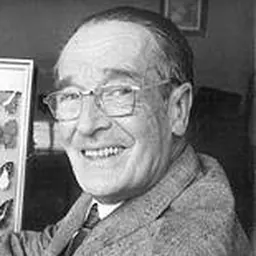
Lived 1909 – 1995 (aged 85). Hans Lissmann was a German zoologist and ichthyologist.
Hans Werner Lissmann FRS (30 April 1909 – 21 April 1995) was a British zoologist of Ukrainian provenance, specialising in animal behaviour.
He was elected a Fellow of the Royal Society in 1954, following breakthrough research with his assistant Kenneth E. Machin identifying the electric field generated by the African knifefish (Gymnarchus), and the uses which the fish makes of it.
Life
Early years
Hans Werner Lissmann was born into a wealthy German family in Mykolaiv, Ukraine, which was then part of Russia. As members of the ethnic German minority the family fell under suspicion when war broke out in 1914. Lissmann and his elder brother were sent into "internal exile" in Siberia, separated from their parents, Robert and Ebba Lissmann. At the end of the war they were permitted to return home, but by 1922 the family had relocated to Hamburg in Germany, which is where Lissmann received his school-level education. In 1933 he was sent with a travel bursary to the Hungarian Scientific Academy's biological research station at Lake Balaton. While he was there Germany underwent significant régime change. Lissmann rejected a government requirement that he should disseminate Nazi propaganda and instead chose to relocate again. He made his way to India. Here he obtained a stipend from the recently established Academic Assistance Council which enabled him to travel to Great Britain and to obtain, in 1934, a post in the Research Department of the Cambridge University Zoological Institute, headed up by James Gray. The focus of his research during his early Cambridge years was on the interplay between movement sequencing, the sensory organs and the nervous systems of animals.
Electrolocation in the African knifefish
Lissman noticed that the African knife fish, Gymnarchus niloticus, could swim equally well forwards or backwards, implying a "sixth sense", which he went on to investigate in detail.
A particularly important research finding took place in 1950. The previous year, on a visit to London Zoo, Lissmann had noticed that the African knifefish (Gymnarchus) was able repeatedly to swim backwards at the same speed and with exactly the same corporeal dexterity around obstacles in its fish tank as when it swam forwards, while avoiding collision. He inferred that the fish must have what in human terms would be seen as some form of "sixth sense", something which he also thought he detected in the electric eel in another aquarium tank nearby: he thought the phenomenon might well involve electricity. Towards the end of 1949 Lissmann married, and as a wedding present from one friend he was given his own knife fish, which he now went on to study in his laboratory. He placed the fish in a large fish tank into which he inserted electrodes. With these he was able to detect a naturally occurring electric current emanating from the fish, albeit far too weak to be felt by a person. He found ways to increase the current to a point where it could be measured with a conventional oscilloscope. One story - not universally accepted - reports that the fish generated a measurably increased electrical charge when a student combed her hair beside the fish tank. The fish died soon after this, but replacements were acquired, and working with his research assistant Kenneth E Machin (1924-1988), whose PhD had covered radio-astronomy, Lissmann was able, through observation and measurement, to demonstrate that the variable electrical field was produced by the knife fish itself, and that the fish reacted to any change in the electric field around it, even when produced close to, but outside, the fish tank itself. They were helped in their work by a perspex model of an African knife fish constructed by Machin, with two electrodes attached to it permitting the perspex fish to generate an electric field equivalent to that produced by the real fish. Machin struggled and failed to produce for the perspex fish an intricate variability in the strength and shape of its magnetic field comparable to the produced by the real fish, but observations involving the perspex fish nevertheless provided a large additional amount of valuable data. A key conclusion was that the African knifefish was using changes in resistance within the electric field with which it surrounded itself to detect changes in its surroundings, and was using the information to trigger appropriate behavioural responses. an amateur flautist, became a physician in Essex.
Works
"Die Umwelt des Kampffisches (Betta splendens Regan)", in: Zeitschrift für vergleichende Physiologie, 18:1 (1932) pp 65–111. "Körperhaltung und Bewegungsform eines Myriopoden im Zusammenhang mit seiner Autotomie", in: Zeitschrift für vergleichende Physiologie 21 (1935), pp. 751–766. "Continuous Electrical Signals from the Tail of a Fish, Gymnarchus Niloticus Cuv", in: Nature, 167, 4240 (1951), pp. 201–202. "The Mechanism of Object Location in Gymnarchus Niloticus and Similar Fish", in: Journal of Experimental Biology, 35 (1958), pp. 451–486. (with Ken E. Machin) "The Mode of Operation of the Electric Receptors in Gymnarchus Niloticus", in: Journal of Experimental Biology 37:4 (1960), pp. 801–811. (with Ken E. Machin) "Electric Location by Fishes", in: Scientific American, 208, pp 50–59, March 1963. "James Gray. 14 October 1891-14 December 1975", in: Biographical Memoirs of Fellows of the Royal Society, 24 (1978), pp. 54–70.
Don’t just read it —
keep it.
Full-length biographies made to live with: read them, listen on the way to work, watch them tonight.
- E-book
- Audio
- Video
Instant download · yours to keep · every purchase keeps this site free
Important facts
People in Hans Lissmann's life
Named in this biography and alive at the same time

Related people
Same field, nearest in time





Contemporaries
People whose lives overlapped Hans Lissmann's




Frequently asked questions
Who was Hans Lissmann?
British zoologist (1909–1995)
When was Hans Lissmann born?
Hans Lissmann was born on 30 April 1909 in Mykolaiv.
When did Hans Lissmann die?
Hans Lissmann died on 21 April 1995 in Cambridge.
What was Hans Lissmann's occupation?
Hans Lissmann was a zoologist and ichthyologist.
What nationality was Hans Lissmann?
Hans Lissmann was German.
Sources & further reading
· DBpedia: Hans Lissmann (zoologist)
Cite this page
APA: Biography.guide. (2026). Hans Lissmann. https://biography.guide/hans-lissmann/
MLA: "Hans Lissmann." Biography.guide, https://biography.guide/hans-lissmann/.
Chicago: "Hans Lissmann." Biography.guide. https://biography.guide/hans-lissmann/.
Data last updated: 2026-09-22 · Spot an error? Report a correction.
Page generated 2026-09-27 05:24 UTC