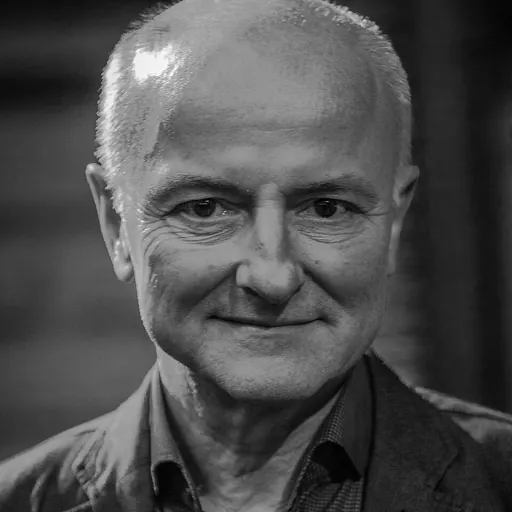
About Hans-Joachim Lang
Born 1951. Hans-Joachim Lang is a German historian, journalist, university teacher, writer, cultural studies scholar and germanist.
Hans-Joachim Lang (born 6 August 1951) is a German journalist, historian, and adjunct professor of cultural anthropology at the Ludwig-Uhland Institute for Empirical Cultural Studies University of Tübingen. Dr. Lang researched and authored the award-winning book Die Namen der Nummern (The Names of the Numbers), published in 2004, which identified all of the victims murdered in the gas chamber of the Natzweiler-Struthof concentration camp for Nazi anatomist August Hirt as part of his plan to create a pseudo-scientific Jewish skeleton collection during World War II.
Biography Lang was born and grew up in Speyer. He received a doctorate in German studies and political science from the University of Tübingen, Baden-Württemberg in 1980, where he studied under the French sociologist Freddy Raphael. In 1982, he became the editor of the scientific section of the newspaper Schwäbisches Tagblatt in Tübingen. He joined the faculty at his alma mater, University of Tübingen, as an adjunct professor of cultural anthropology at the Ludwig-Uhland Institute for Empirical Cultural Studies.
Lang conducted this research in his free time over 20 years, when he was working as a science journalist. In 2017, he is an Honorary Professor and no longer a journalist. He remarks in an interview the changes in France over the time of his research. Initially, many institutions, but not all, did not respond to his request for information, "institutions in France didn't like to cooperate," but 11 years later this changed: "Dr Hans-Joachim Lang identified the victims in 2004. Eleven years later Dr. Raphael Toledano, French researcher, found together with the director of the Institute for Forensic Medicine three small glass containers, in which tiny bits of leftovers from a human stomach and five small pieces of skin were preserved, which can be attributed to Menachem Taffel, one of the 86 victims." During the German occupation of France, Hirt had been appointed head of the Anatomical Institute at the Reichsuniversität Straßburg (Reichs University of Strasbourg) in 1941.
Twenty-nine women and 57 men from 8 countries were selected from Jewish prisoners in Auschwitz by Beger and Fleischhacker and brought to the Natzweiler-Struthof concentration camp, where skull x-rays and blood groups were recorded. On 11th, 13, 17 and 19 August 1943, the camp commander murdered 86 people in the gas chamber built outside the camp by the SS exclusively for poison gas experiments by medical professors on prisoners. The victims were transported by the SS from Natzweiler to the Reichsuniversität Straßburg. With the approach of the Allied troops, these bodies, preserved in formalin, were hidden in the basement of the Anatomy Institute, where they were discovered. On 23 November 1944, Strasbourg was liberated by the U.S. Seventh Army under the command of Gen. Alexander Patch. Three weeks later the French military tribunal began its investigation.
On 3 January 1945, an article in the London newspaper Daily Mail reported the discovery of 86 bodies in the Anatomical Institute of the Reichsuniversität Straßburg. The "French Office of Investigations of War Crimes" took photographs of the remains and documented the findings of the remains. Evidence collected formed the basis of the subsequent trial of August Hirt by the War Crimes Tribunal in Metz in 1954. The French military, which controlled Strasbourg, gave up trying to identify the victims and buried the bodies in the local Jewish cemetery in a mass grave.
At the Nuremberg Doctors' Trial in 1946, Hirt's anatomy assistant, Henri Henrypierre (or Henripierre) testified that he noted numbers tattooed on the arms of the corpses brought to the Institute, and kept a secret recording of them hidden in the apartment of his romantic interest. August Hirt was sentenced to death in absentia at the Military War Crimes Trial at Metz on 23 December 1953, however it was unknown at the time that Hirt had shot himself in the head on 2 June 1945 at Schluchsee, Baden-Württemberg.
Identifying the victims
While at the Schwäbisches Tagblatt, Dr. Lang, studied the war crimes committed by Auguste Hirt, at the Reichsuniversität Straßburg during the German occupation of France, and attempted to determine the identities of the victims in the Jewish Skeletal Collection. Other than Serge Klarsfeld, who documented his attempts in his book Le Mémorial de la déportation des Juifs de France no other attempts were previously made to identify these people. and at the U.S. Holocaust Memorial Museum website.
In November 2005 the remains of these individuals were buried in the Jewish cemetery of Cronenbourg, on the outskirts of Strasbourg, under the auspices of the Communauté Israélite of Strasbourg, the Consistoire of the Bas-Rhin, and Grand Rabbi Abraham Deutsch. A memorial was erected at the cemetery in December 2005 with the names of the 86 victims, and a memorial plaque listing the names of the victims was placed outside the Anatomy Institute at Strasbourg's University Hospital. wrote that: "he book is more than an essay on the moral catastrophe of medicine. It tells not only of a crime, but also writes history in a special way one step further: it gives the victims back their names."
Other notable works Lang has written several books and articles on holocaust topics and Nazi war crimes. His book Die Frauen von Block 10: Medizinische Versuche in Auschwitz. (The women of Block 10: Medical experiments in Auschwitz) tells the story of 800 women who were subjected to pseudoscientific medical experiments at Auschwitz and provides biographical information about the victims.
The book Als Christ nenne ich Sie einen Lügner – Theodor Rollers Aufbegehren gegen Hitler (As a Christian, I Call You a Liar:Theodor Roller's revolt against Hitler) tells the story of a young bank accountant named Theodor Roller who refused to sign an oath of allegiance to Adolf Hitler, and wrote letters to Hitler explaining his faith. As a result, he was imprisoned in a psychiatric facility.
An article Lang wrote for Die Zeit tells about the last person executed for murder in 1948 by the West German government in the aftermath of World War II.
Awards 1989 – Wächterpreis der deutschen Tagespresse, (Guardian of the German Press Prize, awarded by the German Freedom of the Press Foundation) for his article on the Tübingen regional court. 2004 – Prize of the Auschwitz Foundation for Die Namen der Nummern
Publications
Books
Selected articles
Documentaries , documentary directed by Sonia Rolley, Axel and Trancrède Ramonet, duration 55 min. Production France 3 – Temps Noir, April 2013. Le nom des 86 (The name of the 86), documentary directed by Emmanuel Heyd and Raphael Toledano, duration 63 min. Production Dora Films sas – Alsace 20 – Télébocal – Cinaps TV, 2014.
Don’t just read it —
keep it.
Full-length biographies made to live with: read them, listen on the way to work, watch them tonight.
- E-book
- Audio
- Video
Instant download · yours to keep · every purchase keeps this site free
Important facts
People in Hans-Joachim Lang's life
Named in this biography and alive at the same time

Related people
Same field, nearest in time


Contemporaries
People whose lives overlapped Hans-Joachim Lang's


Frequently asked questions
Who is Hans-Joachim Lang?
German historian and journalist
When was Hans-Joachim Lang born?
Hans-Joachim Lang was born on 6 August 1951 in Speyer.
What is Hans-Joachim Lang's occupation?
Hans-Joachim Lang is a historian, journalist, university teacher, writer, cultural studies scholar and germanist.
What nationality is Hans-Joachim Lang?
Hans-Joachim Lang is German.
Sources & further reading
· Wikipedia: Hans-Joachim Lang
Cite this page
APA: Biography.guide. (2026). Hans-Joachim Lang. https://biography.guide/hans-joachim-lang/
MLA: "Hans-Joachim Lang." Biography.guide, https://biography.guide/hans-joachim-lang/.
Chicago: "Hans-Joachim Lang." Biography.guide. https://biography.guide/hans-joachim-lang/.
Data last updated: 2026-09-21 · Spot an error? Report a correction.
Portrait: Wikimedia Commons · author & licence
Page generated 2026-09-27 04:59 UTC