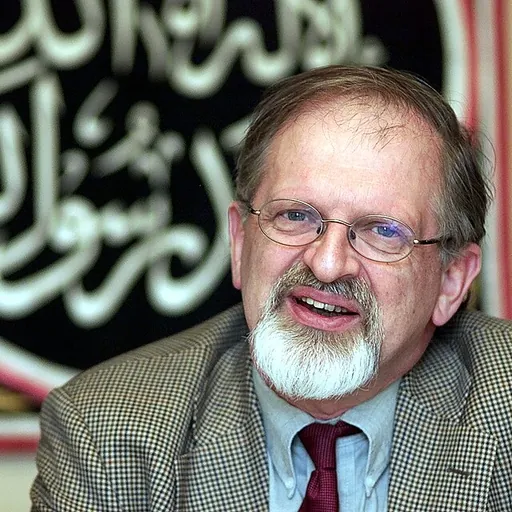
Hans Jansen
Dutch politician and academic of contemporary Islam
About Hans Jansen
Lived 1942 – 2015 (aged 72). Hans Jansen was a Dutch columnist, writer, politician, university teacher, islamicist and author.
Johannes Juliaan Gijsbert "Hans" Jansen (17 November 1942 – 5 May 2015) was a Dutch politician, scholar of contemporary Islam and author.
Hans Jansen belonged to the "revisionists" in Islamic Studies, i.e. he fundamentally doubted the historicity of the Islamic traditions on early Islam which were written 150 to 200 years after Muhammad. Moreover, Jansen doubted the existence of Muhammad as a historical person.
Life and career Hans Jansen's parents were strict Calvinists. At the age of 17, Jansen began studying theology at the University of Amsterdam, yet changed the subject after one year to Arabic and Semitic languages. In 1966 he spent one year in Cairo in order to learn Arabic. Then he continued his studies at the University of Leiden where he received his Ph.D. in 1974.
Jansen taught at the universities of Groningen, Leiden and Amsterdam, and was director of the Dutch Research Institute in Cairo. Then he became associate professor at the University of Leiden. From 2003-2008 he was Houtsma Professor of Modern Islamic Thought at the University of Utrecht. and in 2012.
In 2008, he advised Geert Wilders about his anti-Islam movie Fitna and in 2010 he was a principal witness in the trial of Geert Wilders.
Jansen was an expert witness on the Koran and Shariah in the trial in Birmingham Magistrates Court (Crown vs Timothy Martin Burton) on 8 April 2014, which came to be known as the Birmingham Taqiyya Trial. Burton was subsequently found guilty of Racially Aggravated Harassment.
In the 2014 European Parliament election, Jansen was elected for Wilders' Party for Freedom as MEP.
Research
Hans Jansen is part of the so-called "revisionist" or historical-critical line of Islamic Studies. He fundamentally doubts the historicity of the Islamic traditions on the beginning of Islam which came into being 150 to 200 years after the event.
In his main work De Historische Mohammed (not available in English), Jansen discusses chapter by chapter the depictions in the prophet's biography by Ibn Ishaq, via the recension by Ibn Hisham, which is an important text for traditional Islam. He argues that the respective depictions are not credible. Jansen asserts self-contradictions, contradictions to other historical sources, embellishments by later authors, politically or theologically motivated distortions of the depiction, symbolic meanings of allegedly historical names, literary construction of the depiction according e.g. to biblical models, and chronological and calendrical incredibilities. In part, Jansen only sums up what other researchers already had found.
Some examples:
Although there were leap months at the time of Muhammad which had to be intercalated frequently into the moon calendar and which only later became abandoned (allegedly by Muhammad), not a single of the many most accurately dated events depicted by Ibn Ishaq is in a leap month. The precise dating of so many events by an author who writes 150 years later is not very credible. The depiction of a strong relationship between Muhammad and his wife Aisha is motivated politically and theologically: Aisha was the daughter of Caliph Abu Bakr who became Muhammad's successor against the claims of his rival Ali. In order to legitimate this succession against the Shiites who were in favour of Ali, the relationship of Abu Bakr's daughter to Muhammad was emphasized, including that Aisha allegedly was the favourite wife of Muhammad, and that the prophet consummated marriage with Aisha allegedly at an astonishingly early age. The depiction of slaughtering the Jewish tribe of the Banu Quraiza is motivated politically resp. theologically: As the "treaty of Medina" shows, the Jews were initially part of the Umma and were addressed as "believers"; cf. the research of Fred Donner. When Islam later separated from Judaism, antisemitic readings of the past came into being. The threefold treason of Muhammad by three Jewish tribes is a literary construction according to biblical models, e.g. the threefold treason of Jesus by the apostle Peter, and thus is historically questionable. There are other traditions about the same event which tell that only the leaders of the tribe had been punished but not each single member of the tribe. The names of the three Jewish tribes do not occur in the "treaty of Medina". Finally, such a mass slaughtering would not have gone unnoticed, even not in Muhammad's time, and especially not considering that the victims were Jews: Jews used to live in international trading networks, and Jews are known to write down their history. Most likely, the slaughtering of the Banu Quraiza never happened. The depictions of Ibn Ishaq are generally known to boldly exaggerate the capacities of the prophet. According to Ibn Ishaq Muhammad always kills more enemies than stated in other traditions. Even the depiction of the prophet's male potency who allegedly could satisfy all his wives in one night is exaggerated in a questionable way. Of the same category is the depiction of Muhammad as an illiterate person. The revelation of the Quranic text is all the more miraculous and the capacity of the prophet is all the more astonishing if Muhammad was an illiterate person. The account of Muhammad's message to the emperor of Byzantium, that he should convert to Islam, retrospectively justifies the Arabic expansion as a religious, Islamic expansion.
Jansen states that the historically questionable traditions are of great importance for the interpretation of the Quran. The Quran mostly does not reveal the situation for which a revelation was made. The historical context is merely indicated, at best. Many Islamic traditions came into being long after Muhammad on the basis of mere guesses for what situation a Quranic verse had been revealed. By the historically questionable traditions the interpretation of Quran is restricted since then.
In the epilogue, Jansen concluded that Muhammad did not exist as a historical person. Thus, Jansen belongs to a minority within the "revisionist" school which supports this position. The book De Historische Mohammed was reviewed positively e.g. by Prof. Karl-Heinz Ohlig. A respectful but critical review was given e.g. by Stefan Weidner on Qantara.de. The historian Dan Diner highly acclaimed Hans Jansen's Mohammed as a work of enlightenment.
Publications Books in Dutch: Inleiding tot de Islam (1987) De Koran uit het Arabisch Vertaald door Prof. dr. J.H. Kramers (1992) (edited by Asad Jaber & Johannes J.G.Jansen) Nieuwe Inleiding tot de Islam (1998) Het Nut van God (2001) God heeft gezegd: terreur, tolerantie en de onvoltooide modernisering van de islam (2003) De radicaal-islamitische ideologie: Van Ibn Taymiyya tot Osama ben Laden, Oratie Universiteit van Utrecht, 3 februari 2004 Islam: een hoorcollege over de islamitische godsdienst en cultuur (2005, audio-cd) De historische Mohammed: de Mekkaanse verhalen (2005) De historische Mohammed: de verhalen uit Medina (2007) Bombrieven (2008, correspondence with Abdul-Jabbar van de Ven) Islam voor varkens, apen, ezels en andere beesten (2008) Zelf Koran lezen (2008) Eindstrijd, edited by Jansen & Snel (2009)
Books in English (Many other titles are not yet available in English): The Interpretation of the Koran in Modern Egypt (Leiden: E.J. Brill, 1974) The Neglected Duty: The Creed of Sadat’s Assassins and Islamic Resurgence in the Middle East (New York: Macmillan, 1986) The Dual Nature of Islamic Fundamentalism (London: Hurst & Company, 1997) Why shouldn't Israel exist in the Middle East? A Synopsis (Soesterberg, Nederland: Aspekt Publishers, 2017) Columns For the Dutch blog GeenStijl.nl
Don’t just read it —
keep it.
Full-length biographies made to live with: read them, listen on the way to work, watch them tonight.
- E-book
- Audio
- Video
Instant download · yours to keep · every purchase keeps this site free
Important facts
People in Hans Jansen's life
Named in this biography and alive at the same time







Related people
Same field, nearest in time






Contemporaries
People whose lives overlapped Hans Jansen's




Frequently asked questions
Who was Hans Jansen?
Dutch politician and academic of contemporary Islam (1942–2015)
When was Hans Jansen born?
Hans Jansen was born on 17 November 1942 in Amsterdam.
When did Hans Jansen die?
Hans Jansen died on 5 May 2015 in Amsterdam.
What was Hans Jansen's occupation?
Hans Jansen was a columnist, writer, politician, university teacher, islamicist and author.
What nationality was Hans Jansen?
Hans Jansen was Dutch.
Sources & further reading
Cite this page
APA: Biography.guide. (2026). Hans Jansen. https://biography.guide/hans-jansen/
MLA: "Hans Jansen." Biography.guide, https://biography.guide/hans-jansen/.
Chicago: "Hans Jansen." Biography.guide. https://biography.guide/hans-jansen/.
Data last updated: 2026-09-21 · Spot an error? Report a correction.
Portrait: Wikimedia Commons · author & licence
Page generated 2026-09-27 05:00 UTC