
About Hamish Henderson
Lived 1919 – 2002 (aged 82). Hamish Henderson was a British musicologist, songwriter, translator, poet, writer and composer.
(James) Hamish Scott Henderson (11 November 1919 – 9 March 2002) was a Scottish poet, songwriter, communist, intellectual and soldier.
Henderson was a catalyst for the folk revival in Scotland. He was also an accomplished folk song collector and discovered such notable performers as Jeannie Robertson, Flora MacNeil and Calum Johnston.
Early life He was born in Blairgowrie, Perthshire His father was the army officer James Scott (1874–1934). Henderson's name was recorded at registration as James, but he preferred the Scots form, Hamish.
Henderson spent his early years in nearby Glen Shee and Dundee, and then moved to England with his mother. He attended Lendrick School in Bishopsteignton, a preparatory school where the headmaster was James Maclaren. Janet Henderson died in 1933, and Maclaren became his guardian. Around this time he won a scholarship to Dulwich College in London. He studied Modern Languages at Downing College, Cambridge, in the years leading up to World War II. As a visiting student in Germany he ran messages for an organization run by the Society of Friends aiding the German resistance and helping to rescue Jews.
World War II He took part in the Desert War in Africa, during which he wrote his poem Elegies For the Dead in Cyrenaica, encompassing every aspect of a soldier's experience of the sands of North Africa. On 2 May 1945, Henderson personally oversaw the drafting of the surrender order of Italy issued by Marshal Rodolfo Graziani.
Henderson collected the lyrics to "D-Day Dodgers," a satirical song to the tune of "Lili Marlene", attributed to Lance-Sergeant Harry Pynn, who served in Italy. Henderson also wrote the lyrics to "The 51st (Highland) Division's Farewell to Sicily", set to a pipe tune called "Farewell to the Creeks". The book in which these were collected, Ballads of World War II, was published "privately" to evade censorship, but earned Henderson a ten-year ban from BBC radio, preventing a series on ballad-making from being made. His 1948 war poetry book, Elegies for the Dead in Cyrenaica, received the Somerset Maugham Award.
Folk song collector Henderson threw himself into the work of the folk revival after the war, discovering and bringing to public attention Jeannie Robertson, Flora MacNeil, Dolina MacLennan, Calum Johnston and others. In the 1950s, he acted as a guide to the American folklorist, Alan Lomax, who collected many field recordings in Scotland.
People's Festival Ceilidhs Henderson was instrumental in bringing about the Edinburgh People's Festival Ceilidh in 1951, which placed traditionally performed Scottish folk music on the public stage for the first time as "A Night of Scottish Song". However, the People's Festival, of which it was part, was planned as a left-wing competitor to the Edinburgh Festival and was deeply controversial. At the event, Henderson performed The John Maclean March, to the tune of Scotland the Brave, which honoured the life and work John Maclean, a communist and Scottish nationalist hero.
However, the event marked the first time that Scotland's traditional folk music was performed on a public stage. The performers included Flora MacNeil, Calum Johnston, John Burgess, Jessie Murray, John Strachan, and Jimmy MacBeath. The event was extremely popular and was regarded as the beginning of the second folk revival.
Henderson continued to host the events every year until 1954, when the Communist ties of several members of the People's Festival Committee led to the Labour Party declaring it a "Proscribed Organisation". Losing the financial support of the local trades unions, the People's Festival was permanently cancelled. Henderson's own songs, particularly "Freedom Come All Ye", have become part of the folk tradition themselves. There he contributed to the sound archives, some of which are now available online on Tobar an Dulchais. Henderson held several honorary degrees and after his retirement became an honorary fellow of the School of Scottish Studies. For many years he held court in Sandy Bell's Bar, the meeting place for local and visiting folk musicians. In April 1979, he was ' the prevailing spirit' at the first Edinburgh International Folk Festival conference 'The People's Past ' both on ballads and in challenging traditional history telling. He also spoke at a Riddle's Court meeting which had hosted in the past, the Workers' Educational Association when he said that Calvinism was repressive in the Scottish psyche and that 'we had to divest ourselves of layers or preconception and misconception before we could come to grips with Scotland and its people.'
Henderson was a socialist, whom he had first heard of among Communist Italian partisans during the war. The translation was published in the New Edinburgh Review in 1974 and as a book in 1988.
In 1983, Henderson was voted Scot of the Year by Radio Scotland listeners when he, in protest of the Thatcher government's nuclear weapons policy, turned down an OBE.
Legacy
In 2005, Rounder Records released a recording of the 1951 Edinburgh People's Festival Ceilidh as part of The Alan Lomax Collection. Henderson had collaborated with the preparations for the release.
In August 2013, Edinburgh University announced that it had acquired his personal archive of "more than 10,000 letters from almost 3400 correspondents, plus 136 notebooks and diaries", dating from the 1930s to the end of his life. These will be kept in the Special Collections department of the main library. The annual Carrying Stream Festival is Edinburgh Folk Club’s celebration of Henderson’s life and legacy.
Discussions around national identity and constitutional resettlement in Scotland, especially those surrounding the Scottish Independence Referendum of 2014, have often invoked Henderson's legacy. Politicians and cultural commentators alike describe their admiration for his song 'Freedom Come-All-Ye' and lend their voices to those touting it as an alternative national anthem. As a radical democrat whose political beliefs were closely bound up in the study of folk culture and high literature, Henderson's work expresses a tension between romantic nationalism and socialist internationalism which has been reaffirmed in public life in Scotland since his death.
Debate on his parenting, and a possible link to the eighth Duke of Atholl or a 'cousin' of that lineage, Hamish Henderson (1948) Elegies for the Dead in Cyrenaica, J. Lehmann, London Hamish Henderson (1987), "Antonio Gramsci" in Ross, Raymond J. (ed.), Cencrastus No. 28, Winter 87/88, pp. 22 – 26, Hamish Henderson (1995), Zeus as Curly Snake: The Chthonian Image, in Ross, Raymond (ed.), Cencrastus No. 52, Summer 1995, pp. 7 – 9, Alec Finlay, editor (1992) Alias MacAlias: Writings on songs, folk and literature, Polygon, Edinburgh Alec Finlay, editor (1996) The Armstrong Nose: Selected letters of Hamish Henderson, Polygon, Edinburgh Geordie McIntyre (1973), Resurgimento!, an interview with Hamish Henderson, in Maisels, Chic K. (ed.), Folk Song and the Folk Tradition, Festival issue of the New Edinburgh Review, August 73, pp. 12 & 13 Raymond Ross, editor (2000) Collected Poems and Songs, Curly Snake Pub., Edinburgh, Scotland Eberhard Bort, editor (2010) Borne on the Carrying Stream: The Legacy of Hamish Henderson, Grace Note Publications Eberhard Bort, editor (2011) Tis Sixty Years Since: The 1951 Edinburgh People's Festival Ceilidh and the Scottish Folk Revival Jack Mitchell (1976), Hamish Henderson and the Scottish Tradition, in Burnett, Ray (ed.), Calgacus No. 3, Spring 1976, pp. 26 – 31, Timothy Neat (2012) Hamish Henderson: Poetry Becomes People (1952-2002), Birlinn Ltd, Edinburgh Corey Gibson (2015) The Voice of the People: Hamish Henderson and Scottish Cultural Politics, Edinburgh University Press, Ian Spring (2020), Hamish Henderson: A Critical Appreciation, Rymour Books, Perth, Fred Freeman (2022), "Burns, Hamish and Sang", Pairt 1, in Morton, Elaine & Hershaw, William, Lallans 100, Simmer 2022, pp. 111 – 119, Tom Hubbard, "Hamish Henderson as Translator", in Hubbard, Tom (2022), Invitation to the Voyage: Scotland, Europe and Literature, Rymour, pp. 93 – 95,
Don’t just read it —
keep it.
Full-length biographies made to live with: read them, listen on the way to work, watch them tonight.
- E-book
- Audio
- Video
Instant download · yours to keep · every purchase keeps this site free
Important facts
People in Hamish Henderson's life
Named in this biography and alive at the same time



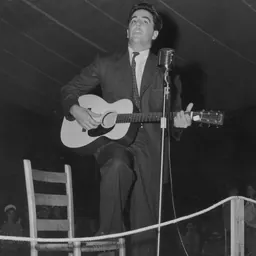



Related people
Same field, nearest in time

Contemporaries
People whose lives overlapped Hamish Henderson's

Frequently asked questions
Who was Hamish Henderson?
Scottish writer (1919–2002)
When was Hamish Henderson born?
Hamish Henderson was born on 11 November 1919.
When did Hamish Henderson die?
Hamish Henderson died on 9 March 2002.
What was Hamish Henderson's occupation?
Hamish Henderson was a musicologist, songwriter, translator, poet, writer and composer.
What nationality was Hamish Henderson?
Hamish Henderson was British.
Sources & further reading
Cite this page
APA: Biography.guide. (2026). Hamish Henderson. https://biography.guide/hamish-henderson/
MLA: "Hamish Henderson." Biography.guide, https://biography.guide/hamish-henderson/.
Chicago: "Hamish Henderson." Biography.guide. https://biography.guide/hamish-henderson/.
Data last updated: 2026-09-20 · Spot an error? Report a correction.
Page generated 2026-09-27 05:02 UTC