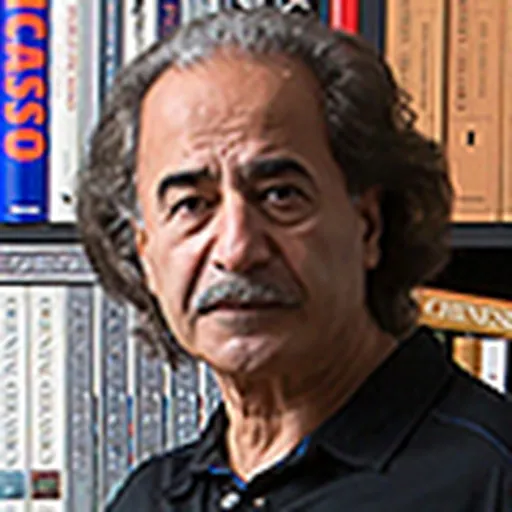
About Hamid Sadighi Neiriz
Born 1947. Hamid Sadighi Neiriz is an Iranian artist.
Hamid Sadighi Neiriz (born 14 November 1947 in Tehran) is an Iranian visual artist, art dealer, gallerist and art collector. He chose the name Neiriz as artist name after the origin of his family in the Neiriz region of Iran. He has lived in Berlin since 1964.
Biography
Sadighi Neiriz spent his childhood and youth in Tehran. At the age of 17, Neiriz moved to West Berlin, to take up art studies. He began to study in 1966, initially Architecture at the Berlin University of the Arts (UdK), but after a few semesters he switched to Art Photography, which he was practising continuously in the 1970s. From 1972 onward he studied Art History and Archaeology at the Technical University (TU), Art History and Ethnology at the Free University (FU) – in connection with excursions and archaeological excavations. During his studies, Neiriz attended several excavations in the surroundings of the Alban Hills located southeast of Rome. In the course of his studies and in close contact to the Museum of Islamic Art, Neiriz's later orientation towards Islamic Studies was amplified: "After I had experienced a kind of cultural epiphany, I went to Iran to study archaeology, and to dedicate myself to Persian literature and philosophy". From summer 1976 to winter 1977 Neiriz attended the lectures of Professor Seyyed Hossein Nasr on philosophy of Suhrawardi at the University of Tehran, and of Professor Abdolhossein Zarrinkoob on the Masnavi of Rumi. During that period his main studies were Archaeology with Professor Ezzatollah Negahban, followed by various excavation expeditions in 1977 under Negahban's direction in the east of Sefid Rud. After a year, Neiriz returned to Berlin, but soon went back to Esfahan, to do research for his doctoral thesis at the Madrasah Chahar Bagh under the supervision of Professor Honarfar. During a break in one of the traditional tea rooms he discovered an antique nomadic kilim, which brought up associations with compositions of classical modern paintings, and he set out to search for similar pieces. Neiriz started a collection, explored origins, travelled to the nomads and their khans.
Painting
In his early paintings (1972-1979) could be mainly figurative-surrealistic tendencies. With time, it moved to a more abstract gestural painting techniques in proximity to Informal Art, Tachism or Abstract Expressionism – tendencies formed immediately after World War II, which continue until today.
Neiriz's study of the world art, mostly in direct contact with originals, his own Iranian background, his knowledge of history and religion, and his domicile in the west-east oriented cultural metropolis of Berlin flow into his work. Three groups determine Neiriz's 2001/2002 exhibition at the Spandau Citadel, differentiated by his series Excavations, Fragments and Masks, which stand for the archaic ethno-religious elements of his art. The reappearing title "Mask" underlines the importance of the mask for Neiriz, especially those of African Tribal Art. With his work cycles Neiriz takes up the sensual and spiritual experiences in dealing with ancient art and translates them into his own artistic forms of expression.
Photography
Photography played a significant role in Neiriz's early years and was followed by several exhibitions: e.g. at the Goethe-Institut in Tehran in December 1978 during the Iranian Revolution which showcased his social critical photographs taken in Iran before the revolution, one in 1979 at the Deutsch-Französische Gesellschaft in Berlin, titled Tableaux Parisiens which presented his street and architectural photographs taken in Paris. The Tehran exhibition included colored as well as black and white photographs.
Neiriz's photography exhibitions in Tehran were well attended and soon he was hailed as “the mystic Hamid is a thoughtful artist of the Revolution. Dr. Javad Mojabi describes Neiriz as a "thinking artist, equipped with an aesthetic eye and intellectual approach to photography. He encourages his audience to explore behind the decorative veneer of his themes, uncovering deeper, innate aspects of objects as metaphors, so that content or conflict becomes visible. His photographs show a wealth of symbolism, often connected to religion and mysticism".
Neiriz Kilim Collection
Kilims became the main emphasis of Berlin based “Gallery Neiriz”, which was established together with Karin Pregley Hawkes und Robin Hawkes in Berlin on April 1, 1980, with Neiriz's discoveries from his travels. Soon it advanced to one of the leading galleries of Non-European Art. Although ancient nomadic weaving of the Near East remained the focus, over time African and Oceanic Tribal Art, Islamic and Buddhist Art, archaeological objects from China, Persia, and ancient America, Japanese woodblock prints and Chinese furniture were added. Neiriz's knowledge of kilims is not only based on ethnological studies. The experience that he gained during many travels plays an equally important role. In accompanying nomadic tribes on their migration from winter to summer quarters, he experienced their understanding of nature and the cosmos. In the 1998/99 weavings from the Neiriz Collection were shown in the exhibition “Das Bauhaus webt” (“Bauhaus Weaves”). Here, for the first time nomadic weaves were seen in direct comparison with Bauhaus products. An important inspirer of Bauhaus weaving, Paul Klee (1879–1940), was also interested in nomadic art and whose "feeling was subject to similar primal fears".
Don’t just read it —
keep it.
Full-length biographies made to live with: read them, listen on the way to work, watch them tonight.
- E-book
- Audio
- Video
Instant download · yours to keep · every purchase keeps this site free
Important facts
People in Hamid Sadighi Neiriz's life
Named in this biography and alive at the same time


Related people
Same field, nearest in time




Contemporaries
People whose lives overlapped Hamid Sadighi Neiriz's



Frequently asked questions
Who is Hamid Sadighi Neiriz?
Iranian artist
When was Hamid Sadighi Neiriz born?
Hamid Sadighi Neiriz was born on 14 November 1947 in Tehran.
What is Hamid Sadighi Neiriz's occupation?
Hamid Sadighi Neiriz is an artist.
What nationality is Hamid Sadighi Neiriz?
Hamid Sadighi Neiriz is Iranian.
Sources & further reading
· Wikipedia: Hamid Sadighi Neiriz
· DBpedia: Hamid Sadighi Neiriz
Cite this page
APA: Biography.guide. (2026). Hamid Sadighi Neiriz. https://biography.guide/hamid-sadighi-neiriz/
MLA: "Hamid Sadighi Neiriz." Biography.guide, https://biography.guide/hamid-sadighi-neiriz/.
Chicago: "Hamid Sadighi Neiriz." Biography.guide. https://biography.guide/hamid-sadighi-neiriz/.
Data last updated: 2026-09-23 · Spot an error? Report a correction.
Portrait: Wikimedia Commons · author & licence
Page generated 2026-09-27 05:05 UTC