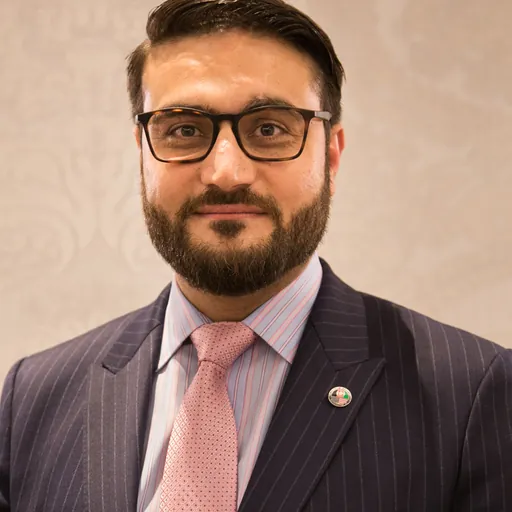
About Hamdullah Mohib
Born 1983. Hamdullah Mohib is a diplomat.
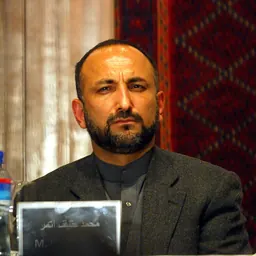
Hamdullah Mohib (Pashto/; born 1983) is a Pashtun Afghan politician and former diplomat.
Educated in England, Mohib was deputy chief of staff to Afghan President Ashraf Ghani and simultaneously Ambassador of Afghanistan to the United States from 2014 to 2018. He was then National Security Adviser of Afghanistan from 2018 to 2021, when he fled the country along with Ghani after the 2021 Taliban offensive, just before the collapse of the Islamic Republic of Afghanistan and the fall of Kabul.
Early life Hamdullah Mohib was born in a small village north of Jalalabad in 1983. He was the youngest of eleven children. Mohib's father worked in Kabul as a court clerk. Upon completion of his degree, Mohib went on to work for Intel Corporation.
After seven years in the UK, Mohib returned to Afghanistan, During the 2009 Afghan presidential election, Mohib worked on the campaign of Afghan Finance Minister Ashraf Ghani, who came in fourth place, losing to incumbent President Hamid Karzai. His thesis was entitled "End-to-end 3D video communication over heterogeneous networks"; He founded the think tank "Discourse Afghanistan" as part of APN, and he established community service programming to serve special needs orphans in Kabul and to honor Afghan women's achievements.
During his tenure as the Deputy Chief of Staff to President Ghani, where he Coordinated and oversaw the office of the spokesperson, correspondence and diplomatic communications, protocol and petitions, as well as the Presidential Secretariat. While at the Presidential Palace, he was responsible for drafting bilateral and multilateral agreements, coordinating with counterparts from the government, and organizing official presidential visits to many other nations.
Mohib formally presented his credentials as Afghan Ambassador to the United States to U.S. President Barack Obama in September 2015.
National Security Adviser In August 2018, Ghani appointed Mohib to the post of national security adviser after Mohammad Hanif Atmar abruptly resigned from that post. At the same time, Ghani declined to accept offers of resignation submitted by Defense Minister Tariq Shah Bahrami, Interior Minister Wais Barmak, and National Directorate of Security chief Mohammed Masoom Stanekzai, over policy differences; Ghani asked the trio to remain in office.
Role in government Mohib was initially criticized for being too young and inexperienced for the job. As national security advisor, he pushed various tribal, political, and ethnic factions to support a united push for peace, saying that a lack of social cohesion and the many Afghan rivalries impaired national security and the prospect of ending the Taliban insurgency. Along with Mohammed Masoom Stanekzai, Mohib was the chief negotiator on Ghani's behalf in 2019 and 2020, during the impasse between Ghani and Abdullah Abdullah in the aftermath of the 2019 Afghan presidential election, in which both Ghani and Abdullah claimed victory and took the oath of office, triggering a political crisis. The two rivals signed a power-sharing deal in May 2020. Mohib himself was viewed as a possible future Afghan president.
Over the Eid holidays in May 2020, Mohib visited the gravesite of Mohammad Najibullah in the Melan graveyard in Gardez, eastern province of Paktia. Najibullah was Afghan president from 1986 and 1992; he was the last president of the Soviet-backed Democratic Republic of Afghanistan, but turned to Afghan nationalism in his final years. Najibullah was tortured and killed by the Taliban in 1996. He remains a divisive and polarizing figure in Afghanistan, reviled by some Afghans due to his association with the Soviet invasion, as well as his brutality as head of the Soviet-supported Afghan secret police, but recalled favorably by some Pashtun nationalists who regarded Najibullah as a patriot and promoter of national reconciliation. Mohib's surprise visit marked the first time a senior member of an Afghan government paid a visit to Najibullah's grave. The visit was seen as an attempt to remind Afghans of the brutality of the Taliban while also appealing to Afghan nationalists.
As Ghani's national security adviser, Mohib sometimes exercised direct control of military operations despite having no military experience. He issued orders that bypassed the ordinary chain of command and called unit commanders directly, a reversal of the prior longstanding U.S. policy of refusing to negotiate with the Taliban without the participation of the Afghan government.
In a March 2019 conference in Washington, D.C., Mohib accused the U.S. "delegitimizing" the Afghan government in Kabul by excluding it from the peace talks in Doha, in which Khalilzad was the leading U.S. negotiator. Mohib accused Khalilzad, who unsuccessfully ran for president of Afghanistan in 2009 and 2014, of seeking to become a "viceroy" and being motivated by personal political ambition. The day following Mohib's remarks, U.S. Under Secretary of State for Political Affairs David Hale informed President Ghani in a phone call that the U.S. government would cut ties with Mohib, and that he would no longer be officially received in Washington or by U.S. civilian and military officials. Others, such as MP Zakaria Zakaria, said that Mohib's comments were truthful and honest. The former U.S. Special Representative for Afghanistan and Pakistan Daniel Feldman said that the issue should not negatively affect U.S.-Afghan relations. and in January 2021, when Mohib and Khalilzad met in Kabul.
The Afghan government had said it was willing to directly negotiate with the Taliban without preconditions, but in late October 2019, Mohib announced the Afghan government's reversal of this policy, outlining a new demand that the Taliban agree to a cease-fire before engaging in negotiations. Mohib described the precondition as a test of whether the Taliban could actually exert control over its commanders and militant forces. Negotiations resumed, however, and in 2020, the Trump administration and the Taliban signed the Agreement for Bringing Peace to Afghanistan. In the agreement, the Taliban agreed to "start intra-Afghan negotiations" and the U.S. pledged to withdraw military combat forces by May 2021. The Taliban did not honor its commitments. The U.S. pressured Ghani to negotiate with the Taliban, viewing the Afghan president as obstreperous, and Ghani was unwilling to give up power.
Fall of Kabul In the summer of 2021, the Taliban seized control of much of the country, and the new U.S. Biden administration decided to continue with the U.S. withdrawal from Afghanistan. Ghazni fell on August 12, and Kandahar and Herat the following day. Under siege, Dostum fled to Uzbekistan, as did Ata Mohammad Noor, a powerful and independent leader in the north. The U.S. government arranged a major evacuation effort from Hamid Karzai International Airport. Mohib said that blame for the Afghan government's collapse was widely distributed, and that those with a share of the responsibility included Afghan government officials and Ghani, as well as the Afghan government's allies in the international community.
Taliban deputy spokesman Ahmadullah Wasiq claimed in a November 2021 tweet that the UAE had banned on Ghani officials living in exile in the Emirates, including Mohib, Atta Muhammad Nur, and Ghani himself, from engaging in Afghan politics. The following month, Mohib confirmed in a Face the Nation interview that while being hosted by the government of the United Arab Emirates, he and other Ghani officials in exile respected the UAE's policy that "they don't want any political activity." and is proficient in Urdu
Works by Mohib Former Afghan national security advisor, spoke about what went wrong, who's to blame, and what lies in store for his country, Foreign Policy (January 22, 2022). Collapse And Consequences In Afghanistan: A Conversation with Hamdullah Mohib, Hoover Institution (January 12, 2022). Full transcript: Hamdullah Mohib on "Face the Nation", CBS News (December 19, 2021). Ex-Afghan National Security Adviser Recalls The Fall Of the Republic, Gandhara (December 17, 2021). Afghan National Security Advisor Talks Future Of The Country, NPR (July 14, 2021). Afghan security chief on his country's future, CBS NEWS (May 18, 2021). Yet to see a change in Taliban's posture: Afghan NSA Hamdullah Mohib, The Economic Times (March 24, 2021). Transcript: Prospects for Peace: A Conversation with Afghanistan's National Security Advisor, Hudson Institute (March 23, 2021) Taliban Want Absolute Power: Hamdullah Mohib , Didpress Agency (February 14, 2021). A Conversation With National Security Advisor Hamdullah Mohib of Afghanistan, Council on Foreign Relations (October 1, 2019). Afghanistan: National Security Advisor Hamdullah Mohib, Asia Society (October 1, 2019). Hamdullah Mohib, Chair of Delegation of Afghanistan, addresses the general debate of the 754th session, UN ( September 20, 2019). The Future of U.S.-Afghanistan Relations: A view from Afghanistan, Hudson Institute (March 15, 2019). Trump envoy is selling out Afghanistan in Taliban peace talks: senior Afghan official, (March 14, 2019). Security Council Debate on the Situation in Afghanistan , UN (March 11, 2019). One on One: Interview with Hamdullah Mohib, National Security Adviser of Afghanistan, TRT world (February 22, 2019). Afghan government, struggling with war fronts and peace bids, forms new team of rivals and loyalists, The Washington Post (January 10, 2019). Grateful that US is Interested in peace, but peace must be Afghan-led, Afghan-owned: Hamdullah Mohib, ThePrint (January 7, 2019). Mohib: We 'must end' Afghan war, BBC HARDtalk (October 23, 2018). Champions for Change: Afghan Ambassador Hamdullah Mohib, Council on Foreign Relations (July 10, 2018). Ambassador Hamdullah Mohib Brings Positive Message About His Country, KGOU (April 21, 2017). Letter to the Editor: An Ashraf Ghani Government in Afghanistan Would Give Out Jobs Only Based on Merit, Washington Post (September 22, 2016). How Afghanistan Can Succeed, CNN (September 30, 2015). A Grassroots Democracy for Afghanistan, Foreign Policy (June 27, 2011).
Don’t just read it —
keep it.
Full-length biographies made to live with: read them, listen on the way to work, watch them tonight.
- E-book
- Audio
- Video
Instant download · yours to keep · every purchase keeps this site free
Important facts
People in Hamdullah Mohib's life
Named in this biography and alive at the same time




Related people
Same field, nearest in time


Contemporaries
People whose lives overlapped Hamdullah Mohib's


Frequently asked questions
Who is Hamdullah Mohib?
Afghan politician and diplomat
When was Hamdullah Mohib born?
Hamdullah Mohib was born in 1983 in Nangarhar Province.
What is Hamdullah Mohib's occupation?
Hamdullah Mohib is a diplomat.
Sources & further reading
Cite this page
APA: Biography.guide. (2026). Hamdullah Mohib. https://biography.guide/hamdullah-mohib/
MLA: "Hamdullah Mohib." Biography.guide, https://biography.guide/hamdullah-mohib/.
Chicago: "Hamdullah Mohib." Biography.guide. https://biography.guide/hamdullah-mohib/.
Data last updated: 2026-09-20 · Spot an error? Report a correction.
Portrait: Wikimedia Commons · author & licence
Page generated 2026-09-27 04:58 UTC