
About Hakuo Iriyama
Lived 1904 – 1991 (aged 86–87). Hakuo Iriyama was a Japanese artist.
Iriyama Hakuo (, or birth name ; 1904 – 11 November 1991) was a lacquer artist from Shirone, Niigata in Japan. He began training as an apprentice in his family at the age of 15, and developed his own technique of painting, which he referred to as .
Early life It was in 1926 when Hakuo started to study dry lacquer techniques in Tokyo, and in two years, he was commenced to the Craft Department to major Lacquer Craft at Ueno Bijyutsu Gakko (present day Tokyo University of the Arts) in 1928. While still studying at the college, Hakuo won his first prize in 1931 at the national Arts and Crafts Exhibition (Bijutsu Kougei-ten). There was another prestigious art show for an aspiring artist called the Art Associations Exhibition (Bijutsu Kyokai-ten), which Hakuo won the next year. When graduated from his college in 1933, his graduation work was on honorable display for the highest excellency before joining the permanent collection of the Art Museum at Tokyo University of the Arts.
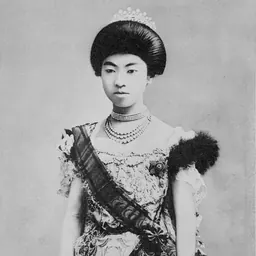
Hakuo continued to make traditional crafts with his own design to apply for art shows. In 1935 and 1936, he won two major shows, and the success at the Art Associations Exhibition had Hakuo's tea caddy set to be joined to the collection of Empress Teimei later, along with incense burners and jewelry chests. The other show, or the 3rd Shin Bunten Exhibition was a government sponsored show to encourage arts and crafts sectors to contribute to gain foreign currencies, and exporters were keen to commission talented person like Hakuo who took increased orders for overseas trade since around 1936.
The former office of Ministry of Economy, Trade and Industry sanctioned the Japan Foreign Trade Council, a foreign trade campaign system where Hakuo gained membership in 1940. As that year was the 2,600th year in commemoration of the Imperial reign, works were shipped feverishly to customers overseas, and as the wartime restriction on industrial materials and metals heightened, in 1944, Hakuo sたred a research group for lacquer enamel inlay over metal.
The Second World War was over in 1945 when Hakuo won the Grand Prix at the first post-war national art exhibition Nitten. It was sanctioned by the government of Japan for the promotion of arts and crafts to support export, and demand from overseas expanded. Three more Grand Prix was awarded at the second, the fourth, and the six Nitten Exhibitions between 1946 and 1950, when Hakuo decided to leave the art organizations and start working independently.
Etching and lacquer For the first time, Hakuo concentrated on his own ideas and developed the lacquer etching technique which he would name "Shitsuga" in 1950. The thick base layer of lacquer spread over a plate with dry lacquer coat would be etched with a flexible bamboo spatula, thus presenting a semi-three dimensional carving. When dried, the sculptured surface was colored with pigmented lacquer just like an oil painting. While the plate, or the relief was already sculpted, coloring enhanced to mimick the natural features.
That same year in 1950, Hakuo announced the new Lacquer Wood Block Print by using a plate with dry lacquer finish and lacquer as the printing pigment/ink. It was during that time a block of dry lacquer was curved into a "Lacquer Ink Stone", or . His show became popular as Mitsukoshi Gallery had his second exhibit of "Lacquer paintings" in 1957 again, then the third from 28 October to 2 November 1958. including the international social functions at the Tokyo American Club which hold membership of over 3,500. Isetan held a larger show in the period of 28 May to 3 June 1965.
Don’t just read it —
keep it.
Full-length biographies made to live with: read them, listen on the way to work, watch them tonight.
- E-book
- Audio
- Video
Instant download · yours to keep · every purchase keeps this site free
Important facts
People in Hakuo Iriyama's life
Named in this biography and alive at the same time
Related people
Same field, nearest in time




Contemporaries
People whose lives overlapped Hakuo Iriyama's





Frequently asked questions
Who was Hakuo Iriyama?
Japanese artist
When was Hakuo Iriyama born?
Hakuo Iriyama was born in 1904.
When did Hakuo Iriyama die?
Hakuo Iriyama died on 11 November 1991.
What was Hakuo Iriyama's occupation?
Hakuo Iriyama was an artist.
What nationality was Hakuo Iriyama?
Hakuo Iriyama was Japanese.
Sources & further reading
Cite this page
APA: Biography.guide. (2026). Hakuo Iriyama. https://biography.guide/hakuo-iriyama/
MLA: "Hakuo Iriyama." Biography.guide, https://biography.guide/hakuo-iriyama/.
Chicago: "Hakuo Iriyama." Biography.guide. https://biography.guide/hakuo-iriyama/.
Data last updated: 2026-09-20 · Spot an error? Report a correction.
Page generated 2026-09-27 05:01 UTC