
Haile Gebrselassie
Ethiopian long-distance runner and businessman (born 1973)
About Haile Gebrselassie
Born 1973. Haile Gebrselassie is an Ethiopian marathon runner, long-distance runner, athletics competitor, runner and athlete.
Athletics career Early career Haile was born one of ten children in Asella, Ethiopia. As a child growing up on a farm, he used to run ten kilometres to school every morning, and the same distance back every evening. This led to a distinctive running posture, with his left arm crooked as if he was still holding his school books. Gebrselassie's mother died from cancer when he was six.
In 1992, Haile gained international recognition in Seoul, South Korea, when he won the 5000-metre and 10,000-metre races at the 1992 World Junior Championships and a silver medal in the junior race at the World Cross Country Championships held in Boston, the United States.
The following year, in 1993, Haile won the first of what would eventually be four consecutive world championships titles in the men's 10,000 metres at the 1993, 1995, 1997, and 1999 World Championships. His win in 1993 was however his most infamous as he accidentally stepped on the heel of Moses Tanui's shoe at the bell, causing it to fly off his foot. After the contact, with just one shoe, an angered Tanui moved out to a 10-meter lead, only to have Haile run him down on the final straight. Also at the 1993 World Championships he ran in the 5,000-metre race to finish a close second behind Ismael Kirui of Kenya. In 1994 he won a bronze medal at the IAAF World Cross Country Championships. Later that year he set his first world record by running 12:56.96 in the 5,000 metres, breaking Saïd Aouita's record by almost two seconds.
In 1995, Haile ran the 10,000 metres in 26:43.53 in Hengelo, the Netherlands, lowering the world record by nine seconds. That same summer, in Zürich, Switzerland, Haile ran the 5000 metres in 12:44.39, taking 10.91 seconds off the world record 12:55.30 (established by Kenya's Moses Kiptanui earlier in the year). Later that summer he won the 10k world championship with his final 200m being run in 25 seconds. This world record at the Weltklasse meet in Zürich was voted "Performance of the Year" for 1995 by Track & Field News magazine. At the same Weltklasse meet in Zürich in 1996, an exhausted Haile, suffering from blisters obtained on the hard track in Atlanta (where he had won the Olympic 10,000 metres gold), had no answer to the 58-second lap of Daniel Komen with five laps to go as Komen went on to win and just miss Haile's record, finishing in 12:45.09. In 1997, Haile turned the tables on Komen at the same meet. Coming off his third 10K world championship gold medal, Haile beat Komen in another Zürich classic on 13 August 1997, covering the final 200 metres in 26.8 seconds to break his 5000 metres world record with a time of 12:41.86. Komen, in turn, took Haile's record only nine days later when Komen ran a 12:39.74 performance in Belgium.
Middle career The next year, 1998, saw Haile lowering the indoor world records for 2000 and 3000 metres, enjoying success outdoors by taking back both the 5000 and 10,000 metres world records, as well as earning a share in the Golden League jackpot for winning all of his races in the Golden League series that summer. In June 1998 in Hengelo, Netherlands, Haile set a 10,000 metres world record 26:22.75, breaking Paul Tergat's world record 26:27.85, running evenly paced 13:11/13:11 5K splits.
Just 13 days later, Haile took on the 5000 metres mark of Komen in Helsinki, Finland. Croatian pacemaker Branko Zorko took the pace out slowly, hitting 1000 metres in 2:33.91 and dropping out at the mile. Million Wolde and Assefa Mezgebu led Haile through 2000 metres in 5:05.62. His pacemakers could not maintain the pace, though, and Haile was left alone for a problematic solo effort six laps out. Hitting 3000 metres in 7:38.93, even the British commentators announcing the race counted him out. With four laps to go (8:40.00), Haile needed a sub-4-minute final 1,600 metres for the record. With one lap to go and in great pain, Haile took off, recording a final lap of 56.77 seconds and a final 1,600 metres of 3:59.36 (= 4:00.96-mile) to race to a 12:39.36 world record.
In 1999, Haile starred as himself in the movie Endurance. The film chronicled his quest to win Olympic gold in the 10,000 metres in Atlanta. On the track, he won 1500/3000 metres double at the World Indoor Track Championships, defended his Outdoor World Track Championships 10,000 metres title, and remained undefeated in all his races (which ranged from 1500 up to 10,000 metres).
In 2000, Haile again won all of his races, ranking first in the world in both the 5000 and 10,000 metres. At the 2000 Sydney Olympics, he became the third man in history to successfully defend an Olympic 10,000 metres title (after Emil Zátopek and Lasse Virén). The narrow Olympic victory over Kenya's Paul Tergat came down to a blistering final kick, with Tergat's 26.3-second last 200 metres being topped by Haile's even faster 25.4. The winning margin of victory was only 0.09 seconds, closer than the winning margin in the men's 100-metre dash final.
On 26 August 2001, he ran his first half marathon (16 wins out of 20) and won in 1:04:34. Also in 2001, Haile won the IAAF World half Marathon Championships and the bronze medal in the 10,000 metres at the 2001 World Championships in Athletics. In the same year, he conceptualized the Great Ethiopian Run with Peter Middlebrook, which was latterly supported by Brendan Foster, British runner Richard Nerurkar the British ambassador to Ethiopia Myles Wickstead.
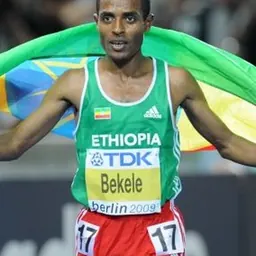
On 30 August 2003, Haile topped the polls when elected as a member of the IAAF Athletes Commission. Also in 2003, at the World Championships in Paris, Haile was involved in one of the most remarkable 10,000 metres races of all time while gaining a silver medal behind countryman Kenenisa Bekele. The last half of the 10,000 metres final at the championships was completed in a staggering 12:57.24 (12:57.2 for Bekele and 12:58.8 for Haile). According to the IAAF, "Not only was this split the fastest closing 5000 metres in the championships 10,000m (the previous record was 13:12.12, recorded in Atlanta), but it was also the fastest 5000 metres in a global championship surpassing the 12:58.13 Salah Hissou recorded when he won the 5,000m in Sevilla'99." (This remark remained true until a week later when the World Athletic Championships 5000 metres medalists (including Bekele) all ran faster than the second 5000 metres split in the previous week's 10,000 metres.) "The difference between the closing 5000 metres splits (12:57.24) and the 5000 metres World record (12:39.36) was 17.98 seconds, which is a record. The previous best of 18.4 seconds (13:31.4 for the closing 5000 metres when the World Record was 13:13.0) was recorded in the 1976 Olympics."
In the 2004 Athens Olympics, Haile sought to become the first man in history to win three straight Olympic gold medals in the 10,000 metres. He was unable to do so due to an injury; however, he finished fifth in a race won by his compatriot Kenenisa Bekele, who had broken both of Haile's major track world records, the 5000 metres and the 10,000 metres records. Shortly before the Athens games, Haile was unable to train for three weeks due to inflammation of his Achilles tendon. The injury was severe enough that he would not have competed otherwise but did so because of significant pressure from his country. This loss in the final period of training likely cost him a medal.
Later career Since leaving the track after the 2004 Olympics, Haile has focused on road racing and the marathon. His adult marathons to date include London 2002 (3rd place), Amsterdam 2005 (1st place), London 2006 (9th place), Berlin 2006 (1st place), Fukuoka 2006 (1st place), London 2007 (DNF), Berlin 2007 (1st place and World Record), Dubai 2008 (1st place), Berlin 2008 (1st place and another World Record), Dubai 2009 (1st place) Berlin 2009 (1st place), Dubai 2010 (1st place), and NYC 2010 (DNF).
In 2002, Haile made his debut at the marathon at the London Marathon. He started the race at a very fast pace, within world record time. He was unable to hold it, however, as world record holders Khalid Khannouchi and Paul Tergat both eventually passed him. Khannouchi broke his world record, while Haile finished third.
In 2005, Haile went undefeated in all of his road races. This included a British all-comers' record in the 10K in Manchester (27:25), a win at the Amsterdam Marathon in the fastest marathon time in the world for 2006 (2:06:20), and a new world best for 10 miles in Tilburg Ten Miles race, The Netherlands (44:24). (His unofficial split of 41:22 at the 15K mark was 7 seconds faster than the official world best.)
Haile started 2006 positively on 15 January by setting his first world record on American soil. He ran the half marathon of the Rock 'n' Roll Arizona Marathon to beat Samuel Wanjiru 2005 record for the distance by a full 21 seconds with a time of 58 minutes and 55 seconds. During the race he passed the 20 km mark in 55:48, breaking also Paul Tergat's record for this distance which had stood since 1998. That year also marked another victory for Haile as he shattered the 25 km world road record (albeit in non-IAAF ratified fashion) by 68 seconds in a time of 1:11.37. The race was organized where Haile and six other runners would run 5 kilometres and then cross the starting line of the 20-K Alphen race in Alphen aan den Rijn of the Netherlands.
On 23 April 2006, he finished ninth in the London Marathon with a time of 2:09:05 (the race was won by Kenyan Felix Limo, who clocked 2:06:39). Haile referred to the ninth-place finish as "the worst race of my career". However, on 24 September he came back with a win in the Berlin Marathon in the fastest time of the year, 2:05:56. His time in Berlin made him only the fifth man in history to run under 2:06 for the marathon. This was followed by a win in the Fukuoka Marathon in Japan at 2:06:52.
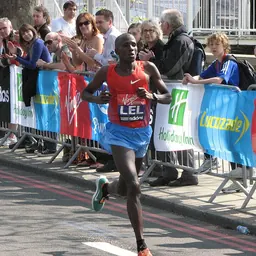
In London on 22 April 2007, Haile challenged the 2006 London Marathon winner Felix Limo, 2005 London Marathon winner Martin Lel, 2004 Athens gold medalist Stefano Baldini, 2006 New York Marathon winner Marílson Gomes dos Santos, and the then marathon world record holder Paul Tergat in what organizers anticipated would be an exciting race. However Haile dropped out at the stage complaining of a stitch and inability to breathe, which turned out to be an allergic reaction to the pollen in the air. This left the 2005 winner Martin Lel to come home in the first place.
One month later, Haile made a surprise return to the track for the first of two stadium races that summer. In the first, he ran a 26:52.81 finishing fifth in a very competitive 10,000 metres race in Hengelo, The Netherlands. It was the first time a man over 30 ran the 10,000 m in less than 27 minutes. Then, on 27 June 2007, Haile launched an attack upon the world record for the one hour run, in Ostrava, Czech Republic. This record attempt was successful as Haile passed the hour mark at 21,285 metres (13 miles 397 yards), eclipsing the previous best of 21,101 metres, set by Mexican Arturo Barrios in La Flèche, France, on 30 March 1991. Furthermore, Haile covered 50 laps (20,000 m) in 56:25.98, another world best, well within the previous 56:55.6 also set by Barrios in 1991. These were his 23rd and 24th world records.
Haile made his running debut in New York City when he won the New York City Half Marathon on 5 August 2007, in 59:24, breaking the previous course record by two minutes. His win in the Lisbon Half Marathon (59:15) in March 2008 gave him a perfect record of 9–0 in winning all of his half marathons. He lost his first half marathon in Den Haag (14 March 2009), when he was beaten by Sammy Kitwara (59:47 for Kitwara, 59:50 for Haile).
On 30 September 2007, Haile won the Berlin Marathon in 2:04:26 (4:44.8 per mile), setting the world record and shaving 29 seconds off Paul Tergat's record, set on the same course in 2003. His victory further energized the celebrations of the Ethiopian Millennium (unique to the Ethiopian calendar), which began on 12 September 2007.
Before the 2008 Dubai Marathon, his manager suggested that Haile would be able to run a sub 2:04 time for a new world record. While Haile agreed that a sub 2:04 was possible, he stated that the conditions would need to be perfect for such a time. The event was held on 18 January 2008 and was won by Haile in a time of 2:04:53, making it the second-fastest marathon in history. However the early pace had been too fast and he was unable to continue at that speed, resulting in a time 27 seconds short of his world record.
At the Hengelo FBK-Games on 24 May, Haile ran 26:51.20 for the 10,000 metres to finish a close second behind countryman Sileshi Sihine's 26:50.53. This is the Master 35–39 age group world record. His nine career sub-27-minute 10,000-meter performances are more than any other athlete except for Kenenisa Bekele, who also has nine.
Because of Beijing's air pollution levels, Haile decided to withdraw from the marathon at the 2008 Beijing Olympics. He has asthma and said that running in such conditions might be harmful to his health. Haile later admitted that he regretted the decision as the Beijing air was cleaner than expected. He did, however, run the 10,000 metres on 17 August, finishing sixth with a time of 27:06.68. The gold medal went to his countryman and then world record holder, Kenenisa Bekele with a 27:01:17 Olympic record winning time. The following month, on 28 September 2008, he defended his Berlin Marathon title, averaging 2:56.5 per kilometer (4:43.7 per mile) for a time of 2:03:59, breaking his own world record by 27 seconds.
Haile won the Dubai Marathon on 16 January 2009 but fell short of breaking his own world record that he had set four months earlier on the flat course. He finished in 2:05:29, well ahead of countryman Deressa Chimsa. In September of that year, he won the Berlin Marathon for the fourth consecutive time. He attempted to break the world record he had set the previous year but, despite a quick start, warm conditions saw him finish in 2:06:08, two minutes away from his best mark. He did, however, pass the 30-kilometer point in 1:27:49, which was a new world record for a road 30K.
In 2010, he tried to attack his world record for the third consecutive time at the Dubai Marathon 2010. Although he won the race with a time of 2:06:09, he failed to break his 18-month world record. In a post-race interview, Haile revealed that he had suffered back pain, requiring intensive pre-race physiotherapy, resulting from having slept in a bad position. His problems continued at the NYC Half Marathon, where he pulled up mid-race visibly uncomfortable in his running. He had an easy victory in the inaugural edition of the 10K de Madrid in April. He scored his third victory at the Great Manchester Run the following month, although he missed out on Micah Kogo's course record.
Retirement On 7 November, after dropping out of the 2010 New York City Marathon with an inflamed knee, Haile announced his retirement. Days later, he posted to his Twitter account that he was reconsidering his decision and wanted to run in the 2012 London Olympics. Haile had stated previously that after retiring he would like to enter politics, with scepticism from the public about his knowledge on politics and the unfamiliar culture of celebrities holding public office in Ethiopia. However he won his first race back in a 10k road race in Angola with a new course record of 28:05 and beat countryman Deriba Merga and the Kenyan Josphat Menjo who had run the fastest 10000m of that year.
Haile missed the 2011 Tokyo Marathon due to an injury, but won the half marathon at the Vienna City Marathon on 17 April 2011. About a month later Haile easily won the Great Manchester Run in England for the fourth time, finishing in 28:10. He attempted to earn an Olympic spot at the Fanny Blankers-Koen Games in Hengelo, the stadium in which he had broken four world records. However, in extremely hot weather he finished seventh with a time of 27:20.39, sixth amongst Ethiopians, and did not qualify for the 2012 Summer Olympics. However, he did appear at the opening ceremony as one of the eight flagbearers who brought the Olympic flag into the stadium. Another outing at the Fukuoka Marathon, however, saw him enter as the favourite but drop out at 32 km.
On 14 April 2013, Haile won the open field of the Vienna City half marathon with a time of 01:01.14. He set his first over-40 world record with a time of 46:59 for 10 miles in Switzerland, on 15 September 2013. He took 3rd overall in the 2013 BUPA Great North Run, 32 seconds behind the winner Kenenisa Bekele and 31 seconds behind the reigning Olympic and world champion Mo Farah.
Haile has announced his retirement from competitive running after finishing 16th in the Great Manchester Run on Sunday 10 May 2015. It brings to an end a 25-year career in which he claimed two Olympic gold medals, eight World Championship victories and set 27 world records. "I'm retiring from competitive running, not from running. You cannot stop running, this is my life," he told BBC Sport.
Currently, Haile is the former president of the Ethiopian Athletics Federation, has been selling Hyundai cars in Addis Ababa, Ethiopia, since 2009, and cooperates with Hyundai for the Marathon Motors Engineering factory there which started assembling the electric Hyundai Ioniq in July 2020. He has become a small-lot coffee farmer in Ethiopia. His coffees can be found under his estate name, Haile Estate, such as the Sun Dried Ethiopian Haile Estate Coffee, which is distributed by Starbucks Reserve.
Business career Haile Gebrselassie ventured into an entrepreneurship career in 1995, investing earnings from his sporting achievements that led to establishing companies. Until recent years, he has had 600 staff and offices every day. In 2010, Haile opened Haile Resorts in Lake Hawassa, and the resort quickly expanded to include destinations in Amhara, Oromia, Southern Nations, Nationalities, and People's Region. He recently inaugurated the Grand Haile Resort in Addis Ababa headquartered in Lam Beret. Haile has a dealership for Hyundai cars in Ethiopia and started assembling Hyundai electric cars in 2020.
Haile owned Marathon Motors, a vehicle business that also assembles Hyundai cars, and which recently rolled off the first electric car from its assembly plant. Haile owned several businesses and is involved in real estate projects and owns four hotels, a coffee plantation. In 2015, there was estimated 1,000 employees and reached 3,000 employees across his investments in Ethiopia and beyond. Haile currently received 30 million birr revenue from various businesses.
Haile Gebrselassie is an ambassador for the German charity organisation "Menschen für Menschen", which is committed to the development of his home country of Ethiopia.
Achievements International competitions
Marathon performances
Track and field circuit
World records and best performances Distance Mark Date Location Notes 5000 metres 12:56.96 4 June 1994 Hengelo, Netherlands Two miles 8:07.46 28 May 1995 Kerkrade, Netherlands world best 10,000 metres 26:43.53 5 June 1995 Hengelo, Netherlands 5000 metres 12:44.39 16 August 1995 Zürich, Switzerland 5000 metres 13:10.98 27 January 1996 Sindelfingen, Germany, indoors 3000 metres 7:30.72 4 February 1996 Stuttgart, Germany, indoors 5000 metres 12:59.04 20 February 1997 Stockholm, Sweden indoors Two miles 8:01.08 31 May 1997 Hengelo, Netherlands third fastest time ever, world best 10,000 metres 26:31.32 4 July 1997 Oslo, Norway 5000 metres 12:41.86 13 August 1997 Zürich, Switzerland 3000 metres 7:26.15 25 January 1998 Karlsruhe, Germany indoors 2000 metres 4:52.86 15 February 1998 Birmingham, UK indoors 10,000 metres 26:22.75 1 June 1998 Hengelo, Netherlands 5000 metres 12:39.36 13 June 1998 Helsinki, Finland 5000 metres 12:50.38 14 February 1999 Birmingham, UK indoors 10 kilometres 27:02 11 December 2002 Doha, Qatar road race Two miles 8:04.69 21 February 2003 Birmingham, UK indoors, world best 15 kilometres 41:22 4 September 2005 Tilburg, Netherlands road race, not IAAF-ratified 10 miles 44:24 4 September 2005 Tilburg, Netherlands road race, world best 20 kilometres 55:48 15 January 2006 Tempe, US Half marathon 58:55 15 January 2006 Tempe, US 25 kilometres 1:11:37 12 March 2006 Alphen aan den Rijn, Netherlands road race, not IAAF-ratified – no post-race EPO test One hour run 21,285 m 27 June 2007 Ostrava, Czech Republic 20,000 metres 56:25.98 27 June 2007 Ostrava, Czech Republic Marathon 2:04:26 30 September 2007 Berlin, Germany Marathon 2:03:59 28 September 2008 Berlin, Germany 30 kilometres 1:27:49 20 September 2009 Berlin, Germany
Personal bests
+Outdoor track Distance Time Date Location Notes 1500 metres 3:33.73 6 June 1999 Stuttgart, Germany Mile run 3:52.39 27 June 1999 Gateshead, United Kingdom 3000 metres 7:25.09 28 August 1998 Brussels, Belgium Two miles 8:01.08 31 May 1997 Hengelo, Netherlands 5000 metres 12:39.36 13 June 1998 Helsinki, Finland 10,000 metres 26:22.75 1 June 1998 Hengelo, Netherlands 20,000 metres 56:26.0h 27 June 2007 Ostrava, Czech Republic One hour run 21,285 m 27 June 2007 Ostrava, Czech Republic African record+Road Distance Time Date Location Notes 10 km 27:02 13 December 2002 Doha, Qatar 15 km 41:38 11 November 2001 Nijmegen, Netherlands 10 miles 44:24 4 September 2005 Tilburg, Netherlands World best 20 km 55:48 15 January 2006 Tempe, United States Half marathon 58:55 15 January 2006 Tempe, United States 25 km 1:11:37 12 March 2006 Alphen aan den Rijn, Netherlands Marathon 2:03:59 28 September 2008 Berlin, Germany
+Indoor track Distance Time (min) Date Location 800 metres 1:49.35 9 February 1997 Dortmund, Germany 1500 metres 3:31.76 1 February 1998 Stuttgart, Germany 2000 metres 4:52.86 15 February 1998 Birmingham, United Kingdom 3000 metres 7:26.15 25 January 1998 Karlsruhe, Germany Two miles 8:04.69 21 February 2003 Birmingham, United Kingdom 5000 metres 12:50.38 14 February 1999 Birmingham, United Kingdom
Filmography
Don’t just read it —
keep it.
Full-length biographies made to live with: read them, listen on the way to work, watch them tonight.
- E-book
- Audio
- Video
Instant download · yours to keep · every purchase keeps this site free
Important facts
People in Haile Gebrselassie's life
Named in this biography and alive at the same time




Related people
Same field, nearest in time





Contemporaries
People whose lives overlapped Haile Gebrselassie's


Frequently asked questions
Who is Haile Gebrselassie?
Ethiopian long-distance runner and businessman (born 1973)
When was Haile Gebrselassie born?
Haile Gebrselassie was born on 18 April 1973 in Assela.
What is Haile Gebrselassie's occupation?
Haile Gebrselassie is a marathon runner, long-distance runner, athletics competitor, runner and athlete.
What nationality is Haile Gebrselassie?
Haile Gebrselassie is Ethiopian.
Sources & further reading
· Wikipedia: Haile Gebrselassie
Cite this page
APA: Biography.guide. (2026). Haile Gebrselassie. https://biography.guide/haile-gebrselassie/
MLA: "Haile Gebrselassie." Biography.guide, https://biography.guide/haile-gebrselassie/.
Chicago: "Haile Gebrselassie." Biography.guide. https://biography.guide/haile-gebrselassie/.
Data last updated: 2026-09-20 · Spot an error? Report a correction.
Page generated 2026-09-27 05:22 UTC