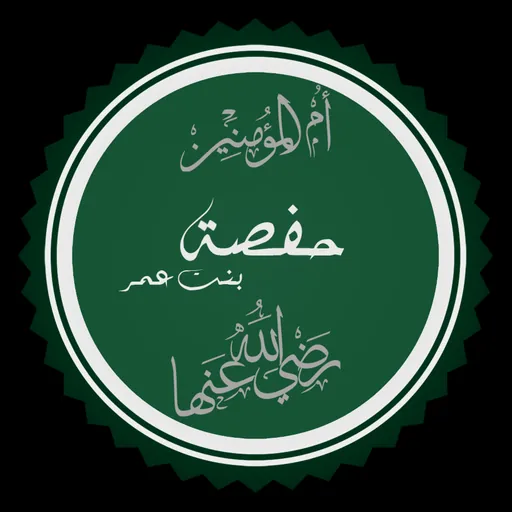
Hafsa bint Umar ibn Al-Khattab
The fourth wife of Islamic prophet Muhammad
About Hafsa bint Umar ibn Al-Khattab
Lived 604 – 665 (aged 60–61).
Hafsa bint Umar (; 605–665) was the fourth wife of Muhammad and a daughter of the second caliph Umar . In Islamic writings, her name is thus often prefixed by the title "Mother of the Believers" (Arabic: أمّ المؤمنين, romanized: ʾumm al-muʾminīn).
Early life Hafsa was the daughter and eldest child of 'Umar ibn al-Khattab and Zaynab bint Maz'un. She was born "when Quraysh were building the House Kaʿbah, five years before the Prophet was sent," i.e., in 605.
Marriage She was first married to Khunays ibn Hudhafa but became a widow in August 624.
As soon as Hafsa had completed her waiting period, her father Umar offered her hand to Uthman ibn 'Affan, and thereafter to Abu Bakr; but they both refused her. Disappointed, Umar went to Muhammad to complain about this, and Muhammad replied, "Hafsa will marry one better than Uthman and Uthman will marry one better than Hafsa."
Muhammad married Hafsa in Sha'ban AH 3 (late January or early February 625). This marriage "gave the Prophet the chance of allying himself with this faithful follower", i.e. Umar, who had become his father-in-law.
Surat al-Tahrim There are two stories related to the revelation of the opening verses of Surat al-Tahrim. One is authentic according to Imams al-Bukhari and Muslim and found in Sahih Muslim 1474, narrated by the Prophet's wife Aisha. In this first narration, Muhammad refrained from drinking honey to please his wives.
The latter narration is mursal (meaning the chain of narration goes back to a successor instead of a direct companion of Muhammad) and ḍaʻīf (weak). Its isnad is weaker than that of the first story; however, it is accepted by some tafseer scholars who preferred this explanation, such as in Tafsir Al-Jalalayn and Tafsir at-Tabari. Imam al-Tabarani says "The first opinion (concerning the story of honey) is stronger, yet it is not impossible that both matters occurred, and that this (i.e. the revelation) came down concerning both stories". In this narration, Muhammad. was intimate with Maria al-Qibtiyya while Hafsa was away visiting her father. On her return she found out what had happened and asked him "In my home and on my bed?". Muhammad then gave up Maria to please Hafsa. Al-Qurtubi states that the first one is authentic and the second is weak.
Ibn Al-Arabi wrote in Ahkam al-Qur'an that: "Indeed, the only authentic narration is that it was about honey, that the Prophet drank it with Zainab, and Aisha and Hafsa pretended to be offended by it. There occurred what occurred and the Prophet made an oath never to drink it again. He confided that to his wife and the verse was revealed regarding all of them".
Notable work Uthman, when he became Caliph, used Hafsa's copy when he standardized the text of Qur'an. She is also said to have narrated sixty hadiths from Muhammad.
Death She died in Sha'ban AH 45, i.e., in October or November 665. She is buried in Al-Baqi Cemetery next to the other Mothers of the Faithful.
Contrasting views Sunni view Hafsa is seen as scholarly and inquisitive by Sunni Muslims, and considered a Mother of The Believers. . After the death of Muhammad she did not remarry, as it was considered haram for Muslims to marry his widow.
Shi'a view Due to the honey incident with the prophet, Shi'as disapprove of Hafsa and Aisha in this particular incident and cite the beginning of Surat al-Tahrim and the accompanying hadith as evidence.
Don’t just read it —
keep it.
Full-length biographies made to live with: read them, listen on the way to work, watch them tonight.
- E-book
- Audio
- Video
Instant download · yours to keep · every purchase keeps this site free
Important facts
People in Hafsa bint Umar ibn Al-Khattab's life
Named in this biography and alive at the same time

Contemporaries
People whose lives overlapped Hafsa bint Umar ibn Al-Khattab's




Frequently asked questions
Who was Hafsa bint Umar ibn Al-Khattab?
The fourth wife of Islamic prophet Muhammad (c.605–665)
When was Hafsa bint Umar ibn Al-Khattab born?
Hafsa bint Umar ibn Al-Khattab was born in 604 in Mecca.
When did Hafsa bint Umar ibn Al-Khattab die?
Hafsa bint Umar ibn Al-Khattab died in 665 in Medina.
What was Hafsa bint Umar ibn Al-Khattab known for?
Hafsa bint Umar ibn Al-Khattab was known for Mother of the Believers and Wife.
Sources & further reading
· Wikipedia: Hafsa bint Umar ibn Al-Khattab
Cite this page
APA: Biography.guide. (2026). Hafsa bint Umar ibn Al-Khattab. https://biography.guide/hafsa-bint-umar-ibn-al-khattab/
MLA: "Hafsa bint Umar ibn Al-Khattab." Biography.guide, https://biography.guide/hafsa-bint-umar-ibn-al-khattab/.
Chicago: "Hafsa bint Umar ibn Al-Khattab." Biography.guide. https://biography.guide/hafsa-bint-umar-ibn-al-khattab/.
Data last updated: 2026-09-23 · Spot an error? Report a correction.
Portrait: Wikimedia Commons · author & licence
Page generated 2026-09-27 05:07 UTC