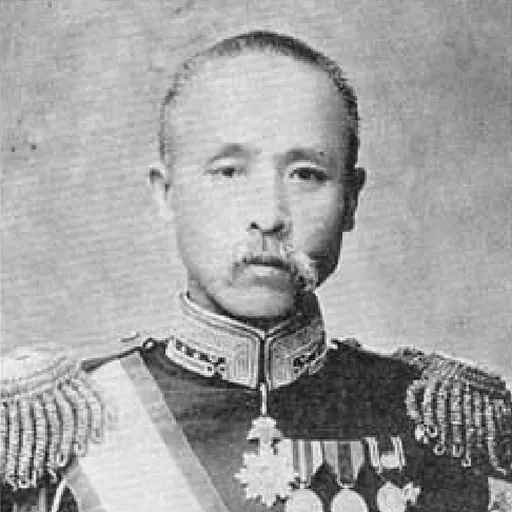
About Gwon Jung-Hyeon
Lived 1854 – 1934 (aged 79). Gwon Jung-Hyeon was a military personnel.
Gwon Jung-hyeon ( November 27, 1854 – March 19, 1934), also spelled Kwon Jung-hyun, was an Imperial Korean Lieutenant General and Politician. He was the Minister of Justice from 1899 to 1910 and the Minister of Agriculture, Commerce and Industry from 1905 to 1910. He is best known for being one of the Five Eulsa Traitors who signed the Eulsa Treaty of 1905 which made the Korean Empire a protectorate of the Empire of Japan. Because of his involvement in the Treaty, he was an unpopular figure in Korea and faced an assassination attempt in 1907 by an assassination group led by .
Biography Gwon was born on November 27, 1854, at Yeongdong. Having learned Japanese from an early age, he joined the Gaehwa Party which was a pro-Japanese political party. In 1883, he became the secretary of the Toei Supervisory Office, and then the secretary in Japan. In 1891 he became the Customs Officer at Incheon and was involved in the signing of the Austria–Korea Treaty of 1892 with Austria-Hungary. In January 1905, Gwon was appointed as the Minister of Military.
On September 26, 1905, he was appointed as the Minister of Agriculture, Commerce and Industry as a member of Han Kyu-seol's cabinet. On November 17, 1905, Gwon signed the Eulsa Treaty with four other ministers. He had previously opposed the signing of treaty, but when Han Kyu-seol was taken away by the Japanese because he also opposed the treaty, Gwon changed his stance and assented the signing. The five bureaucrats, including Gwon Jung-hyeon were shunned as later generations retrospectively title them the Five Eulsa Traitors. In 1912, he received the Korea Annexation Commemorative Medal and was promoted to Senior Fifth Rank .
In 1919, he submitted his resignation and resigned as an advisor to the Central House, but after that he requested the governor-general of Korea, Makoto Saitō, to return, and in 1925 he was appointed as an advisor to the Korean History Compilation Committee. He was reinstated as an advisor to the Central House during the period of Governor-General Hanzō Yamanashi.
Legacy Gwon's legacy remains heavily controversial among the Korean populace as he was known as a collaborator with the Japanese forces. He was listed in the Korean History Compilation Committee's along with the other four Five Eulsa Traitors in 2002. He was also listed in the List of Pro-Japanese Groups by the Institute for Ethnic Issues in 2008 and in the by the . In 2007, the seized his property along with the property of his adopted son. In a survey conducted on the lineage of nobility in 1960, his grandson was working at an Antique Art Association.
Don’t just read it —
keep it.
Full-length biographies made to live with: read them, listen on the way to work, watch them tonight.
- E-book
- Audio
- Video
Instant download · yours to keep · every purchase keeps this site free
Important facts
People in Gwon Jung-Hyeon's life
Named in this biography and alive at the same time
Related people
Same field, nearest in time
Contemporaries
People whose lives overlapped Gwon Jung-Hyeon's



Frequently asked questions
Who was Gwon Jung-Hyeon?
Korean politician
When was Gwon Jung-Hyeon born?
Gwon Jung-Hyeon was born on 27 November 1854 in Chungcheong Province, Joseon, Yeongdong County.
When did Gwon Jung-Hyeon die?
Gwon Jung-Hyeon died on 19 March 1934 in Empire of Japan, Japanese Korea, Keiki-dō, Seoul.
What was Gwon Jung-Hyeon's occupation?
Gwon Jung-Hyeon was a military personnel.
Sources & further reading
· DBpedia: Gwon Jung-hyeon (politician)
Cite this page
APA: Biography.guide. (2026). Gwon Jung-Hyeon. https://biography.guide/gwon-jung-hyeon-military-personnel/
MLA: "Gwon Jung-Hyeon." Biography.guide, https://biography.guide/gwon-jung-hyeon-military-personnel/.
Chicago: "Gwon Jung-Hyeon." Biography.guide. https://biography.guide/gwon-jung-hyeon-military-personnel/.
Data last updated: 2026-09-29 · Spot an error? Report a correction.
Portrait: Wikimedia Commons · author & licence
Page generated 2026-10-04 13:26 UTC