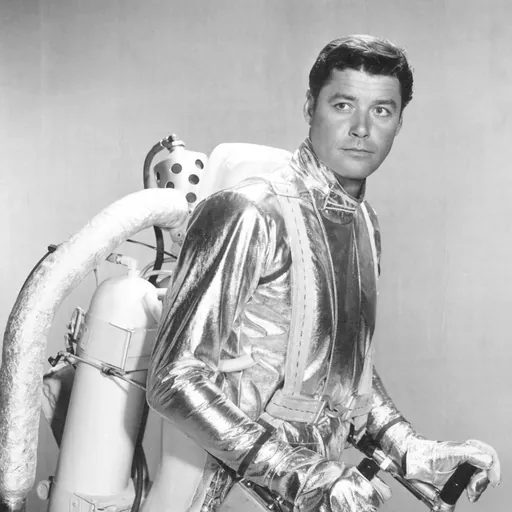
About Guy Williams
Lived 1924 – 1989 (aged 65). Guy Williams was an American actor, television actor, model and film actor.
Armando Joseph Catalano (January 14, 1924 – April 30, 1989 ), better known as Guy Williams, was an American actor. He played swashbuckling action heroes in the 1950s and 1960s.
Among his most notable achievements were two TV series: the title role in Zorro (1957-1959), and as the father of the Robinson family on the popular sci-fi series Lost in Space (1965-1968).
During most of the 1970s, Guy Williams frequently visited and worked in television shows in Argentina, where he was most revered. He retired in the early 1980s in Buenos Aires, where he died of a ruptured brain aneurysm in 1989.
Biography
Early life Guy Williams was born of Sicilian descent on January 14, 1924, as Armando Joseph Catalano in the Washington Heights area of New York City. His parents were insurance broker Attilio Catalano from Lercara Friddi and Clara (Arcara) Catalano from Messina, and were by then living in poverty. Attilio was the son of a wealthy timber grower in Messina, who had purchased land in New Jersey. Williams grew up in the Little Italy neighborhood of The Bronx.
In Public School 189, Williams stood out in mathematics. Later, he attended George Washington High School, while he occasionally worked at a soda fountain. He then left to attend the Peekskill Military Academy, where he was an enthusiastic student. His interests included American football and chess.
First artistic steps Williams wanted to be an actor, spurred by his good looks and 6'3" height. When he decided not to continue studying, his mother, who later became an executive of a foreign film company, was disappointed because it was expected that he would follow in his father's footsteps as an insurance broker.
After working as a welder, cost accountant and aircraft-parts inspector during World War II, Williams became a salesman in the luggage department at Wanamaker's. While there, he decided to send his photos to a modeling agency. He quickly found great success with assignments resulting in photographs in newspapers and magazines, including Harper's Bazaar as well as on billboards and book covers. He then adopted the name Guy Williams in the 1940s on the advice of his agent Henry Willson after a director refused to cast him because of his on-screen moniker, Guido Armando, that sounded "too foreign".
In 1946, Williams signed a one-year contract with Metro-Goldwyn-Mayer and moved to Hollywood. For his debut, he had a featured role as the Enola Gay bombardier in the MGM docudrama The Beginning or the End (1947), about the development of the atom bomb. He appeared in only a few films afterwards and soon returned to New York.
In 1948, to advertise cigarettes while skiing, Williams did an extensive filming trip accompanied by Janice Cooper, a John Robert Powers model. During the long photographic sessions, they fell in love, marrying on December 8, just after they returned to New York City. They had two children, Guy Steven Catalano (aka Guy Williams Jr.) and Antoinette Catalano (aka Toni Williams); both became actors.
By 1950, Williams was filming some of the pioneering television commercials in the U.S. His father died in 1951, never to witness his son's rise to fame. In 1952, Williams obtained a new one-year contract with Universal-International and moved to Hollywood. He also appeared in an episode of The Lone Ranger, playing a town sheriff.
Early Hollywood (1951–1957) Guy Williams appeared in small supporting roles in films, including: The Day the Earth Stood Still (1951) (uncredited) as Radar Operator at beginning of film Bonzo Goes to College (1952) – as Ronald Calkins The Mississippi Gambler (1953) – as Andre The Golden Blade (1953) – as Baghdad's town crier The Man from the Alamo (1953) – as a sergeant Take Me to Town (1953) – as a small hero Highway Patrol (1955) – as Patrolman Hanson I Was a Teenage Werewolf (1957) – as police officer
In 1953, he suffered a serious accident when he fell from a horse and was dragged over 200 yards, resulting in a long scar on his left shoulder. Because of this he returned to New York to continue acting and modeling there and temporarily abandoned his film career. In 1953, he left Universal and became a freelancer for movies produced by Allied Artists and Warner Brothers.
Zorro (1957–1959, 1960–1961)
Early in 1957, Williams appeared twice in the role of Steve Clay in the television series Men of Annapolis, a military drama set at the United States Naval Academy. He also appeared in the Rod Cameron drama State Trooper in the episode "No Fancy Cowboys" about the defrauding of guests at a dude ranch.
About this time, the Walt Disney Company was casting for Zorro, a television series based on the character created in 1919 by Johnston McCulley: the young nobleman Don Diego de la Vega and his masked alter ego Zorro. To play the main character, the chosen actor would have to be handsome and have some experience with fencing. Walt Disney interviewed Guy Williams, telling him to start growing a mustache "neither very long or thick." The exclusive contract paid Williams the then very high wage of $2,500 per week, equivalent to $ in . Williams resumed his professional training in fencing with the Belgian champion Fred Cavens (who also trained Douglas Fairbanks, Errol Flynn and Tyrone Power), since the show required sword fights in most episodes. He also took guitar lessons with the famous Vicente Gomez. Williams' first appearance as Zorro was on the Disney anthology television series The Fourth Anniversary Show, wherein he challenged the notion that Zorro was a fictional character.
The series of half-hour episodes debuted on ABC on October 10, 1957. It was an instant hit in the U.S. Seventy-eight episodes were produced over two seasons (1957–1959), and two movies were edited from TV episodes: The Sign of Zorro (1958) and Zorro the Avenger (1959). The theme song was composed by Norman Foster and George Bruns and performed by The Mellomen; it reached #17 on the Hit Parade. In 1959, a legal dispute arose between Disney and ABC, causing a hiatus and the eventual cancellation of Zorro. However, four hour-long episodes were produced with the original primary cast, including Williams. These episodes were released as part of the Walt Disney Presents series between October 30, 1960, and April 12, 1961.
On March 5, 1959, as Zorro was ending its original run, Williams was a guest star, along with Sally Brophy and Tom Nolan, on The Ford Show, Starring Tennessee Ernie Ford.
In 1962, Williams played Sir Miles Hendon in Walt Disney's The Prince and the Pauper, shot in England.
European films After finishing his contract with Disney, Guy Williams went to Europe to film two movies: Damon and Pythias (MGM production filmed in Italy in 1962, directed by Curtis Bernhardt), as Damon, the classic Greek hero who offers his life as warrant of the word of Pythias (played by Don Burnett), his friend who has been condemned to death for political reasons; Captain Sindbad (MGM production filmed in Germany in 1962, directed by Byron Haskin, based on the classic tale of the Arabian Nights), in the role of Sindbad the Sailor.
Bonanza (1964) In 1964, Guy Williams returned to Hollywood to resume his career, being added to the cast of the hit TV series Bonanza as Ben's nephew Will Cartwright.
Lost in Space (1965–1968)
In 1965, Guy Williams returned to weekly television in the popular science-fiction series Lost in Space with June Lockhart as his wife. Williams played Professor John Robinson, an expert in astrophysics and geology, who commanded the mission of the Jupiter 2 spaceship, taking his family on a voyage to colonize the Alpha Centauri star system.
First visit to Argentina (April 1973)
Williams always had a frank and open temperament, was a great connoisseur of wine, a chess and fencing enthusiast and a great lover of travel. As early as 1969, at the end of Lost in Space, he was disappointed that no job offer materialized. He then decided to retire to enjoy his small fortune earned by investing in various businesses.
Starting on January 2, 1967, Channel 13 television in Buenos Aires broadcast "Zorro" during the daytime every day from 12:30 to 1:00p.m. and evenings from 7:00 to 7:30p.m., with great success. In the late 1960s and early 1970s, toy stores, kiosks and newsstands throughout Argentina sold action figures, costumes, and all kinds of Zorro-related merchandise.
Due to the success of the series, Channel 13 management had the idea to meet with Williams to see how he would feel about starring in a variety of children's programming at the station. The journalist Leonardo Gleizer was tasked with traveling to the US to make contact with Williams:
Willams's arrival at the Ministro Pistarini International Airport of Ezeiza, on Sunday, 1 April, 1973, was a tremendous event. Thousands of children with their parents came to the Airport to greet the actor. Guy agreed to dress up as Zorro in several programs of Channel 13 (something he had emphatically rejected in the USA) and to make a small fencing exhibition in the program Teleshow (Channel 13, Monday to Friday from 2:30 to 5:00 p.m.) hosted by Víctor Sueiro.
Such was the success of the presentation in Sueiro's program that the channel's wardrobe department made a costume similar to the one in the popular series, with which Williams also appeared in Porcelandia (Wednesdays from 9:30 to 10:30 p.m.), where Jorge Porcel had a sketch called El Sorro con S; in this program they needed to recreate a fencing scene. Williams' contender was the very young Argentine fencing champion Fernando Lupiz (who in 2005 presented a daily TV show where he taught fencing and showed Zorro cartoons), who was about to turn 20 years old.
In 1983, Williams returned to Los Angeles for three final television appearances. He joined Lost in Space cast members June Lockhart, Angela Cartwright, Bob May, and Marta Kristen for three celebrity episodes of Family Feud against the casts of Batman, Hawaiian Eye, and Gilligan's Island respectively. He later appeared as a guest on Good Morning America.
During his final years, Williams invested in real estate in Argentina and spent his time walking or drinking coffee in the cafes of the Recoleta neighborhood. In between, he suffered a stroke in 1983 from which he recovered slowly, and after which he gave up on his attempt to return to Los Angeles. an autopsy revealed he had died a week before of a ruptured brain aneurysm. Williams had already suffered an aneurysm in 1983. In 2001, (August 2), he was posthumously granted a star on the Hollywood Walk of Fame, at 7080 Hollywood Blvd after petitions from thousands of his fans in front of the Hollywood Chamber of Commerce in 2000. In October 2002, the fans of Williams, with his children Steven and Toni in attendance, dedicated a bench to him in New York's Central Park. In August 2003, fans belonging to an online group Guy Williams' Friendslist, along with Williams' wife Janice, their children Steven and Toni, and Toni's son Nando in attendance, placed a commemorative plaque dedicated to Williams in the Old Cemetery section of the Mission San Luis Rey de Francia at Oceanside, California, where the Zorro series was filmed in 1957. In 2011, Williams was named a Disney Legend.
A number of books have been written which feature Williams, particularly in his role as Zorro. This includes the Zorro Television Companion, detailing the making of the Disney series, as well as a biography by Antoinette Girgenti Lane, Guy Williams: The Man Behind the Mask (2005).
A collection of original Zorro short stories, some inspired specifically by Guy Williams, was edited by Richard Dean Starr and released in 2008. It includes an introduction by Guy Williams Jr. (with Matthew Baugh) and an afterword by Isabel Allende. The cover art on the trade paperback edition by Douglas Klauba was a homage to Guy Williams.
Filmography Films
Television YearTitleRoleNotes 1951 Studio One Episode: The Paris Feeling 1955 The Mickey Rooney Show Elliot Ross, Dr. Pierce Episode: Seven Days to Doom Edwards, Network Executive Episode: The Average Man Four Star Playhouse Dick Episode: Trudy Damon Runyon Theater Episode: Big Shoulders The Lone Ranger Sheriff Will Harrington Episode: Six-Gun Artist Cameo Theatre Episode: Bending of the Bough The Loretta Young Show Episode: The Last Spring 1956 Crossroads 1st Soldier Episode: The Comeback 1956–57 Highway Patrol Officer Episode: Runaway Boy Officer Barney Episode: Plane Crash Officer Hansen Episode: Harbor Story Jerry March Episode: Officer's Wife 1957 Cavalcade of America First Player Episode: Decision for a Hero State Trooper Vince Breedon Episode: No Fancy Cowboys Code 3 Chet Larmon Episode: Bail Out (uncredited) 1957–1958 Men of Annapolis Steve Clay Episode: Seawall Mike Episode: The Fight 1958 Sergeant Preston of the Yukon Jim Lorane Episode: The Generous Hobo 1957–1961 Zorro Zorro Main role: 78 episodes 1957–1961 Walt Disney Presents Zorro Main role: 5 episodes 1964 Bonanza Will Cartwright 5 episodes 1965–1968 Lost in Space Dr. John Robinson Main cast: 84 episodes
Don’t just read it —
keep it.
Full-length biographies made to live with: read them, listen on the way to work, watch them tonight.
- E-book
- Audio
- Video
Instant download · yours to keep · every purchase keeps this site free
Important facts
People in Guy Williams's life
Named in this biography and alive at the same time






Related people
Same field, nearest in time



Contemporaries
People whose lives overlapped Guy Williams's



Frequently asked questions
Who was Guy Williams?
American actor (1924–1989)
When was Guy Williams born?
Guy Williams was born on 14 January 1924 in Manhattan.
When did Guy Williams die?
Guy Williams died on 30 April 1989 in Buenos Aires.
What was Guy Williams's occupation?
Guy Williams was an actor, television actor, model and film actor.
What nationality was Guy Williams?
Guy Williams was American.
Sources & further reading
· DBpedia: Guy Williams (actor)
Cite this page
APA: Biography.guide. (2026). Guy Williams. https://biography.guide/guy-williams-actor/
MLA: "Guy Williams." Biography.guide, https://biography.guide/guy-williams-actor/.
Chicago: "Guy Williams." Biography.guide. https://biography.guide/guy-williams-actor/.
Data last updated: 2026-09-22 · Spot an error? Report a correction.
Portrait: Wikimedia Commons · author & licence
Page generated 2026-09-27 05:01 UTC