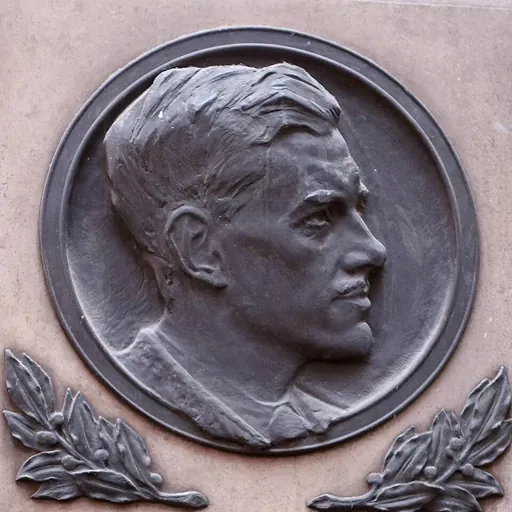
About Guy Alfred Wyon
Lived 1883 – 1924 (aged 40). Guy Alfred Wyon was a pathologist, known for TNT.
Guy Alfred Wyon (15 October 1883 – 2 March 1924) MD, BSc. was an English pathologist, researcher and lecturer, focusing mainly on bacterial growth and producing papers on the subject.
Before the First World War he was a house physician and surgeon. During the war he was seconded to the Medical Research Council and took an active part in the three-man team which discovered the mode of entry of potentially-lethal TNT poisoning into the human system in British shell factories, and used that knowledge to implement a method of prevention of further deaths. In 1917 he served in a Casualty Clearing Station in France, and following the Armistice he was in control of a mobile laboratory in the Meuse Valley. After the war he became a demonstrator and then a lecturer at Leeds University, England, while continuing research.
Wyon was related to the Wyon family of sculptors and engravers associated with the Royal Mint. He married organist Emma Mildred "Ruby" Hitchcock, the daughter of a miller, and they had three sons, of whom one was a medical missionary. Wyon died in Leeds at age 40 of influenza and pneumonia.
Background
Wyon's 1924 memorial plaque by A.G. Wyon, at the old School of Medicine, Thoresby Place, Leeds Guy Alfred Wyon (Hampstead 15 October 1883 – Leeds 2 March 1924) MD, BSc, of 5 Spring Road, Headingley, West Yorkshire, England, was related to those members of the Wyon family of die-engravers and medallists who were associated with the Royal Mint.
On 18 July 1911 at the Free Church, Bures, Suffolk, Wyon married organist Emma Mildred "Ruby" Hitchcock (Sudbury 12 June 1879 – Thirsk 1973), a medical missionary. Wyon and his wife were both nonconformists. They had three sons, The others were Dr Peter Hitchcock Wyon (1913–2007), a medical practitioner, and William Allan Wyon (1921 – Beirut 25 May 1945).
Wyon died on 2 March 1924 aged 40 years, The funeral took place on 5 March 1924 at Lawnswood Crematorium, where his ashes were scattered in the Cemetery Copse behind the chapel. The Probate of 16 April 1924 states that he left . gross to his widow.
The tragedy of First World War female factory employees of shell factories dying of TNT poisoning, plus the subsequent prevention and remedy discovered by Moore, Wyon and Webster, was censored by the War Office for the sake of public morale until October 1921, when Moore published an article on the subject in the British Medical Journal. This article shed some light on Wyon's working conditions:
I [Benjamin Moore] seem to remember that along with my colleagues Wyon and Webster, I went down to a munition factory in a county somewhere in England where girls were dying of T.N.T. poisoning. (T.N.T. was trinitroluol, our most forceful explosive), and that there we studied the subject for several weeks, that we rubbed the poisonous substance into our own skins and suffered from the poisonous effects, that we worked as operators in the factory and were assisted by many willing helpers. Finally we discovered that only a certain percentage of persons was acutely susceptible to the poison, and these were persons who readily let it through their skins. We tracked out how such susceptible persons could be detected and sent on to other work, and we reported accordingly. For weeks and months no action was taken, and we were prevented by the censorship from making our discoveries known, and deaths kept on occurring till there was almost a stampede of labour. In one factory alone illness due to T.N.T. was costing over £1,000 a week. It was only when I threatened to stump round the munition centres and explain to the workers upon T.N.T. what was at the root of the evil that executive action was taken, and within two or three weeks there was not another fatal case of T.N.T. poisoning throughout the whole country. Until summer 1922 he was working in the bacteriology department, researching "nutritive requirements for bacterial growth, the reaction of culture media, and other problems of general bacteriology". His focus was the chemistry of bacterial growth, and several of his papers on the subject were published in medical journals.
In 1922 Wyon was promoted to a lectureship in pathology at Old Leeds School of Medicine, Thoresby Place, Leeds. That position included responsibility for the clinical laboratory in Leeds General Infirmary in Great George Street. "He addressed himself with special keenness to the chemical side of the work". When Wyon caught influenza, he was working on "the simplification and improvement of routine methods, the study of fundamental principles on which these were based, the establishment of normal standards". After he died, the Yorkshire Evening Post said, "Dr Wyon's work in Leeds has been most distinguished ... His colleagues deplore his loss most deeply".
The Journal of Pathology and Bacteriology said of him: Tall ... and of striking aspect, Wyon was of a very quiet and retiring disposition. At home and among his colleagues his keen sense of humour, his good temper, kindliness and unusual gentleness of character endeared him to all. Personal advancement was about the last thing in his thoughts; indeed he may be said to have sacrificed much, in a material sense, in the pursuit of his own high ideals.
Don’t just read it —
keep it.
Full-length biographies made to live with: read them, listen on the way to work, watch them tonight.
- E-book
- Audio
- Video
Instant download · yours to keep · every purchase keeps this site free
Important facts
People in Guy Alfred Wyon's life
Named in this biography and alive at the same time



Related people
Same field, nearest in time


Contemporaries
People whose lives overlapped Guy Alfred Wyon's



Frequently asked questions
Who was Guy Alfred Wyon?
English researcher
When was Guy Alfred Wyon born?
Guy Alfred Wyon was born on 15 October 1883 in Hampstead, London.
When did Guy Alfred Wyon die?
Guy Alfred Wyon died on 2 March 1924 in Leeds, West Riding of Yorkshire.
What was Guy Alfred Wyon's occupation?
Guy Alfred Wyon was a pathologist.
What was Guy Alfred Wyon known for?
Guy Alfred Wyon was known for TNT.
Sources & further reading
Cite this page
APA: Biography.guide. (2026). Guy Alfred Wyon. https://biography.guide/guy-alfred-wyon/
MLA: "Guy Alfred Wyon." Biography.guide, https://biography.guide/guy-alfred-wyon/.
Chicago: "Guy Alfred Wyon." Biography.guide. https://biography.guide/guy-alfred-wyon/.
Data last updated: 2026-09-23 · Spot an error? Report a correction.
Portrait: Wikimedia Commons · author & licence
Page generated 2026-09-27 05:05 UTC