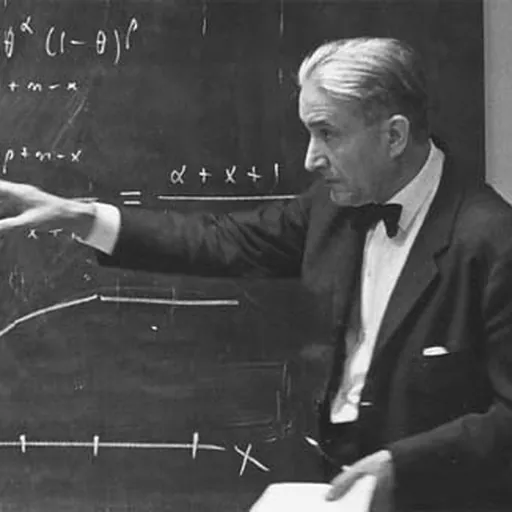
About Gustav Elfving
Lived 1908 – 1984 (aged 75). Gustav Elfving was a Finnish mathematician and statistician.
Erik Gustav Elfving (25 June 1908 – 25 March 1984) was a Finnish mathematician and statistician. He wrote pioneering works in mathematical statistics, especially on the design of experiments. In the same year he enrolled at the University of Helsinki, planning to major in astronomy. He switched to mathematics, graduating in 1930 in mathematics, with astronomy and physics as minor subjects. From 1927 to 1929, he worked as a computational assistant at the astronomical observatory of the University of Helsinki. He studied probability theory under J. W. Lindeberg, In the Nevanlinna theory of the values of meromorphic functions, Elfving's results were praised by Drasin .
Fiancée's death and his 1935 expedition to Greenland Elfving was engaged to a young woman, who died in 1935, probably from tuberculosis. The grieving parents of his fiancée helped Elfving contact the Danish Geodetic Institute, which hired him as the mathematician for a cartographic expedition to Western Greenland in the summer of 1935.
Statistical research
Other statistical contributions As a Professor at the University of Helsinki, Elfving was responsible for writing Finnish language texts, which were used for decades. In his texts and reviews, Elfving emphasized the decision-theoretic foundations of statistics, following Neyman, Pearson, and Wald, and recognized the value of Bayesian methods in statistics and also in operations research. Elfving introduced the statistical symbol for probabilistic independence ⊥⊥, which is a stronger condition than orthogonality ⊥, by the 1950s.
Elfving made notable contributions in many fields. In mathematics, he did research in complex analysis and probability theory (particularly Markov and point processes). In statistical theory, his most influential work was in optimal design, but he also worked in sampling theory, psychometrics, applied statistics, and the decision sciences (including decision theory, game theory, and Bayesian statistics). He also contributed to mathematics education by writing textbooks, book reviews, and popular science. He wrote papers and a book on the history of mathematics. Johann Fellman has studied optimal designs for nonsingular or nondifferentiable information functions as well economic theory, and genetics (particularly the frequency of twin births) and for his supervision of Kenneth Nordström and Katarina Juselius.
Academic and scientific offices
During 1938–1945, Elfving worked as a lecturer at the Helsinki University of Technology. During the academic year 1946–1947, Elfving served as locum tenens professor at Stockholm University. In 1948 Elfving became a Professor of Mathematics at the University of Helsinki succeeding Lars Ahlfors, who had moved to Harvard University. Elfving visited William Feller at Cornell University in 1949 and 1950. He was an invited plenary speaker at the Third Berkeley Symposium on Probability and Mathematical Statistics in 1955. That same year, he visited Columbia University in the Spring, at the invitation of Theodore W. Anderson, Herbert Robbins, and Herbert Solomon. He visited Solomon again at Stanford University during the fall of 1960 and the spring of 1966. He served on the editorial boards of three international journals: Probability Theory and Related Fields (1962–1975), The Annals of Mathematical Statistics (1964–1967), and Mathematica Scandinavica (1953–1972). Elfving had a deep sense of honor and propriety: When he resigned from the editorial boards following decades of service, he requested that he not be sent complimentary issues of the journals; when he failed to accomplish high levels of research, he offered to return the funding to the granting agency.
At the University of Helsinki from 1964 to 1975, Elfving acted as the "inspector" of the Åbo Nation, a Swedish-speaking "nation" at the University of Helsinki. In Finnish and Swedish universities, "nations" are student associations with similarities to fraternities or cooperatives; the inspector is a highly respected university officer, usually a senior professor, who officiates and delivers addresses at formal functions.
Don’t just read it —
keep it.
Full-length biographies made to live with: read them, listen on the way to work, watch them tonight.
- E-book
- Audio
- Video
Instant download · yours to keep · every purchase keeps this site free
Important facts
People in Gustav Elfving's life
Named in this biography and alive at the same time




Related people
Same field, nearest in time



Contemporaries
People whose lives overlapped Gustav Elfving's



Frequently asked questions
Who was Gustav Elfving?
Mathematical statistician (1908-1984)
When was Gustav Elfving born?
Gustav Elfving was born on 25 June 1908 in Helsinki.
When did Gustav Elfving die?
Gustav Elfving died on 25 March 1984 in Helsinki.
What was Gustav Elfving's occupation?
Gustav Elfving was a mathematician and statistician.
What nationality was Gustav Elfving?
Gustav Elfving was Finnish.
Sources & further reading
Cite this page
APA: Biography.guide. (2026). Gustav Elfving. https://biography.guide/gustav-elfving/
MLA: "Gustav Elfving." Biography.guide, https://biography.guide/gustav-elfving/.
Chicago: "Gustav Elfving." Biography.guide. https://biography.guide/gustav-elfving/.
Data last updated: 2026-09-21 · Spot an error? Report a correction.
Portrait: Wikimedia Commons · author & licence
Page generated 2026-09-27 05:00 UTC