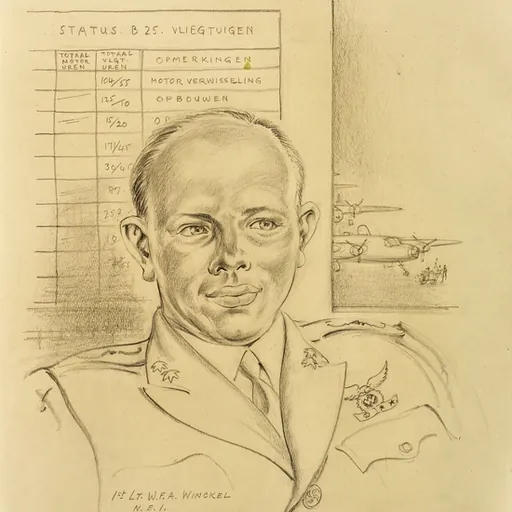
About Gus Winckel
Lived 1912 – 2013 (aged 100). Gus Winckel was a Dutch aircraft pilot.
Willem Frederick August "Gus" Winckel (3 November 1912 – 17 August 2013) was a Dutch military officer and pilot who flew for the Royal Netherlands East Indies Air Force (ML-KNIL) in World War II. During the attack on Broome, Western Australia, on 3 March 1942, Winckel managed to land his plane full of refugees safely on the Broome airstrip just before the Japanese attack. He then dismounted the plane's machine gun and shot down one of the Japanese fighters, the only Allied "kill" during the attack.
Shortly after the attack on Broome, Winckel was sent on a mission to Bandung, Java, to recover several officers from the Allied headquarters, which was under threat of being overrun. He served the remainder of the war with No. 18 (Netherlands East Indies) Squadron RAAF in Australia. After World War II, he fought in the Dutch Politionele acties.
Early life Winckel was born on 3 November 1912 in Muntok, Bangka Island, in what was then the Dutch East Indies. On the island his parents ran a trading store in commodities such as rubber, tin and sugar. Winckel had an untroubled childhood and at age fifteen was sent back to the Netherlands to study at the nautical school in Delfzijl. He stayed with his grandparents while studying, and three years later became a seaman first class for the merchant marine. He specialised in navigation. Winckel saw the danger of his plane being on the open airstrip and proceeded to dismount the Colt 7.99mm machine gun from the plane. When one of the Zeros, piloted by Osamu Kudō, flew over at low altitude, Winckel managed to shoot him out of the air; the crash killed Kudō. Winckel was thereby credited with the raid's only "kill" on the Allied side. He also believed that he hit another Japanese plane that had to ditch in the sea. His hand was treated and Winckel flew medical evacuations for the next two days without rest.
Meanwhile, Japanese forces were taking over Java and threatening the Allied headquarters at Bandung. On 5 March, the Allied command decided that several senior RAF and RAAF officers had to be evacuated from Bandung. Winckel was chosen as the pilot. He protested the decision, arguing that his lack of rest would hinder his chances of finding Bandung in the dark as he did not have any electronic aids. Winckel flew to Java, where he managed to land his plane on a road lit by jeep headlights. He picked up fourteen passengers, refuelled the plane and successfully returned to Australia. From Moruya he patrolled the Eastern Australian shore. At the end of May 1942, a Japanese midget submarine attacked Sydney Harbour. Winckel and his fellow pilots were subsequently ordered to patrol for submarines. During a patrol on 5 June 1942, Winckel attacked what he believed was a Japanese submarine in his B-25 Mitchell bomber. This was one of a large number of claimed successes against Japanese submarines during this period. However, postwar research indicates that no Japanese submarines were sunk off the Australian east coast during the war. Winckel spent the rest of the war with No. 18 Squadron and served from MacDonald Airfield and Batchelor Airfield in Northern Australia as a pilot on operations, and as an instructor working in Canberra. During the war, he was nicknamed "Lucky Bill" by his colleagues and "Babyface Killer" by the Japanese.
Post-war life After the war, Winckel was sent back to Indonesia to fight in the Dutch Politionele acties.
Don’t just read it —
keep it.
Full-length biographies made to live with: read them, listen on the way to work, watch them tonight.
- E-book
- Audio
- Video
Instant download · yours to keep · every purchase keeps this site free
Important facts
People in Gus Winckel's life
Named in this biography and alive at the same time


Related people
Same field, nearest in time



Contemporaries
People whose lives overlapped Gus Winckel's





Frequently asked questions
Who was Gus Winckel?
Dutch World War II hero (1912-2013)
When was Gus Winckel born?
Gus Winckel was born on 3 November 1912 in Mentok.
When did Gus Winckel die?
Gus Winckel died on 17 August 2013 in Pukekohe.
What was Gus Winckel's occupation?
Gus Winckel was an aircraft pilot.
What nationality was Gus Winckel?
Gus Winckel was Dutch.
Sources & further reading
Cite this page
APA: Biography.guide. (2026). Gus Winckel. https://biography.guide/gus-winckel/
MLA: "Gus Winckel." Biography.guide, https://biography.guide/gus-winckel/.
Chicago: "Gus Winckel." Biography.guide. https://biography.guide/gus-winckel/.
Data last updated: 2026-09-20 · Spot an error? Report a correction.
Portrait: Wikimedia Commons · author & licence
Page generated 2026-09-27 04:57 UTC