
About Guru Ram Das
Lived 1534 – 1581 (aged 46). Guru Ram Das was a clergyman, religious leader and writer.
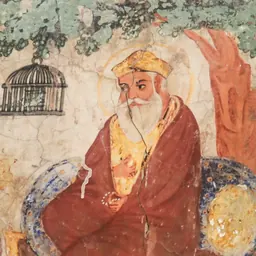
Guru Ram Das (Gurmukhi: ਗੁਰੂ ਰਾਮ ਦਾਸ, pronunciation: ; 24 September 1534 – 1 September 1581), sometimes spelled as Guru Ramdas, was the fourth of the ten Sikh gurus. He was born to a family based in Lahore. His birth name was Jetha, and he was orphaned at age seven; he thereafter grew up with his maternal grandmother in a village.
Renamed Ram Das ("servant of God"), Bhai Jetha became the fourth Guru of Sikhism in 1574. He faced hostility from the sons of Guru Amar Das, and shifted his official base to lands identified by Guru Amar Das as Guru-ka-Chak. He served until his death in 1581.
Early life
Family background and life in Lahore The Gurdwara Janam Asthan Guru Ram Das in Lahore, Pakistan, commemorates the birthplace of the Guru. Bhai Jetha was born in the morning of 24 September 1534 in a family belonging to the Sodhi gotra (clan) of the Khatri caste in Chuna Mandi, Lahore. His father was Hari Das and his mother was Mata Anup Devi (also known later-on as Anup Kaur or Daya Kaur He was named "Jetha" because he was the eldest child among his siblings.
Anup Devi would give her son boiled grams to sell at the market. One day, Ram Das instead went to the bank of the Ravi river and fed gathered sanyasis, an episode reminiscent of Guru Nanak's sacha sauda. Both of Jetha's parents died when he was aged around seven. He spent time with Guru Amar Das by accompanying him on religious pilgrimages.
Representing the Sikhs at the Mughal court Before becoming Guru, Jetha represented Guru Amar Das in the Mughal court. became known as Guru Ram Das, and held the office for seven years.
He was the first of Guru Nanak's successors to rekindle ties with Sri Chand, Nanak's son, after a long period of strained relations between mainstream Sikhs and the Udasis. thumb According to the Sikh historical records, the site was chosen by Guru Amar Das and called Guru Da Chakk, after he had asked Guru Ram Das to find land to start a new town with a man made pool as its central point. After his coronation in 1574, and the hostile opposition he faced from the sons of Guru Amar Das,
As per the instruction of his predecessor, Guru Ram Das also constructed two man-made pools of holy water (known as sarovars) in Guru-Da-Chak, with their names being Ramdas Sarovar and Amritsar Sarovar.
These cover a range of topics:
One who calls himself to be a disciple of the Guru should rise before dawn and meditate on the Lord's Name. During the early hours, he should rise and bathe, cleansing his soul in a tank of nectar [water], while he repeats the Name the Guru has spoken to him. By this procedure he truly washes away the sins of his soul. – GGS 305 (partial)The Name of God fills my heart with joy. My great fortune is to meditate on God's name. The miracle of God's name is attained through the perfect Guru, but only a rare soul walks in the light of the Guru's wisdom. – GGS 94 (partial)O man! The poison of pride is killing you, blinding you to God. Your body, the colour of gold, has been scarred and discoloured by selfishness. Illusions of grandeur turn black, but the ego-maniac is attached to them. – GGS 776 (partial)|Guru Granth Sahib|Translated by G. S. Mansukhani This was intermittently used, and its use lapsed in late 18th century. However, sometime in 19th or 20th century, by conflicting accounts, the composition of Guru Ram Das came back in use along with the Anand Karaj ceremony, replacing the Hindu ritual of circumambulation around the fire. The composition of Guru Ram emerged to be one of the bases of the British colonial era Anand Marriage Act of 1909.
Masand system While Guru Amar Das introduced the manji system of religious organization, Guru Ram Das extended it with adding the masand institution. However, the early Masand leaders tended to be hardworking and committed Sikhs. literally, "scoundrels"), and is alleged to have attempted to assassinate young Hargobind. However, alternate competing texts written by the Prithi Chand led Sikh faction to offer a different story, contradict this explanation on Hargobind's life, and present the elder son of Guru Ram Das as devoted to his younger brother Guru Arjan. The competing texts do acknowledge disagreement and describe Prithi Chand as having become the Sahib Guru after the martyrdom of Guru Arjan Dev and disputing the succession of Guru Hargobind, the grandson of Guru Ram Das.
Literature Guru Ram Das composed written works, which is preserved in the Guru Granth Sahib, known as gurbani. His style differs from that of his predecessor, whilst Guru Amar Das had a more conservative approach, possibly due to his older-age, the younger Guru Ram Das was more innovative in his poetry, such as the addition of new rāgs that the hymns were set to, where as Guru Amar Das utilized the same set of rāgs that Guru Nanak had employed in his compositions, and Guru Ram Das composing innovating rhythms. Furthermore, while the works of earlier gurus freely borrowed Persianate vocabulary, the works of Guru Ram Das show a move toward Sanskritic and Hindi vocabulary.
Bhai Jetha was already a trailblazer in Sikh literature; since he is the only Guru who has been featured in any of the pothis before becoming a Guru. The Goindwal Pothis all have neatly crossed out sections, which were done at a later point, in which there are fourteen songs by a man named Ghulam Sadasevak. It had confused many Sikh historians for centuries as it was the first time one had crossed out previously accepted canon. Ghulam Sadasevak is a Persian and Sanskrit pen-name, meaning "eternal servant of the Lord". In the Pinjore Pothi, within the hashiya (decorative margin), there is a title saying, "Your intoxicated slave, Jeth Chand", Jeth Chand being Guru Ram Das. The mainstreaming of a non-Guru in religious literature is very unusual, though it is possible Guru Amar Das had added the songs after it was declared Bhai Jetha was going to be the next Guru. The other possibility is that Bhai Jetha as a devotee wrote the songs and it was transcribed into the Pinjore pothi from his personal handbook. Though it is quite clear that while the songs were written, Bhai Jetha does not claim the position or persona of Guru Nanak (as did all Gurus, including Guru Ram Das after his Guruship), but devotes the beginning of the final verse to Guru Nanak.
Gallery
Don’t just read it —
keep it.
Full-length biographies made to live with: read them, listen on the way to work, watch them tonight.
- E-book
- Audio
- Video
Instant download · yours to keep · every purchase keeps this site free
Important facts
People in Guru Ram Das's life
Named in this biography and alive at the same time


Related people
Same field, nearest in time




Contemporaries
People whose lives overlapped Guru Ram Das's

Frequently asked questions
Who was Guru Ram Das?
guru of Sikhism
When was Guru Ram Das born?
Guru Ram Das was born on 24 September 1534 in Lahore.
When did Guru Ram Das die?
Guru Ram Das died on 1 September 1581 in Goindwal Sahib.
What was Guru Ram Das's occupation?
Guru Ram Das was a clergyman, religious leader and writer.
Sources & further reading
Cite this page
APA: Biography.guide. (2026). Guru Ram Das. https://biography.guide/guru-ram-das/
MLA: "Guru Ram Das." Biography.guide, https://biography.guide/guru-ram-das/.
Chicago: "Guru Ram Das." Biography.guide. https://biography.guide/guru-ram-das/.
Data last updated: 2026-09-20 · Spot an error? Report a correction.
Page generated 2026-09-27 05:24 UTC