
About Günter Gaus
Lived 1929 – 2004 (aged 74). Günter Gaus was a German journalist, politician, diplomat, actor and secretary of state.
Günter Gaus (23 November 1929 – 14 May 2004) was a prominent German journalist-commentator who became a diplomat and (very briefly) a regional politician in Berlin. Once he had moved on – as he probably assumed, permanently – from the worlds of print journalism and television, in 1976 Günter Gaus joined the Social Democratic Party. The party's leader (and former chancellor), Willy Brandt, was a close political ally and a friend. Gaus let it be known that he had resigned his party membership towards the end of 2001, after Chancellor Schröder had incautiously – and "without consulting the party" – pledged "unconditional/unlimited solidarity" ("bedingungslose/uneingeschränkte Solidarität") with the United States of America during the build-up to that year's United States invasion of Afghanistan.
Life Provenance and early years Gaus was born and grew up in Braunschweig where his parents, Willi and Hedwig Gaus, owned and ran a successful fruit and vegetable retail business. Alongside the conventional greengrocer merchandise there was a complementary specialist section with a focus on exotic fruits. Many years later his journalist daughter would tell an interviewer that wartime experiences of innumerable nights spent in bomb shelters and, in particular, of the destructive English air attack of 15 October 1944, would have a lasting impact on the child. Gaus was born a couple of months too early to avoid more active participation in a war. Shortly before it ended he was sent for two weeks as part of a large schoolboy contingent to the Netherlands "to dig trenches" (intended, it would appear, to serve as "tank traps"). He was then assigned to walk the streets of his home town and the surrounding countryside in the company of other equally bemused reluctant soldiers "equipped with anti-tank weaponry and pistols". He nevertheless avoided any more personal "enemy encounters".
School years and war May 1945 saw a return to peace and the start of a period of military occupation. Magdeburg, a short distance to the east, was administered as part of the Soviet occupation zone (relaunched in 1949 as the German Democratic Republic / East Germany) but Braunschweig found itself under British occupation. Günter Gaus was able to complete his schooling close to his parents' home at the confusingly named "Gymnasium Gaussschule" (secondary school). In 1947 he became editor-in-chief of "Der Punkt", one of the first "schoolboy newspapers" in post-war Germany. He then found time, in 1949, to pass his Abitur thereby opening the way to university admission. Gaus had already resolved to become a journalist, and before progressing to university he undertook what amounted to an informal internship with the Braunschweiger Zeitung. Soon after his arrival he switched to a course in journalism. During this period he came to the attention of the pioneering media magnate Rudolf Augstein who assiduously – and in the end successfully – sought to recruit him for a job as a political editor at Der Spiegel in Hamburg. Still not quite 29, Günter Gaus made the move to West Germany's leading centre-right political weekly in 1958. In the words of one admirer he turned Spiegel into the "Strafbataillon des deutschen Journalismus" (loosely, "punishment battalion of German journalism"). In 1961 he moved on again, this time joining Süddeutsche Zeitung which, despite its Munich base, is one of the few daily newspapers with a powerful reach throughout (and beyond) Germany. Gaus worked for Süddeutsche Zeitung as the newspaper's political editor between 1961 and 1965.
Marriage During his time with Deutsche Zeitung und Wirtschaftszeitung, Gaus married Erika Butzengeiger at Munich in 1955. A couple of years younger than her husband, Erika Gaus is a daughter of the former bank manager. She succeeded in keeping out of the limelight that frequently surrounded her husband. The couple's daughter, Bettina Gaus, was born towards the end of 1956 and has followed her father into a career as a high-profile political journalist.
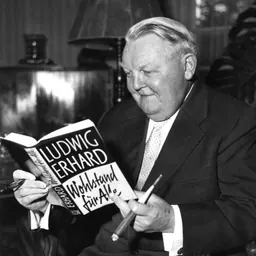
Television On 10 April 1963, the German public television broadcaster ZDF transmitted the first episode of the series called "Zur Person – Porträts in Frage und Antwort". To paraphrase a later tribute from Rudolf Augstein, the show quickly became the medium whereby Günter Gaus launched himself on a completely new and very public career as a television interviewer, and before there were even talk shows (at least in Germany). The programmes were described in the series title as "portraits in questions and answers". Each programme was devoted to a single individual. The interviewee of the launch episode was Ludwig Erhard, the minister for economic affairs, who later became chancellor, widely celebrated by his admirers as an author of West Germany's post-war "economic miracle". By the time the series came to an end, Gaus had interviewed more than 250 personalities, many from the world of politics, though representatives of the arts and philosophy were also enticed into the studios. Aside from Erhard, some of the programme's best remembered subjects were Franz Josef Strauss, Christian Klar, Hannah Arendt, and Rudi Dutschke. Many of the interviews are remembered as classics of their kind, and repeats of them still run on German television more than fifty years later. The design of the television studios was deliberately minimalist, with nothing visible except a dark background, behind two armchairs containing two people. The focus was on the interviewee. When Gaus was seen at all, it was generally only from behind, so that he acquired the oft-repeated soubriquet "Germany's best-known back of the head". He also quickly acquired a reputation as a remarkable television interviewer. His questions were sharp and analytical: not infrequently they seemed disarmingly naive. One reviewer wrote: "After almost every interview, you really have the feeling of now knowing a person better about whom you previously only knew this and that: just as if you had read a detailed biography."
Return to Der Spiegel During the mid-1960s he produced a number of well-received books on the political situation in West Germany at that time; and in 1969, having successfully persuaded him back to Der Spiegel, Rudolf Augstein installed Günter Gaus as editor-in-chief. Despite having no party membership or acknowledged party loyalties, over the next few years Gaus used the avenues available to him – principally but not solely through Der Spiegel – to turn himself into one of the most influential media backers of Chancellor Brandt's still contentious pursuit of normalised relations between East and West Germany (known to historians and others as Willy Brandt's "Ostpolitik").
Permanent representative of the West German government in East Berlin
In 1973 Gaus made an abrupt switch to a form of politics, accepting a post as Secretary of state in the Chancellor's Office. The chancellor's intention was that Gaus should take on a quasi-diplomatic role in respect of the intensively political issues surrounding Intra-German relations. Everything involved in relations between West Germany and East Germany was complicated by the fact that legally – and in the eyes of conservatives on both sides of the divide, politically – there was no mutual recognition between the two "states". There could be no question of appointing an ambassador or even a conventional "chargé d'affaires" to a country that did not, under West German law, exist as a separate entity. Contemporary and subsequent sources tend to describe the posting as something along the lines "the first head of the permanent representation of the Federal Republic of Germany in the German Democratic Republic". Appropriate changes to the (West) German constitutional "Basic law", following laborious negotiations, entered into legal force for most purposes at the end of 1973. On 2 May 1974 West Germany's "Permanent Representation" office opened at Hannoversche Straße 28–30 in East Berlin under the direction of Günter Gaus. He retained the posting till 1981, despite the resignation from the chancellorship of Willy Brandt at around the same time as the mission was opened. Gaus' relationship with Brandt's successor as chancellor, Helmut Schmidt, was never a particularly easy one. There was also a more wide-ranging agreement on facilitating transit through East Germany between West Germany and West Berlin. A particular visible aspect of this agreement came in October 1979 with the abolition of road tolls for motorists undertaking the journey. However, the election results in the regional elections of February 1981 had deprived the SPD of an overall senate majority in West Berlin: in June 1981 the SPD Vogel senate was replaced by the (coalition-based) CDU-FDP Weizsäcker senate. Gaus returned to his former life as a respected political journalist-commentator. During the 1980s, in the words of one supportive commentator, "he wrote and wrote, determined to explain what the German Democratic Republic and 'Germany overall' were all about". In political terms, Günter Gaus felt he was becoming increasingly distanced from the mainstream following reunification, the manner of which he continued to deplore in print. He opposed what he saw as the casual militarisation of German foreign policy, and was deeply critical of Germany's participation in the Yugoslav Wars and the Iraq War during the 1990s. He also criticised the malign aspects of globalisation during the final years of the twentieth century, condemning so-called "natural law" justifications for the globalising market economy"... angeblichen Naturgesetz der globalisierten Marktwirtschaft ..."
"Widersprüche", the memoire on which Gaus had been working when he died, was published – still unfinished – at the end of 2004.
Awards (selection)
Output (selection) Bonn ohne Regierung? Kanzlerregiment und Opposition. Bericht, Analyse, Kritik. Piper, München 1965. Staatserhaltende Opposition oder hat die SPD kapituliert? Gespräche mit Herbert Wehner. Rowohlt, Reinbek bei Hamburg 1966.
Don’t just read it —
keep it.
Full-length biographies made to live with: read them, listen on the way to work, watch them tonight.
- E-book
- Audio
- Video
Instant download · yours to keep · every purchase keeps this site free
Important facts
Family & relationships
People in Günter Gaus's life
Named in this biography and alive at the same time



Related people
Same field, nearest in time


Contemporaries
People whose lives overlapped Günter Gaus's


Frequently asked questions
Who was Günter Gaus?
German journalist, politician and diplomat (1929-2004)
When was Günter Gaus born?
Günter Gaus was born on 23 November 1929 in Brunswick.
When did Günter Gaus die?
Günter Gaus died on 21 May 2004 in Altona.
What was Günter Gaus's occupation?
Günter Gaus was a journalist, politician, diplomat, actor and secretary of state.
What nationality was Günter Gaus?
Günter Gaus was German.
Sources & further reading
Cite this page
APA: Biography.guide. (2026). Günter Gaus. https://biography.guide/gunter-gaus/
MLA: "Günter Gaus." Biography.guide, https://biography.guide/gunter-gaus/.
Chicago: "Günter Gaus." Biography.guide. https://biography.guide/gunter-gaus/.
Data last updated: 2026-09-26 · Spot an error? Report a correction.
Page generated 2026-09-27 05:15 UTC