
About Günter Fink
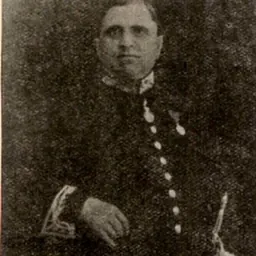
Lived 1918 – 1943 (aged 25). Günter Fink was a military personnel.
Günter Fink (17 March 1918 – 15 May 1943) was a German Luftwaffe ace and recipient of the Knight's Cross of the Iron Cross during World War II. The Knight's Cross of the Iron Cross, and its variants were the highest awards in the military and paramilitary forces of Nazi Germany during World War II. Fink was killed on 15 May 1943 after engaging in aerial combat with Boeing B-17 Flying Fortress bombers. During his career he was credited with 46 aerial victories, all on the Eastern Front.
Early life and career Fink was born on 17 March 1918 in Spandau, now a borough of Berlin, in the German Empire. He joined the military of service of the Luftwaffe and following flight and fighter pilot training in October 1942, Fink was posted to I. Gruppe (1st group) of Jagdgeschwader 77 (JG 77—77th Fighter Wing).
World War II World War II in Europe began on Friday 1 September 1939 when German forces invaded Poland. Flying with JG 77, Fink flew missions over southern Germany and in Invasion of Poland. In late 1940, Fink was transferred to the III. Gruppe of Jagdgeschwader 54 (JG 54—54th Fighter Wing). On 29 March 1941, the Gruppe was ordered to Graz-Thalerhof in preparation for the Balkans campaign.
On 20 April, III. Gruppe was withdrawn from combat operation, relocating to Belgrad-Semlin. On 4 May, the Gruppe began its transfer to Airfield Stolp-Reitz in Pomerania, present-day Słupsk, by train, arriving at Stolp-Reitz on 10 May.
Operation Barbarossa At Stolp-Reitz, JG 54 upgraded their aircraft to the Messerschmitt Bf 109 F-2. For the next four weeks, the pilots familiarized themselves with the new aircraft before on 15 June, III. Gruppe was ordered to Blumenfeld in East Prussia, present-day Karczarningken in the Kaliningrad Oblast, in preparation for Operation Barbarossa, the invasion of the Soviet Union. During the upcoming invasion, JG 54 would be deployed in the area of Army Group North, was subordinated to I. Fliegerkorps (1st Air Corps) and supported the 16th and 18th Army as well as the Panzer Group 4 in their strategic objective to reach Leningrad.
On 29 June, III. Gruppe relocated to Daugavpils, known as Dünaburg to the Germans, to provide fighter protection for German ground forces crossing the Daugava. Here on 5 July, Fink claimed his first aerial victory, an I-18 which was an early war Luftwaffe designation for the Mikoyan-Gurevich MiG-1 fighter.
In June 1942, Fink flew night fighter combat missions on the Eastern Front. On the night of 7/8 June, he claimed four Polikarpov R-5 bombers shot down. In the night of 10/11 June, he was credited with the destruction of three further R-5 bombers destroyed and a Lisunov Li-2 also known as a PS-84. The next night, Fink again claimed a R-5 bomber shot down followed by a further PS-84 claimed on the night of 14/15 June. He claimed his last nocturnal aerial victory on the night 24/25 June, another R-5 bomber, taking his total to eleven nocturnal aerial victories claimed.
On 9 August 1942, Fink was appointed Staffelkapitän (squadron leader) of 8. Staffel of JG 54, succeeding Oberleutnant Max-Hellmuth Ostermann who had been killed in action. Fink had already temporarily led the Staffel from 12 May until early August while Ostermann was on home-leave.
Defense of the Reich and death In mid-February 1943, III. Gruppe of JG 54 was withdrawn from the Eastern Front and ordered to Vendeville, France where it was subordinated to the Geschwaderstab (headquarters unit) of Jagdgeschwader 26 "Schlageter" (JG 26—26th Fighter Wing). The Gruppe was equipped with the Bf 109 G-4 armed with 20 mm MG 151/20 cannons installed in conformal gun pods under the wings. The original plan was to exchange JG 26 which had been fighting on the Western Front with JG 54. The plan was cancelled in March. Instead of III. Gruppe of JG 54 returning to the Eastern Front, the Gruppe was ordered to Bad Zwischenahn on 25 March and then to Oldenburg Airfield two days later. Here, the Gruppe was subordinated to the 2. Jagd-Division (2nd Fighter Division) which was fighting in defense of the Reich.
On 14 March 1943, Fink had been awarded the Knight's Cross of the Iron Cross for 46 aerial victories claimed. Fink was posted as missing in action following aerial combat with United States Army Air Forces Boeing B-17 Flying Fortress bombers on 15 May 1943. His Bf 109 G-4 (Werknummer 14961—factory number) was last seen in a location south of Heligoland over the North Sea. VIII Bomber Command had attacked Emden and Wilhelmshaven. Elements of the 1st Bombardment Wing failed to find their targets, thus mainly attacking Heligoland with a few bombers dropping bombs on Wangeroog and Emden. III. Gruppe had been scrambled at 10:05 and intercepted the bombers shortly before they reached Heligoland. In the resulting encounter, five B-17 bombers were claimed shot down. Three bombers were later confirmed destroyed while two remained unconfirmed, for the loss of four Bf 109s, including Fink and Leutnant Friedrich Rupp from 7. Staffel. In consequence, command of 8. Staffel was passed on to Oberleutnant Rudolf Patzak.
Summary of career Aerial victory claims According to Obermaier, Fink was credited with 46 aerial victories. Mathews and Foreman, authors of Luftwaffe Aces — Biographies and Victory Claims, researched the German Federal Archives and found records for 48 aerial victory claims, all of which claimed on the Eastern Front.
Victory claims were logged to a map-reference (PQ = Planquadrat), for example "PQ 25 Ost 2812". The Luftwaffe grid map covered all of Europe, western Russia and North Africa and was composed of rectangles measuring 15 minutes of latitude by 30 minutes of longitude, an area of about . These sectors were then subdivided into 36 smaller units to give a location area in size.
Awards Iron Cross (1939) 2nd and 1st Class Honor Goblet of the Luftwaffe on 3 August 1942 as Oberleutnant and pilot German Cross in Gold on 27 October 1942 as Oberleutnant in the III./Jagdgeschwader 54 Knight's Cross of the Iron Cross on 14 March 1943 as Oberleutnant and pilot in the 8./Jagdgeschwader 54
Don’t just read it —
keep it.
Full-length biographies made to live with: read them, listen on the way to work, watch them tonight.
- E-book
- Audio
- Video
Instant download · yours to keep · every purchase keeps this site free
Important facts
People in Günter Fink's life
Named in this biography and alive at the same time


Related people
Same field, nearest in time





Contemporaries
People whose lives overlapped Günter Fink's


Frequently asked questions
Who was Günter Fink?
German fighter ace and Knight's Cross recipient (1918–1943)
When was Günter Fink born?
Günter Fink was born on 17 March 1918 in Berlin.
When did Günter Fink die?
Günter Fink died on 15 May 1943 in Heligoland.
What was Günter Fink's occupation?
Günter Fink was a military personnel.
What nationality was Günter Fink?
Günter Fink's recorded nationality: German Reich.
Sources & further reading
Cite this page
APA: Biography.guide. (2026). Günter Fink. https://biography.guide/gunter-fink/
MLA: "Günter Fink." Biography.guide, https://biography.guide/gunter-fink/.
Chicago: "Günter Fink." Biography.guide. https://biography.guide/gunter-fink/.
Data last updated: 2026-09-20 · Spot an error? Report a correction.
Page generated 2026-09-27 04:59 UTC