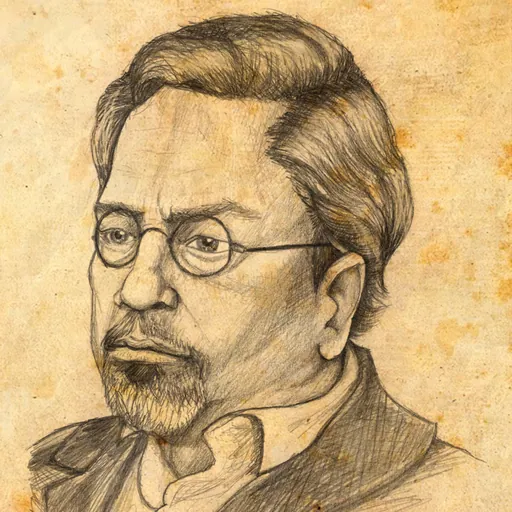
About Guillermo Cabrera Infante
Lived 1929 – 2005 (aged 75). Guillermo Cabrera Infante was a British, Cuban and Spanish linguist, screenwriter, translator, essayist, writer and journalist.
Guillermo Cabrera Infante (; Gibara, 22 April 1929 – 21 February 2005) was a Cuban novelist, essayist, translator, screenwriter, and critic; in the 1950s, he used the pseudonym G. Caín, and he used Guillermo Cain for the screenplay of the cult classic film Vanishing Point.
A one-time supporter of the politics of Fidel Castro, Cabrera Infante went into exile to London in 1965. He is best known for the novel Tres tristes tigres (literally: "three sad tigers", published in English as Three Trapped Tigers), which has been compared favorably to James Joyce's Ulysses.
Biography Born in Gibara in Cuba's former Oriente Province (now part of Holguín Province), in 1941, he moved with his parents to Havana, which would be the setting of nearly all of his writings other than his critical works. His parents were founding members of the Cuban Communist Party.
Originally, he intended to become a physician, but he abandoned that in favor of writing and his passion for the cinema. Starting in 1950, he studied journalism at the University of Havana. Under the Batista regime, he was arrested and fined in 1952 for publishing a short story which included several English-language profanities. His opposition to Batista later cost him a short jail term.
He married for the first time in 1953. From 1954 to 1960, he wrote film reviews for the magazine Carteles, using the pseudonym G. Caín; he became its editor in chief, still pseudonymously, in 1957. With the triumph of the Cuban Revolution in 1959, he was named director of the Instituto del Cine. He was also head of the literary magazine Lunes de Revolución, a supplement to the Communist newspaper Revolución; however, this supplement was prohibited in 1961 by Fidel Castro.
He divorced in 1961 and in the same year married his second wife, Miriam Gomez, an actress. Having fallen somewhat out of favor with the Castro regime (the government's ban on a documentary on Havana nightlife made by his brother led to his being forbidden to publish in Cuba), he served as a cultural attaché in Brussels, Belgium, from 1962 to 1965. During this time, his sentiments turned against the Castro regime; after returning to Cuba for his mother's funeral in 1965, he went into exile, first in Madrid, then in London.
In 1966, he published Tres tristes tigres, a highly experimental, Joycean novel, playful and rich in literary allusions, which intended to do for Cuban Spanish what Mark Twain had done for American English, recording the great variety of its colloquial variations. It won the 1964 Premio Biblioteca Breve for best unpublished novel.
He co-wrote the script for Richard C. Sarafian's 1971 cult film Vanishing Point under the pseudonym Guillermo Caín.
Although he is considered a part of the famed Latin American Boom generation of writers that includes his contemporary Gabriel García Márquez, he disdained the label. Ever an iconoclast, he even rejected the label "novel" to describe his most acclaimed works, such as Tres tristes tigres and La Habana para un infante difunto. He was influential to Puerto Rican and Cuban writers such as Luis Rafael Sánchez (La guaracha del Macho Camacho) and Fernando Velázquez Medina (Última rumba en La Habana).
In 1997, he received the Premio Cervantes, presented to him by King Juan Carlos of Spain. He died on February 21, 2005, in London, of sepsis. He had two daughters from his first marriage.
Don’t just read it —
keep it.
Full-length biographies made to live with: read them, listen on the way to work, watch them tonight.
- E-book
- Audio
- Video
Instant download · yours to keep · every purchase keeps this site free
Important facts
People in Guillermo Cabrera Infante's life
Named in this biography and alive at the same time





Related people
Same field, nearest in time



Contemporaries
People whose lives overlapped Guillermo Cabrera Infante's
Frequently asked questions
Who was Guillermo Cabrera Infante?
Cuban writer
When was Guillermo Cabrera Infante born?
Guillermo Cabrera Infante was born on 22 April 1929 in Gibara.
When did Guillermo Cabrera Infante die?
Guillermo Cabrera Infante died on 21 February 2005 in London.
What was Guillermo Cabrera Infante's occupation?
Guillermo Cabrera Infante was a linguist, screenwriter, translator, essayist, writer and journalist.
What nationality was Guillermo Cabrera Infante?
Guillermo Cabrera Infante was British, Cuban and Spanish.
Sources & further reading
· Wikipedia: Guillermo Cabrera Infante
· DBpedia: Guillermo Cabrera Infante
Cite this page
APA: Biography.guide. (2026). Guillermo Cabrera Infante. https://biography.guide/guillermo-cabrera-infante/
MLA: "Guillermo Cabrera Infante." Biography.guide, https://biography.guide/guillermo-cabrera-infante/.
Chicago: "Guillermo Cabrera Infante." Biography.guide. https://biography.guide/guillermo-cabrera-infante/.
Data last updated: 2026-09-22 · Spot an error? Report a correction.
Portrait: Wikimedia Commons · author & licence
Page generated 2026-09-27 05:03 UTC