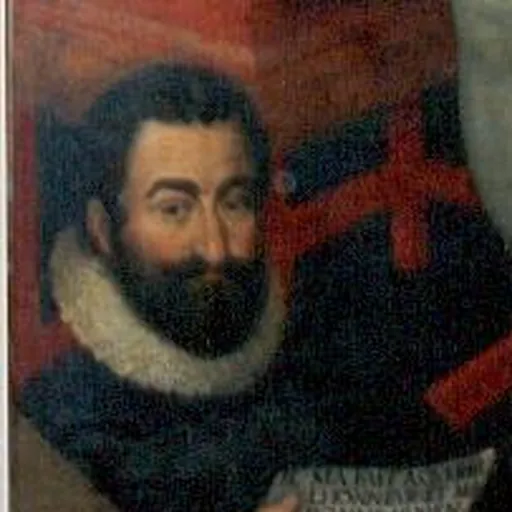
About Guillaume Fouquet de la Varenne
Lived 1560 – 1616 (aged 55–56). Guillaume Fouquet de la Varenne was a chef and diplomat.
Arms of Fouquet de la Varenne : "Gules, a sighthound statant argent, with a collier of France" Guillaume Fouquet de la Varenne (1560 in La Flèche – 7 December 1616) was a French chef who became an important statesman in the service of Henry IV.
Biography Guillaume Fouquet was born into a bourgeois family in La Flèche (France, Loire valley). His father, Martin Fouquet, was master chef ("écuyer de cuisine") to Françoise d'Alençon, Duchess of Vendôme. Martin Fouquet served three generations of the family; following the duchess' death, he served her son, Antoine de Bourbon (1518–1562), husband of Jeanne III of Navarre (Jeanne d'Albret), and later their young son Henry of Navarre, the future Henry IV of France.
In 1578, at the age of 18, and with help from his father, Guillaume became a cook in the service of Catherine de Bourbon (1559–1604), sister of the future king. Impressed by the young man's personality and skill, in 1580 Catherine recommended him to her brother, and he subsequently became a portmanteau at the court of Henry IV.
For thirty years, until the King's assassination in 1610, Fouquet lived in the shadow of Henry IV, but nevertheless took an active part in important events of the realm. Confirming his reputation for skill and bravery and in spite of near-certain personal risk, he devoted himself completely to the causes of the king.
At the age of twenty he took part in the assault against the stronghold of Angoulême held by the League and captured the lieutenant of the city. In 1587 he distinguished himself at the battle of Coutras. He fought against the Leaguers of the Duke of Mayenne at the battle of Arques (1589) and the battle of Ivry (1590), scoring victories that opened access to Paris for the future monarch of France. Henry, who abjured his Protestant faith in 1593 and was crowned in Chartres in 1594, entrusted Fouquet with public diplomatic missions as well as confidential matters.
Henry IV and the royal family. Below left, Fouquet de la Varenne. Attributed to Frans Pourbus the Younger Fouquet is holding a paper on which is written: "He made me to acquire honor and gave me kindness". In early June 1595, Fouquet saved Henry's life at the Battle of Fontaine-Française. He was appointed as Commissary of War, and later as Comptroller General of Posts, replacing Hugues Du Mas, a member of the House of Guise. He re-organized the postal network and in 1598 contributed to the creation of the modern French public postal services by opening up the royal postal service to the public, in commemoration of which a stamp bearing his likeness was issued by the French Post Office in 1946.
The King's sister, Catherine de Bourbon, Duchess of Bar and wife of Henry II, Duke of Lorraine, once said to Fouquet, whom she had known as a cook: "It seems, la Varenne, that you have earned more by carrying my brother's chickens (i.e.: his messages) than by skewering mine."
A close friendship united the king and his favorite since the first battle against the Leaguers on the battlefields of Ivry and Fontaine-Française. "Dear heart, La Varenne has found me in bed again," wrote Henry IV to Marie de Medici in 1606. On the other hand, Henry's relations with Maximilien de Béthune, Duke of Sully were not as trusting. Sully disliked the king and denounced his vain ambition. Fouquet's influence, however, increased up until the final years of Henry's reign.
During his career, Fouquet also served as a counselor to the Parliament of Paris, Master of the Requests of the King (State Councillor), Governor of the town and castle of La Flèche (1592), Governor of the town and castle of Angers (28 August 1604), and later Lieutenant General of the province of Anjou (1613). Fouquet also donated to the ecclesiastical abbeys of Ainay (near Lyon), Saint-Benoit-sur-Loire, Saint-Nicolas d'Angers, Saint-Loup de Troyes, and the Esvière priory near Angers.
His first marriage to Catherine Foussard, who died in 1605, brought him the lands of La Varenne as her dowry. Guillaume Fouquet had several sons. He was knighted in 1598 and carried the title of Baron of Sainte-Suzanne, and later, in 1616, he was made Marquis de Sainte-Suzanne and La Flèche.
The land attached to Saint-Romans in Poitou had previously been elevated into a barony for Fouquet and his second wife, Jeanne de Poix, citing "services rendered by them in acts wars, or in several other ways".
Don’t just read it —
keep it.
Full-length biographies made to live with: read them, listen on the way to work, watch them tonight.
- E-book
- Audio
- Video
Instant download · yours to keep · every purchase keeps this site free
Important facts
People in Guillaume Fouquet de la Varenne's life
Named in this biography and alive at the same time
Related people
Same field, nearest in time



Contemporaries
People whose lives overlapped Guillaume Fouquet de la Varenne's
Frequently asked questions
Who was Guillaume Fouquet de la Varenne?
French chef
When was Guillaume Fouquet de la Varenne born?
Guillaume Fouquet de la Varenne was born in 1560 in La Flèche.
When did Guillaume Fouquet de la Varenne die?
Guillaume Fouquet de la Varenne died on 7 December 1616 in La Flèche.
What was Guillaume Fouquet de la Varenne's occupation?
Guillaume Fouquet de la Varenne was a chef and diplomat.
Sources & further reading
· Wikipedia: Guillaume Fouquet de la Varenne
· DBpedia: Guillaume Fouquet de la Varenne
Cite this page
APA: Biography.guide. (2026). Guillaume Fouquet de la Varenne. https://biography.guide/guillaume-fouquet-de-la-varenne/
MLA: "Guillaume Fouquet de la Varenne." Biography.guide, https://biography.guide/guillaume-fouquet-de-la-varenne/.
Chicago: "Guillaume Fouquet de la Varenne." Biography.guide. https://biography.guide/guillaume-fouquet-de-la-varenne/.
Data last updated: 2026-09-26 · Spot an error? Report a correction.
Portrait: Wikimedia Commons · author & licence
Page generated 2026-10-04 11:11 UTC