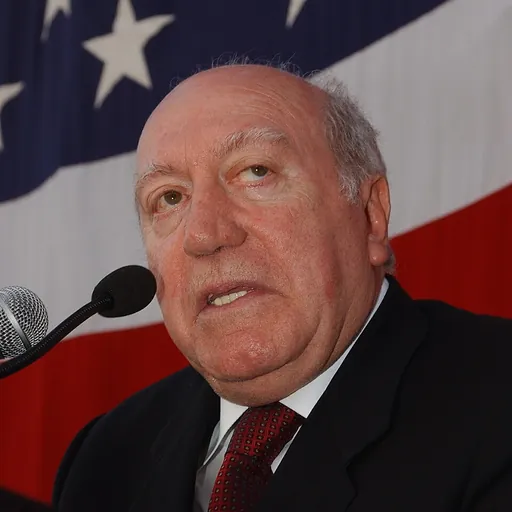
About Guido de Marco
Lived 1931 – 2010 (aged 79). Guido de Marco was a Maltese diplomat, university teacher and politician.
Guido de Marco (22 July 1931 – 12 August 2010) was a Maltese politician, who served as the sixth president of Malta from 1999 to 2004. A noted statesman and lawmaker, de Marco also served as Deputy Prime Minister, Minister of the Interior, Justice, and Minister for Foreign Affairs.
He was elected President of the 45th session of the United Nations General Assembly in 1990, and Chairman of the Commonwealth Foundation in 2004. A renowned criminal lawyer, he defended some of the landmark cases in Malta during the 1980s. His sudden death in 2010 shocked the nation and prompted three days of national mourning and a state funeral.
Early life and family Guido de Marco was born in Valletta to Emanuele and Giovanna (née Raniolo) de Marco. He was educated at St. Joseph High School, St. Aloysius' College and the University of Malta. He obtained a Bachelor of Arts degree in Philosophy, Economics and Italian in 1952, becoming a Doctor of Laws in 1955.
De Marco and his future wife, Violet Saliba, met as students. He proposed to her on February 5, 1951, as he walked her home from Valletta to Pietà.
Political career Letter of application for membership of the European Economic Community by Malta, 1990. Sent from the Maltese foreign affairs minister Guido de Marco to the Italian foreign affairs ministers Gianni De Michelis, at the time holding the rotating presidency of the EU Council. Held at the House of European History in Brussels
In 1962, de Marco resigned from his position at the Attorney General's Office, entering the political arena to later contest at the 1966 Maltese general election. The successful criminal lawyer would henceforth dedicate much of his life to the Nationalist and Maltese cause. He became a lecturer, and later a professor of criminal law at the University of Malta.
His political career began with his election to the House of Representatives in 1966. He was returned to Parliament at every general election he contested up to 1998. He was appointed secretary general of the Nationalist party in 1972 and became the party's deputy leader in 1977. He was elected as a representative at the Parliamentary Assembly of the Council of Europe of 1967, remaining a member for almost twenty years. During his career as Minister for the Interior and Justice, De Marco's efforts led to the integration into domestic law of important international conventions, particularly the European Convention on Human Rights. As Minister for the Interior, he pioneered the reforms and modernisations in the Police Force, being instrumental in the founding of the Police Academy.
As Minister for Foreign Affairs he submitted Malta's application for membership of the European Communities.
He became an honorary doctor at St. Petersburg State University in 2004 "for achievements in science and politics, in particular, for his efforts to integrate Malta into the EU."
Declining health and death On 5 August 2010, de Marco underwent an angioplasty to widen an obstructed heart artery. The intervention developed complications which led him to a critical, but stable condition. A series of medical bulletins were issued immediately by the medical team at Mater Dei Hospital, stating that De Marco was responding to treatment and showing signs of improvement. His condition continued to improve by the hour, to the extent of being taken off life-support machines. Five days later he was discharged from Mater Dei Hospital, but monitored closely by the medical team.
On 12 August 2010, de Marco gave an interview with Maltese newspaper Times of Malta, in which he said: "When I came round from the coma I no longer felt I was going to die. I felt I was going to remain. I'm here to stay... for now at least." de Marco collapsed at his home in Sliema shortly after conducting the interview at 3:30 p.m. and was rushed to Mater Dei Hospital, where he was pronounced dead on arrival. which was at the moment relieved with the previous improvement in his condition. The government declared three days of national mourning.
Messages of solidarity and expressions of sorrow were issued immediately by the President of the Republic, the Nationalist Party, the Labour Party, as well as from other entities and the diplomatic corps. The Maltese prime minister Lawrence Gonzi, interrupted his vacation to return to the island. Gonzi declared that "Malta lost one of the most prominent politicians in recent times. He was fundamental for the country's independence, contributed to strengthening democracy, served very important roles in strengthening our country's international relations and occupied important roles in the United Nations. His Presidency has united the country."
Tributes flowed into Malta from abroad. President of the European Parliament Jerzy Buzek called him "a highly respected politician and statesman ... who was deeply respected all over Europe." Former Libyan ambassador to Malta Saad Elshlmani said "On a personal level he was more than just a friend," adding that "people in the Middle East will remember him for his great attachment to the issues of tolerance, cooperation and friendship." United States ambassador Douglas Kmiec also issued a statement: "His tenure as President of the United Nations General Assembly, and his skill and perseverance in guiding Malta to EU membership are great tributes to his statesmanship."
Honours
National honours
Foreign honours
Don’t just read it —
keep it.
Full-length biographies made to live with: read them, listen on the way to work, watch them tonight.
- E-book
- Audio
- Video
Instant download · yours to keep · every purchase keeps this site free
Important facts
People in Guido de Marco's life
Named in this biography and alive at the same time



Related people
Same field, nearest in time

Contemporaries
People whose lives overlapped Guido de Marco's

Frequently asked questions
Who was Guido de Marco?
Maltese politician (1931-2010)
When was Guido de Marco born?
Guido de Marco was born on 22 July 1931 in Valletta.
When did Guido de Marco die?
Guido de Marco died on 12 August 2010 in Msida.
What was Guido de Marco's occupation?
Guido de Marco was a diplomat, university teacher and politician.
What nationality was Guido de Marco?
Guido de Marco was Maltese.
Sources & further reading
Cite this page
APA: Biography.guide. (2026). Guido de Marco. https://biography.guide/guido-de-marco/
MLA: "Guido de Marco." Biography.guide, https://biography.guide/guido-de-marco/.
Chicago: "Guido de Marco." Biography.guide. https://biography.guide/guido-de-marco/.
Data last updated: 2026-09-21 · Spot an error? Report a correction.
Portrait: Wikimedia Commons · author & licence
Page generated 2026-09-27 04:59 UTC