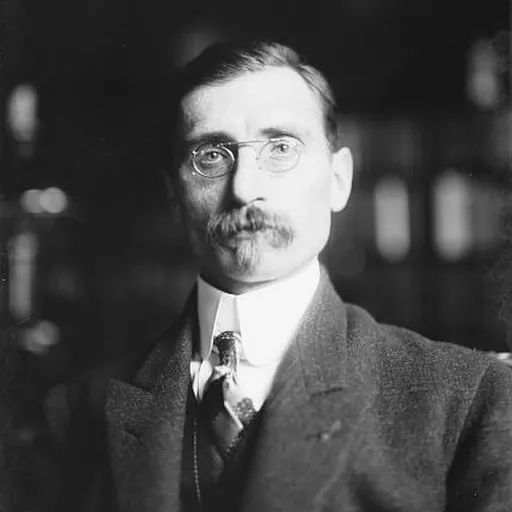
About Guglielmo Ferrero
Lived 1871 – 1942 (aged 71). Guglielmo Ferrero was an Italian historian, writer, journalist, university teacher, classical scholar and philosopher.
Guglielmo Ferrero (; 21 July 1871 — 3 August 1942) was an Italian historian, journalist and novelist, author of the Greatness and Decline of Rome (5 volumes, published after English translation 1907–1909) and The Gamble: Bonaparte in Italy, 1796-1797. Ferrero devoted his writings to classical liberalism, and he opposed any kind of dictatorship and unlimited government.
Biography Born in Portici, near Naples, Ferrero studied law in Pisa, Bologna and Turin. Soon afterwards he married Gina Lombroso, a daughter of Cesare Lombroso, the criminologist and psychiatrist with whom he wrote The Female Offender, The Prostitute and The Normal Woman. In 1891-1894 Ferrero travelled extensively in Europe and in 1897 wrote The Young Europe, a book which had a strong influence over James Joyce.
While studying the history of Rome Ferrero contributed to the literary magazine La Ronda based in Rome. Then he turned to political essays and novels (Between Two Worlds in 1913, Speeches to the Deaf in 1925 and The Two Truths in 1933-1939). When the fascist reign of Black Shirts forced liberal intellectuals to leave Italy in 1925, Ferrero refused and was placed under house arrest. In 1929, Ferrero accepted a professorship at the Graduate Institute of International Studies in Geneva. His last works (Adventure, Bonaparte in Italy, The Reconstruction of Europe, The Principles of Power and The Two French Revolutions) were dedicated to the French Revolution and Napoleon. In 1935, his daughter Nina Ferrero married the Yugoslavian diplomat Bogdan Raditsa.
Ferrero was invited to the White House in 1908 by Theodore Roosevelt, who had read The Greatness and Decline of Rome. He gave lectures in the northeast of the USA, which were collected and published in 1909 as Characters and Events of Roman History.
He died in 1942 at the Mont Pèlerin, Switzerland.
Works In Italian Roma Antica, 3 vols., Firenze: Le Monnier, 1921–22, with Corrado Barbagallo.
In English translation Militarism, a contribution to the Peace Crusade (1903). The Greatness and Decline of Rome translated in five volumes by Sir Alfred Zimmern (Volumes 1 and 2) and the Reverend H J Chaytor (Volumes 3 to 5) Volume 1: The Empire-Builders (1907). Volume 2: Julius Caesar (1907). Volume 3: The Fall of an Aristocracy (1907). Volume 4: Rome and Egypt (1908). Volume 5: The Republic of Augustus (1909). Characters and Events of Roman History from Caesar to Nero (1909). The Women of the Caesars (1911). Between the Old World and the New, a novel (1914). Ancient Rome and Modern America, a comparative study of morals and manners (1914). A Short History of Rome (with Corrado Barbagallo) translated in two volumes by George Chrystal (1918). Volume 1: 754 BC to 44 BC Volume 2: 44 BC to 476 AD Europe's Fateful Hour (1918). Problems of Peace, from the Holy Alliance to the League of Nations, a message from a European writer to Americans (1919). The Ruin of the Ancient Civilization and the Triumph of Christianity, with some consideration of conditions in the Europe of today (1921). Peace and War (1933). The Reconstruction of Europe: Talleyrand and the Congress of Vienna 1814-1845 (1941).
Selected articles "Puritanism," The Atlantic Monthly, Vol. CVI, 1910. "American Characteristics," The Atlantic Monthly, Vol. CVI, 1910. "The Dangers of War in Europe," The Atlantic Monthly, Vol. CXI, 1913.
In French translation Les lois psychologiques du symbolisme, Paris, Félix Alcan, 1895. Published under the name of "Guillaume Ferrero".
Don’t just read it —
keep it.
Full-length biographies made to live with: read them, listen on the way to work, watch them tonight.
- E-book
- Audio
- Video
Instant download · yours to keep · every purchase keeps this site free
Important facts
People in Guglielmo Ferrero's life
Named in this biography and alive at the same time



Related people
Same field, nearest in time

Contemporaries
People whose lives overlapped Guglielmo Ferrero's



Frequently asked questions
Who was Guglielmo Ferrero?
Italian historian and writer (1871-1942)
When was Guglielmo Ferrero born?
Guglielmo Ferrero was born on 21 June 1871 in Portici.
When did Guglielmo Ferrero die?
Guglielmo Ferrero died on 3 August 1942 in Mont Pèlerin.
What was Guglielmo Ferrero's occupation?
Guglielmo Ferrero was a historian, writer, journalist, university teacher, classical scholar and philosopher.
What nationality was Guglielmo Ferrero?
Guglielmo Ferrero was Italian.
Sources & further reading
· Wikipedia: Guglielmo Ferrero
Cite this page
APA: Biography.guide. (2026). Guglielmo Ferrero. https://biography.guide/guglielmo-ferrero/
MLA: "Guglielmo Ferrero." Biography.guide, https://biography.guide/guglielmo-ferrero/.
Chicago: "Guglielmo Ferrero." Biography.guide. https://biography.guide/guglielmo-ferrero/.
Data last updated: 2026-09-21 · Spot an error? Report a correction.
Portrait: Wikimedia Commons · author & licence
Page generated 2026-09-27 05:00 UTC