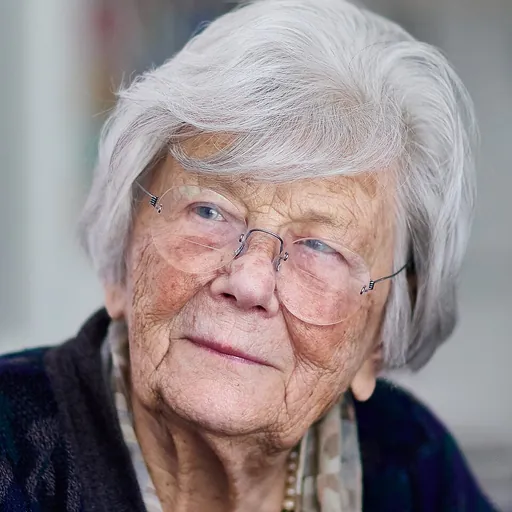
About Gudrun Zapf-von Hesse
Lived 1918 – 2019 (aged 101). Gudrun Zapf-von Hesse was a German type designer, bookbinder and calligrapher.
Gudrun Zapf von Hesse (2 January 1918 – 13 December 2019) was a German book-binder, calligrapher and typographer.
She also designed several typefaces. She was the 1991 winner of the Frederic W. Goudy Award. To mark her hundredth birthday in January 2018, Monotype released the titling typeface Hesse Antiqua.
Early life and education Gudrun von Hesse was born on 2 January 1918 in Schwerin, Mecklenburg-Schwerin (then part of German Empire). in 1940.
Career In 1941, Zapf von Hesse worked as a bookbinder in Berlin.
In 1948, Zapf von Hesse opened a bookbinding studio with one apprentice in the Stempel Type Foundry building.
In the 1970s, Zapf von Hesse worked with her husband Hermann Zapf to prepare bitmaps by hand for his alphabet designs Marconi and Edison. Her use of decoration is "refined by moderation… both understated and unpretentious". For bookbinding technique, she utilized "the flexible method with thin boards and very small borders", which was contrary to the method she was taught during her apprenticeship. The influence of calligraphy is noticeable in her typefaces Diotima and Columbine. In 1991, Zapf von Hesse was the second woman to receive the prestigious Frederic W. Goudy award, an award "given to an outstanding practitioner in the field of typography", given by the Rochester Institute of Technology, Rochester, New York. In 2001, she was recognized with a Lifetime Achievement Award from the Friends of Calligraphy.
Zapf von Hesse's typeface Diotima italic has been called "one of the finest italic types ever" In 2008, the book Manuele Zapficum: Typographic Arrangements of the Words by and About the Work of Hermann Zapf & Gudrun Zapf von Hesse was published in honor of their ninetieth birthdays. about the life and work of Gudrun Zapf von Hesse and Herman Zapf, conceived and produced by her niece professor Alexa Albrand and Directed by Marita Neher was shown shortly before her death in Germany, with Zapf von Hesse in attendance. The documentary was also shown at the Zapf Centennial celebrations which included an exhibit of her life and work
Exhibitions 2019: "Alfabetos Magicos: Cien Anos Con Hermann & Gudrun Zapf." ("Magic Alphabets: 100 Years With Hermann and Gudrun Zapf.") Escola Llotja Sant Andreu (Spain). 2019. "Alphabet Magic: A Centennial Exhibition of the Work of Hermann & Gudrun Zapf. Curated by Jerry Kelly." Grolier Club (New York). 2007: Melbert B. Cary, Jr. Graphic Art Collection, Rochester Institute of Technology (for which the book Spend Your Alphabets Lavishly was published) 2001: Skylight Gallery of the San Francisco Public Library (for which the book Calligraphic Type Design in the Digital Age: An Exhibition in Honor of the Contributions of Hermann and Gudrun Zapf was published) 1998: Hessische Landes– und Hochschulbibliothek (Darmstadt) 1991: Rochester Institute of Technology (Rochester) 1985: ITC-Center of the International Typeface Corporation (New York) 1970: Klingspor Museum (Offenbach am Main) 1952: Grafiska Institutet (Stockholm)
Typeface designs Images of Zapf von Hesse's typefaces are available from the Klingspor Museum's Online Font Library. Reference for the categorization of typefaces is Jerry Kelly's review in Letter Arts Review.
Metal
Diotima Roman (Stempel – 1951): Diotima was modelled from Zapf von Hesse's calligraphy used for her handlettered version of From the Hyperion by Friedrich Holderlin. Gunther Lepold, the director of D. Stempel AG Type Foundry, and Hermann Zapf, Stempel's art director, saw this calligraphy at the Stadel Art School exhibit in 1948, which caused them to invite Zapf von Hesse to Stempel and thus began her type design career. Diotima was punchcut by August Rosenberger. Diotima was redesigned for photocomposition by Linotype/Stempel and Berthold; Zapf von Hesse was not consulted for this redesign and felt "there was a big loss in appearance of this Diotima version in comparison to the original letterpress type". Diotima was named after a Greek priestess in Plato's dialogue about love. Diotima Italic (Stempel – 1953) Ariadne Initials (Stempel – 1953) Smaragd (Emerald) (Stempel – 1954)
Photocomposition
Shakespeare (Hallmark – 1968): Zapf von Hesse received a private commission from Hallmark Cards, resulting in her Shakespeare typeface, used for a 1968 Hallmark publication of Shakespeare’s Sonnets.
Digital
Nofret (Berthold – 1987): Nofret was named after the Egyptian queen Nefertiti, and was released by Berthold in 1987. Nofret was used to print Alex Osborne'sYour Creative Power. The Fachhochschule Hamburg used Nofret as its house typeface. Carmina (Bitstream – 1987) Columbine (URW Hamburg – 1991) Christiana (Berthold – 1991) Alcuin (URW Hamburg – 1992): The typeface, Alcuin, was inspired by the advisor to Charlemagne and his Carolingian minuscule. Hesse Antiqua (2018, Monotype, with Ferdinand Ulrich)
Don’t just read it —
keep it.
Full-length biographies made to live with: read them, listen on the way to work, watch them tonight.
- E-book
- Audio
- Video
Instant download · yours to keep · every purchase keeps this site free
Important facts
People in Gudrun Zapf-von Hesse's life
Named in this biography and alive at the same time


Related people
Same field, nearest in time



Contemporaries
People whose lives overlapped Gudrun Zapf-von Hesse's


Frequently asked questions
Who was Gudrun Zapf-von Hesse?
German typographer (1918–2019)
When was Gudrun Zapf-von Hesse born?
Gudrun Zapf-von Hesse was born on 2 January 1918 in Schwerin.
When did Gudrun Zapf-von Hesse die?
Gudrun Zapf-von Hesse died on 13 December 2019 in Darmstadt.
What was Gudrun Zapf-von Hesse's occupation?
Gudrun Zapf-von Hesse was a type designer, bookbinder and calligrapher.
What nationality was Gudrun Zapf-von Hesse?
Gudrun Zapf-von Hesse was German.
Sources & further reading
· Wikipedia: Gudrun Zapf-von Hesse
· DBpedia: Gudrun Zapf von Hesse
Cite this page
APA: Biography.guide. (2026). Gudrun Zapf-von Hesse. https://biography.guide/gudrun-zapf-von-hesse/
MLA: "Gudrun Zapf-von Hesse." Biography.guide, https://biography.guide/gudrun-zapf-von-hesse/.
Chicago: "Gudrun Zapf-von Hesse." Biography.guide. https://biography.guide/gudrun-zapf-von-hesse/.
Data last updated: 2026-09-21 · Spot an error? Report a correction.
Portrait: Wikimedia Commons · author & licence
Page generated 2026-09-27 05:00 UTC