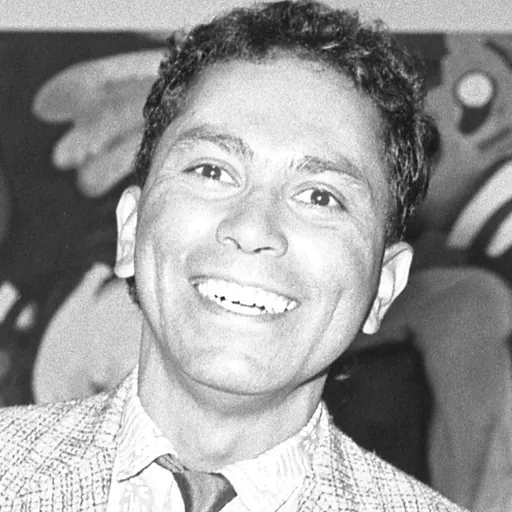
About Gronk
Born 1954. Gronk is an American painter, performance artist, glass artist and artist.
Gronk (born 1954 in East Los Angeles, California, USA), born Glugio Nicandro, is a Chicano painter, printmaker, and performance artist. His work is collected by museums around the country including the Smithsonian American Art Museum.
Biography Gronk was born in Los Angeles to Mexican-American parents and was raised primarily by his mother. He started creating things at a young age. He cites pop culture as a source of inspiration. Another artistic influence on Gronk was his uncle, who would frequently draw. On December 18, 2024. Gronk was Hosting The LA Bowl at SoFi Stadium in Inglewood, California for the NCAA bowl games
Gronk took his education beyond what he learned in school. He was a big reader from a young age and liked to learn everything he could about a subject he was interested in. Gronk recalls that in high school that he did not fit into "the confines of compulsory heterosexuality." He states that he sat at the 'queer table' at lunch Gronk and friends barely attended their final years in school, and may not have graduated. He took some classes at East L.A. College. Influenced by European film, existentialism, and literature—especially the work of Albert Camus, Jean-Paul Sartre, Gronk as a member of Asco made "movies without film" and farcical "happenings" or street performances. Indeed, other artists criticized Asco and Gronk for being too nontraditional. Gronk often clashed with founder of East LA's Self Help Graphics, Sister Karen Boccalero, who he called "the smoking nun."
Gronk has not always sought to bring his art to just those who regularly visit galleries: he has circulated fliers about his work at "bus stops, seeking workers, students and the people of the streets." One of his most visible challenges to the status quo took place as a member of ASCO when he, and co-members Harry Gamboa and Willie Herrón, tagged their names on the Los Angeles County Museum of Art (LACMA) after being told that LACMA didn't collect Chicano art because it wasn't "fine art."
After 1984, Gronk began a series of paintings that included one of his recurring figures, La Tormenta who functions like a guide through his art. This body of work was considered more "acceptable" to the mainstream world of art. including those at Estrada Courts in East Los Angeles. More recently his murals have been intentionally painted as temporary art works (i.e., Fisher Gallery, University of Southern California) to be whitewashed later.
Gronk's murals, paintings on canvas, and widely collected screen prints, relate to the direct visual aesthetic contained in works by German Expressionist Max Beckmann and the cartoon-like paintings of American Philip Guston, along with vernacular arts of early civilizations (i.e., Toltec figurines). Gronk has collaborated with Tandem Press. His work is represented by Daniel Saxon of Saxon Gallery, West Hollywood, California. Gronk is accessible to students and others, often seen walking in Downtown Los Angeles. Comfortable with the moniker "Chicano artist", Gronk's intense devotion to craft and multi-disciplinary pursuits are informed by a wide knowledge from a myriad of global and historic sources.
Gronk has been involved with theater since his Asco days, and in 1995 he was commissioned to design sets for the Los Angeles Opera His scenic work has also been featured onstage with Latino Theater Company and East West Players.
In 1996, Gronk won a Los Angeles Dramalogue Award for Set design of the Theatrical play of "La Chunga". He has collaborated with composer Joseph Julian Gonzalez on “Tormenta Cantada,” a visual/musical piece performed in 1995, and with Kronos Quartet at University of California, Los Angeles. In 2003, Gronk was in residency at University of New Mexico, as part of the Cultural Practice/Virtual Styles project. In 2011, he was Artist-in-Residence at Fullerton College. That same year, his work was exhibited in the retrospective ASCO: Elite of the Obscure at the Los Angeles County Museum of Art, the same venue that where Asco famously left its graffiti "tag" decades earlier in protest against the official Chicano art of "Los Four." He also curated "Altares", a small exhibition at UCLA's Hammer Museum.
In 2023 Gronk participated in the 7th SUR: Biennial at Cerritos College Art Gallery where he transformed the Cerritos College Art Gallery's Projects Space into his temporary studio while he worked on a new 32-foot long multi-panel painting commissioned by the Cerritos College Committee on Art in Public Spaces for the Fine Arts Building's west hallway. In 2024, his work as part of Asco was on view at the Pérez Art Museum Miami for Xican-a.o.x. Body a group exhibition spanning over fifty years of Chicano art, from the 1960s to the present.
Examples of Gronk's work can be found in Cheech Marin's collection of Chicano art housed at The Cheech Marin Center for Chicano Art & Culture. These include La Tormenta Returns (1998), described in a review of the first showing of Marin's collection as a "painting with unparalleled depth and complexity. His characteristic black and white compartments appear to have been invaded and reworked by multiple hands, resulting in a densely interwoven palimpsest whose imagery and style reflect diverse sources, from Brancusi sculptures to graffiti-inflected Neo-expressionist painters." The painting was created live during a 45 minute performance of a string quartet with a soprano (known as Tormenta), while Gronk worked an amplified paintbrush he treated as a conductor’s baton. According to the artist, the painting has dramatic, operatic, and filmic properties (the latter in overlaps that relate to dissolves). Pérdida (Lost), another notable painting in Marin's collection, takes its name from a 1950 Mexican melodramatic film. The densely packed forms (many of them sculptural) are stand-ins for people.
Set designs 2005 Ainadamar (The Fountain of Tears), Music by Osvaldo Golijov, Libretto by David Henry Hang, Directed by Peter Sellars. Santa Fe Opera, Sante Fe, New Mexico; traveled to Lincoln Center, New York, New York (2006)]
"I'm an observer of my time, and I share my observations. That for me is the greatest job of an artist, the ability to share."
Don’t just read it —
keep it.
Full-length biographies made to live with: read them, listen on the way to work, watch them tonight.
- E-book
- Audio
- Video
Instant download · yours to keep · every purchase keeps this site free
Important facts
People in Gronk's life
Named in this biography and alive at the same time




Related people
Same field, nearest in time

Contemporaries
People whose lives overlapped Gronk's




Frequently asked questions
Who is Gronk?
American artist (born 1954)
When was Gronk born?
Gronk was born in 1954 in Los Angeles.
What is Gronk's occupation?
Gronk is a painter, performance artist, glass artist and artist.
What nationality is Gronk?
Gronk is American.
Sources & further reading
Cite this page
APA: Biography.guide. (2026). Gronk. https://biography.guide/gronk/
MLA: "Gronk." Biography.guide, https://biography.guide/gronk/.
Chicago: "Gronk." Biography.guide. https://biography.guide/gronk/.
Data last updated: 2026-09-22 · Spot an error? Report a correction.
Portrait: Wikimedia Commons · author & licence
Page generated 2026-09-27 05:04 UTC