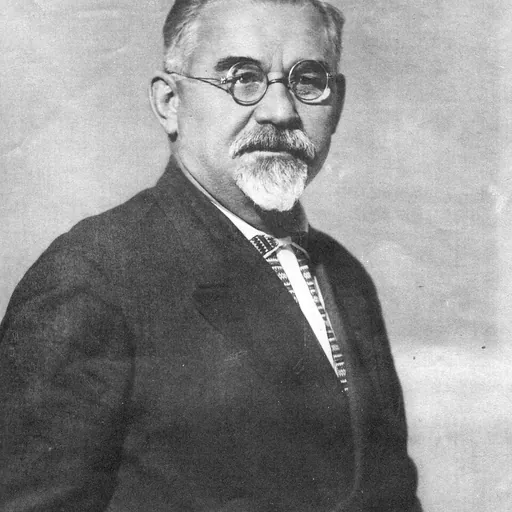
About Grigory Petrovsky
Lived 1878 – 1958 (aged 79). Grigory Petrovsky was a Russian and Ukrainian statesperson, politician, factory worker and revolutionary.
Grigory Ivanovich Petrovsky (; ; 4 February 1878 – 10 January 1958) was a Ukrainian Soviet politician
Biography Early years Petrovsky was born in the village of Pechenihy in Kharkov Governorate on 4 February (O. S. 23 January) 1878, in the family of a craftsman (some sources claim – son of tailor and laundrywoman). Grigory's father died when he was three. Petrovsky had two siblings.
After finishing two classes of school at the Kharkiv Theological Seminary in 1889, Petrovsky was dismissed for not being able to pay for his tuition. Being 11 years old he left education for a job in the city working for a locomotive depot. In 1893, aged 15, he arrived in Yekaterinoslav, where he found a job at the Bryansk Metallurgical Factory (today Petrovsky Factory).
In 1895 Petrovsky joined the revolutionary movement and in 1898 enrolled in the Russian Social Democratic Labour Party (RSDRP) and joined the "Union in the fight for the liberation of the worker's class" as well as the Yekaterinslav committee of RSDRP. At this period of time he actively participated in the political agitation for the Bolsheviks from Mykolaiv to Mariupol, from Donets Basin to Kharkiv, for which he was arrested in 1900 and 1903.
During the Russian Revolution of 1905, Petrovsky became one of the organizers and leaders of the Yekaterinoslav City Council of Worker's Deputies and the local Battle Strike Committee. However, he soon was forced to flee and for a brief period of time emigrated to Germany. In 1907 he returned to Mariupol, where he worked as a turning specialist and continued his revolutionary activity at the factory "Russian Providence" (today – part of Illich Steel and Iron Works).
Duma Deputy
In 1912, Petrovsky was elected a deputy to the Russian 4th State Duma as a representative of workers of the Yekaterinoslav Governorate for the Bolshevik faction. During this time he also was a chief editor of Pravda. In January 1913 Petrovsky was included into the Central Committee of RSDRP. It is known that in the Duma he spoke on 32 occasions, while the text of his 21st speech was prepared personally by Vladimir Lenin. In his speeches Petrovsky was addressing the issues related to improving working conditions and life of miners and workers of Donets Basin.
With the start of World War I in November 1914 he was arrested along with the other six Bolshevik members of the parliament and in February 1915 was sentenced to a lifetime exile in Turukhansky Krai (today – the northern part of Krasnoyarsk Krai).
People's Commissar, Ukrainian Party boss After the Bolshevik seizure of power, Petrovsky was appointed People's Commissar for the Interior Affairs between 30 November 1917 and 1 March 1919. In this post he oversaw the activities of the Cheka and was one of the advocates of the Red Terror, he wrote in his order "A huge number of hostages has to be taken to the bourgeoisie, in cases of resistance these hostages have to be shot in masses (....) No hesitation in the application of the terror" He was a member of the Russian delegation during signing the Treaty of Brest-Litovsk in 1917.
From 1919 he chaired the All-Ukrainian [from 1922, the Ukrainian SSR] Central Executive Committee, and co-chaired the USSR Central Executive Committee of the Communist Party. In January 1938 he was retired from these leading Party executive positions. Petrovsky had belonged to the party majority that opposed the Ukrainian national-communist orientation represented by Yurii Lapchynskyi and Oleksander Shumsky, but in the 1920s had nonetheless supported Ukrainization and Ukrainian economic, cultural, and political autonomy. Other historians, like Vasyl Marochko, a member of an official commission that investigated the Holodomor, say that when Petrovsky fully understood what was being perpetrated and realized the extent of the famine, he pleaded with Stalin to provide Ukrainians with food but this request went unheeded. Soon after the USSR celebrated its sixteenth birthday, he was interrogated by Joseph Stalin, who told him, "We shoot people like you but you will be spared" Petrovsky pleaded Stalin in a letter to release his imprisoned son Pyotr, but his son, who edited Leningradskaia Pravda, was shot. However, after Stalin's death in 1953, he was sufficiently rehabilitated so that, when he died in 1958 at the age of 79, his body was cremated and his ashes placed in the Kremlin Wall Necropolis.
Legacy The city Yekaterinoslav was renamed Dnipropetrovsk after Petrovsky from 1926 until 2016. Petrovsky himself was present at the provisional District Congress of Workers', Peasants' and Soldiers' Deputies that recommended this renaming and he did "accept this honor with great gratitude." On 20 May 2016 the city was renamed "Dnipro". Some Ukrainians believed that the city should have been renamed after Ukraine gained independence in 1991. Ukraine's Dnipropetrovsk Oblast was not renamed because as such it is mentioned in the Constitution of Ukraine, and the Oblast can only be renamed by a constitutional amendment.
The demolished monument to Petrovsky in Dnipropetrovsk as photographed on 30 January 2016.
A statue of Petrovsky in Kyiv (the capital of Ukraine) was demolished in late November 2009, just days before the annual Ukrainian commemorating of the victims of the Holodomor. President of Ukraine Viktor Yushchenko had issued a decree ordering the removal of monuments to Soviet leaders, "in memory of the victims of the Holodomor". In April 2014 the local statue of Vladimir Lenin had already been demolished.
Don’t just read it —
keep it.
Full-length biographies made to live with: read them, listen on the way to work, watch them tonight.
- E-book
- Audio
- Video
Instant download · yours to keep · every purchase keeps this site free
Important facts
People in Grigory Petrovsky's life
Named in this biography and alive at the same time


Related people
Same field, nearest in time




Contemporaries
People whose lives overlapped Grigory Petrovsky's



Frequently asked questions
Who was Grigory Petrovsky?
Soviet politician (1878–1958)
When was Grigory Petrovsky born?
Grigory Petrovsky was born on 23 January 1878 in Pechenihy.
When did Grigory Petrovsky die?
Grigory Petrovsky died on 9 January 1958 in Moscow.
What was Grigory Petrovsky's occupation?
Grigory Petrovsky was a statesperson, politician, factory worker and revolutionary.
What nationality was Grigory Petrovsky?
Grigory Petrovsky was Russian and Ukrainian.
Sources & further reading
· Wikipedia: Grigory Petrovsky
Cite this page
APA: Biography.guide. (2026). Grigory Petrovsky. https://biography.guide/grigory-petrovsky/
MLA: "Grigory Petrovsky." Biography.guide, https://biography.guide/grigory-petrovsky/.
Chicago: "Grigory Petrovsky." Biography.guide. https://biography.guide/grigory-petrovsky/.
Data last updated: 2026-09-20 · Spot an error? Report a correction.
Portrait: Wikimedia Commons · author & licence
Page generated 2026-09-27 04:58 UTC