
About Grigor Khanjyan
Lived 1926 – 2000 (aged 73). Grigor Khanjyan was a Russian and Armenian painter and illustrator.
Grigor Khanjyan (; 29 November 1926 – 19 April 2000) was a Soviet and Armenian artist, painter, and illustrator. He is most notable for his illustrations of historical novels and poems, and murals and tapestries on historical topics. In 1983 Khanjyan was appointed a member of the highest order of chivalry in Soviet art (only 159 members during Soviet history) – the "People's Artist of Soviet Union".
Biography Early years Khanjyan was born in Yerevan, Soviet Armenia. He was the fourth and last child of Sebuh and Verginie – genocide survivors from Yerznka, who settled in Armenia in 1920. Grigor mentioned on several occasions that a doctor had advised his mother, already in relatively advanced age, to get pregnant in order to avoid some health problems and that is the reason for him to be conceived. Soon after Sovietization of Armenia, Sebuh had to leave his main profession and become an accountant. Grigor had one elder brother who became a musician.
Education Panos Terlemezian – who was a friend of Sebuh Khanjyan – first discovered art talent in little Grigor. In 1945, Grigor finished the coursework at Terlemezian Art College in Yerevan and at the age of 19 (together with fellow painters Levon Manaseryan and Van Khachatur) entered the Academy of Fine Arts in Yerevan. At the Academy Khanjyan mostly studied under the guidance of the prolific thematic-compositional artist Eduard Isabekyan whose influence was strong on the style of Khanjyan's works in early years.
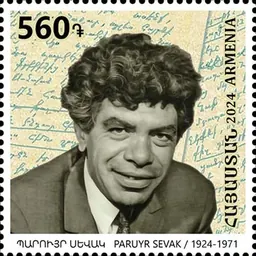
Nationalist painter Khanjyan never joined the Communist Party (something highly expected for having success in the Soviet Union) and had opted for nationalist instead of Soviet very often. For example, for his graduation work he chose the topic of 1907 Communist Congress in London, but pictured Stepan Shaumian (ethnic Armenian) instead of Joseph Stalin (as expected) next to Lenin. In 1965, for the All-Soviet Exhibition of Graphic Art Khanjyan sent his illustrations of Paruyr Sevak's The Unsilenceable Belfry – a story of Armenian genocide.
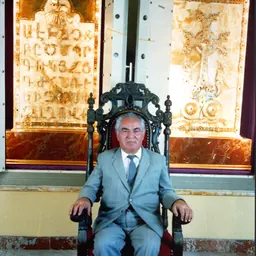
Further, in 1966 he joined the supreme spiritual council of the Armenian Apostolic Church and befriended the Catolicos Vazgen I. For the church he created large-scale tapestries depicting episodes from Armenian history – Battle of Avarayr and Creation of Armenian Alphabet. As the tapestries were held in the Patriarchate buildings, where the common Soviet people could not enter, Khanjyan was asked by Karen Demirchyan (then the head of Armenian Communist Party) to reproduce the works as murals at the newly finished Yerevan Arena for Sport and Music (Hamalir). Instead, Khanjyan created the second largest in the Soviet Union theatrical curtain – Mother Armenia – for Hamalir and followed the advice of his friend, architect Jim Torosyan and made the murals at the Yerevan Cascade (now Cafesjian Museum of Art, then still under construction). Further, he added a third part – Rebirth of Armenia – to make the murals in a form of a triptych. Thus, Rebirth of Armenia was to conclude the triptych History of Armenia with the greatest figures of 20th century Armenia on it (by the time of the artists demise in 2000, the work was still not finished).
Memberships in various organisations
In 1990, Khanjyan accepted the invitation from the Academy of Sciences of Armenia to join it as a full member (receiving the title 'Academician') in the field of Art History.
Legacy Cafesjian Museum of Art named one of the main exhibition halls after Grigor Khanjyan – Khanjyan Gallery – as it is home to one of his most famous historical paintings – the mural triptych 'History of Armenia'. The Rebirth of Armenia section of the triptych was chosen as a symbolic background for US Secretary of State Hillary Clinton's speech in July 2010.
In 2016 Central Bank of Armenia minted a commemorative coin with Khanjyan's tapestry 'Vardanank'.
Notable works Book Illustrations Abovian's Wounds of Armenia (1958) Sevak's Never-abating Bell Tower (1965)
Paintings
In the Painter's Studio (1953) Portrait of My Son (1960) Sunflowers (1970) Twilight (1962) Bread of the Highlands (1972) Still-life with Sunflowers (1978)
Tapestries and Murals Vardanank Creation of Armenian Alphabet Rebirth of Armenia
Religious Altarpiece of Etchmiadzin Cathedral Altarpiece of the Armenian Cathedral of New York
Gallery
Architectural Commission of the Mother See of Holy Etchmiadzin (1970–1988). First row from left: Varazdat Harutyunyan, Vazgen I, K. Altunyan Second row from left: Baghdasar Arzoumanian, H. Babakhanian, Grigor Khanjyan, A. Galikyan, M. Hovhannisyan
Don’t just read it —
keep it.
Full-length biographies made to live with: read them, listen on the way to work, watch them tonight.
- E-book
- Audio
- Video
Instant download · yours to keep · every purchase keeps this site free
Important facts
People in Grigor Khanjyan's life
Named in this biography and alive at the same time



Related people
Same field, nearest in time

Contemporaries
People whose lives overlapped Grigor Khanjyan's


Frequently asked questions
Who was Grigor Khanjyan?
Armenian and Soviet painter (1926-2000)
When was Grigor Khanjyan born?
Grigor Khanjyan was born on 29 November 1926 in Yerevan.
When did Grigor Khanjyan die?
Grigor Khanjyan died on 19 April 2000 in Yerevan.
What was Grigor Khanjyan's occupation?
Grigor Khanjyan was a painter and illustrator.
What nationality was Grigor Khanjyan?
Grigor Khanjyan was Russian and Armenian.
Sources & further reading
Cite this page
APA: Biography.guide. (2026). Grigor Khanjyan. https://biography.guide/grigor-khanjyan/
MLA: "Grigor Khanjyan." Biography.guide, https://biography.guide/grigor-khanjyan/.
Chicago: "Grigor Khanjyan." Biography.guide. https://biography.guide/grigor-khanjyan/.
Data last updated: 2026-09-20 · Spot an error? Report a correction.
Page generated 2026-09-27 05:23 UTC