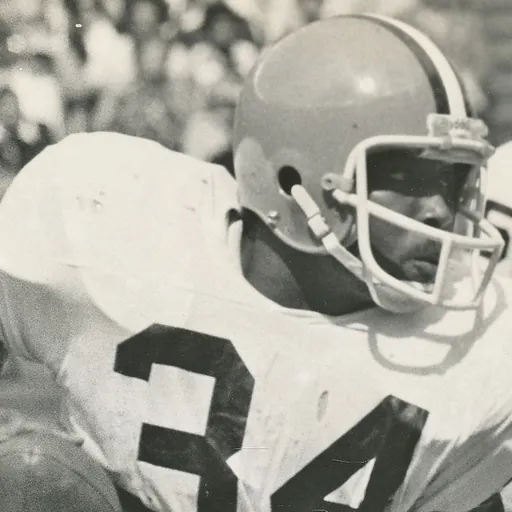
About Greg Pruitt
Born 1951. Greg Pruitt is an American american football player.
Gregory Donald Pruitt (born August 18, 1951) is an American former professional football player who was a running back in the National Football League (NFL) from 1973 through 1984. He played college football for the Oklahoma Sooners. Pruitt was selected to five Pro Bowls, four as a member of the Cleveland Browns and one as a member of the Los Angeles Raiders, three times as a kick returner/return specialist and twice as a running back. He was also part of the Raiders' Super Bowl XVIII winning team, beating the Washington Redskins. He was in the first Cleveland Browns Legends class in 2001.
Pruitt was inducted into the College Football Hall of Fame in 1999. He was a unanimous All-America selection two consecutive seasons at Oklahoma (1971 and 1972), and was the Big Eight's offensive player of the year in 1971. He finished in the top three in Heisman Trophy voting twice. He was on two Oklahoma teams that won the Sugar Bowl, and finished the season ranked No. 2 in the nation.
Early life Pruitt was born on August 8, 1951, in Houston. He attended B. C. Elmore High School in Houston. As a freshman at B. C. Elmore, he was 4 ft 4 in (1.32 m). He weighed only 165 lb (74.8 kg) as a senior.
College career At the time Pruitt graduated high school, he was highly recruited by numerous historically black colleges and universities (HBCU), but only four or five other schools offered him scholarships: the University of Oklahoma, University of Houston, University of Colorado, Arizona State University and/or the University of Kansas. Two of Pruitt's former high school teammates were already attending Oklahoma (Albert Qualls and Lionel Day), and coach Mosley had a longstanding friendship with Michael and Oklahoma head coach Chuck Fairbanks. Moseley believed these were the principal reasons Pruitt chose to attend Oklahoma. He was academic All-Big Eight in 1972. Pruitt ranks third among Sooners in career all-purpose yards. Pruitt gained 3,122 rushing yards, 491 receiving yards, 139 yards on punt returns and 679 yards returning kickoffs. In total, he scored 41 career touchdowns as a Sooner. He came in second in Heisman Trophy voting in 1972, and third in 1971.
Sophomore (1970) As a sophomore (1970), Pruit rushed for 241 yards and five touchdowns, averaging 5.4 yards per carry, in the regular season. He also had 19 receptions for 240 yards and two receiving touchdowns. He had been recruited to Oklahoma as a pass receiver, but was moved to running back in his sophomore year when head coach Chuck Fairbanks implemented the wishbone offense. Pruitt received the game's Most Valuable Player award for a back, in a game where the Sooners ran for a total of 349 yards and Alabama's Johnny Musso rushed for 138 yards on 27 carries. Alabama coach Bear Bryant said after the game that the two main problems for his team in not winning the game were Oklahoma's blocking and Pruitt's running.
Junior (1971) As a junior (1971), Pruitt led the Big Eight in rushing with 1,665 yards (on 178 carries) in the regular season, tied for the Big Eight lead with 17 rushing touchdowns (with teammate Jack Mildren), and led all college football players with a 9.4 yards per carry rushing average.
From October 2 to 23, 1971, Pruitt rushed for at least 190 yards in four consecutive games. On October 2, he gained 205 yards against the No. 17 ranked University of Southern California. The next week (October 16) he rushed for 190 yards against No. 6 ranked Colorado. His biggest rushing game came one week later (October 23) against Kansas State, when he rushed for 294 yards on 19 carries, setting a Big Eight record at the time (broken on November 14 by Charlie Davis's 342 yards for Colorado ); with three rushing touchdowns. He ran for 159 yards the following week (October 30) against Iowa State. Pruitt was named National Back of the Week for two consecutive weeks, against Southern California and Texas.
Pruitt had only 10 carries for 53 yards in the game, though he played an important blocking role for Oklahoma quarterback Jack Mildren who had 31 carries. This was due in significant part to Nebraska's ability to limit Pruitt's outside rushing attempts. Oklahoma's assistant coach Barry Switzer said after the game that this was an oversight by Oklahoma; "He's [Pruitt] a gamebreaker and we probably should have put the ball in his hands at least 25 times . . . They kept us from getting it to him on the outside, so we should have forced it to him with belly plays or off-tackle".
Oklahoma defeated the Auburn Tigers in the January 1, 1972 Sugar Bowl, 40–22. The Sooners rushed for a Sugar Bowl record 439 yards, with Pruitt contributing 95 yards on 18 carries and one rushing touchdown; without a reception. Oklahoma was ranked No.2 nationally at the end of the season.
Senior (1972) As a senior (1972), Pruitt rushed for 938 yards on 152 carries in the regular season. He led the Big Eight with 13 rushing touchdowns. He also had seven pass receptions for 102 yards, and another touchdown. Oklahoma defeated Penn State in the January 1, 1973 Sugar Bowl, 14–0, and was ranked No. 2 nationally at the end of the 1972 season.
Pruitt played in the Hula Bowl after his senior season, and was named the game's outstanding player.
In 33 regular season games with the Sooners (1970 to 1972), Pruit totaled 2,844 rushing yards and 450 receiving yards, with 35 rushing touchdowns and three receiving touchdowns. He averaged 120.9 all-purpose yards per game. During his career at Oklahoma he set records for all-purpose yards in a game (374) and a season (1,940). led to him not being drafted until the Cleveland Browns selected him with the 30th pick of the second round of the 1973 NFL draft. Pruitt's college coach Chuck Fairbanks became the New England Patriots' new coach in January 1973, a few days before the January 30, 1973 NFL draft. The Patriots had three opportunities to draft Pruitt before he was selected by the Browns, but did not do so. Pruitt felt slighted, especially as he expected to be a first round selection. Pruitt was aware that his size was an issue, and was concerned if his own coach, whom he had brought so much success in college, doubted in him, this could affect how other teams perceived him. Browns' coach Nick Skorich did not want to select Pruitt in the second round because of his size, but Browns' owner Art Modell saw Pruitt as a potential successor to Hall of Fame running back Leroy Kelly and overruled Skorich.
As a rookie in 1973, Pruitt played in 13 games, but did not start any. He rushed for 369 yards on 69 carries, averaging six yards per carry with four rushing touchdowns. He also had nine pass receptions for 110 yards and a receiving touchdown. Pruitt returned 16 punts for 180 yards (11.3 yards per return) and 16 kickoffs for 453 yards (28.6 yards per return). That season, Ron Smith led the NFL in punt return average (13 yards per return) and Wallace Francis led the league in kickoff return average (29.9 yards per return). As a rookie, Pruitt was selected to play in the Pro Bowl as a kick returner.
In 1974, Pruitt started nine games at halfback and led the Browns with 540 rushing yards and a 4.3 yards per carry average. He scored three rushing touchdowns. Pruitt also had 21 receptions for 274 yards and a receiving touchdown. He returned 27 punts for 349 yards (12.9 yards per return) and 22 kickoffs for 606 yards (27.5 yards) per return. He was fourth in the NFL in yards per kickoff return and all-purpose yards, and eighth in yards per punt return. In a November 10 game against the New England Patriots, he returned the opening kickoff 88 yards for a touchdown; and had a 25-yard punt return later in that game. Earlier that season, he returned a punt 72 yards against the Denver Broncos to set up a game winning touchdown. Pruitt was selected to play in the Pro Bowl for a second consecutive season.
Pruitt's breakout season as a running back came in 1975. He started all 14 games and led the Browns with 1,067 rushing yards on 217 carries (4.9 yards per carry). He had eight rushing touchdowns, and also had 44 receptions for 299 yards with a receiving touchdown. He was second on the team in receptions. Pruitt returned 13 punts for 130 yards and 14 kickoffs for 302 yards. This was his last season returning punts for the Browns, and he only returned three kickoffs for them over the following six years. In 1975, Pruitt was tied for third in the NFL with Terry Metcalf in rushing average, was fifth in all-purpose yards and sixth in total rushing yards.
Pruitt led the Browns with 1,000 yards rushing in 1976, averaging 4.8 yards per carry with four rushing touchdowns. He also had 45 receptions (second most on the Browns) for 341 yards and a receiving touchdown. He was selected to the Pro Bowl as a running back for the first time, and United Press International (UPI) named his second-team All-American Football Conference (AFC). He was ninth in the NFL in yards from scrimmage. In 1977, he led the Browns with 1,086 yards, averaging 4.6 yards per carry with three rushing touchdowns. He was again second on the team in receptions with 37, for 471 yards and one receiving touchdown. Pruitt was third in the NFL in yards from scrimmage and seventh in total rushing yards. He was once more selected to the Pro Bowl as a running back, with the UPI naming him second-team All-AFC and the Newspaper Enterprise Association naming him second-team All-Pro.
1978 was Pruitt's last productive season with the Browns, though he suffered leg and ankle problems during that season. He suffered a calf injury in the second game of the season that required surgery and caused him to miss four games. he did not regain his form until the 14th game of the season when he rushed for 113 yards on 12 carries and had 46 receiving yards on three catches. He had 138 rushing yards and 69 receiving yards the next week, and 182 rushing yards on 22 carries in the season's final game.
Over his final three seasons in Cleveland (1979 to 1981), Pruitt only had a three-year total of 133 carries for 474 yards. The knee injury and surgery continued to affect Pruitt in ensuing seasons, and he became more of a pass receiver out of the backfield than a runner. He was a favorite passing target for Browns' quarterback Brian Sipe in his last two Browns' seasons. In 1980, Pruitt started nine of 16 games in which he appeared. He had 117 rushing yards in 40 carries (averaging a career-worst 2.9 yards per carry), but 444 yards on 50 receptions and five receiving touchdowns. In nine years with the Browns, Pruitt started 83 games. He rushed for 5,496 yards with 25 touchdowns and a 4.7 yards per carry average (third best among all Browns players with at least 1,000 carries through 2025). He had 323 receptions for 3,022 yards and 19 receiving touchdowns. He returned 56 punts for 659 yards, and 58 kickoffs for 1,523 yards and one touchdown. The Raiders used Pruitt mainly as a return specialist, a role he had not been in since 1975. In 1982, Pruitt returned 27 punts for 209 yards, and 14 kickoffs for 371 yards. In 1983, the 32-year old Pruitt returned 58 punts for 666 yards (11.5 yards per return). He also returned 31 kickoffs for 604 yards. Pruitt led the NFL in punt returns, total punt return yards, and combined kick and punt returns. He was second in punt return average and combined kick and punt return yards. He was selected to the Pro Bowl for the fifth time in his career, and selected as a return specialist for the first time since 1974. Pro Football Weekly named him first-team All-Conference. He had a 97-yard punt return for a touchdown against the Washington Redskins, the longest punt return of the 1983 NFL season. In the earlier AFC divisional playoff round win over the Pittsburgh Steelers, 38–10, Pruitt returned five punts for 47 yards. In his final season with the Raiders (1984), Pruitt returned 53 punts for 473 yards, and only three kickoffs.
In three years with the Raiders, Pruitt returned 138 punts for 1,348 yards and one touchdown, and 48 kickoffs for 991 yards. He rushed for 176 yards with two touchdowns and 4.6 yards per carry average; and caught five passes for 47 yards. Pruitt finished his 12-year NFL career with 5,672 rushing yards, 3,069 receiving yards, 47 total touchdowns, and 13,262 all-purpose yards. His 7.6 yards per carry average in college is sixth best all-time (through 2025). At the time the Browns' traded Pruitt, he was third all-time among Browns' players in rushing attempts, yards, and touchdowns, behind only future Hall of Fame running backs Jim Brown and Leroy Kelly. He was later passed by Nick Chubb and former teammate Mike Pruitt and is fifth all-time in total rushing yards (through 2025). Pruitt's performance against Southeastern Conference schools Alabama and Auburn in the 1970 Astro-Bluebonnett Bowl and 1972 Sugar Bowl, respectively, helped accelerate each team's integration expanding their recruitment of Black players.
After the 1969 University of Texas Longhorns team was the last non-integrated team to be ranked No. 1, Oklahoma and Big Eight archrival University of Nebraska became dominant teams in college football. Both Oklahoma and Nebraska had actively recruited Black players who played key roles on their teams, such as Johnny Rodgers and Rich Glover at Nebraska and Pruitt at Oklahoma. After losing to Texas in 1970, Oklahoma won every game it played against Texas from 1971 to 1975. Nebraska was ranked No. 1 by the AP in 1970 and 1972, and Oklahoma was ranked No. 2 by the AP in both 1971 and 1972. Nebraska's dramatic 35–31 win over Oklahoma in 1971 was called a "Game of the Century". )
As a college senior, Pruitt was 5 ft 9 in (1.75 m) 176 lb (79.8 kg), In 1979, the "Greg Pruitt rule" established tear-away jerseys as illegal.
Pruitt's awards and honors include, among others;
Inducted into the College Football Hall of Fame (1999) Inducted into Cleveland Browns Legends (2001) Super Bowl Champion (1984) Touchdown Club of Washington D. C. Player of the Year (1972) Unanimous All-American (1972) Unanimous All-American (1971) Big Eight offensive player of the year (1971) All-Big Eight (1972) Academic All-Big Eight (1972) All-Big Eight (1971) 5x Pro Bowl selection (1973, 1974, 1976, 1977, 1983) 2x Sugar Bowl Champion (1971, 1972)
Personal life After retiring from professional football, Pruitt owned Pruitt Energy Sources in Houston.
Pruitt's son, Greg Pruitt Jr., attended North Carolina Central University (NCCU), and in three seasons on the school's football team became the school's all-time leading rusher. In 2014, he was inducted into NCCU's Alex M. Rivera Athletics Hall of Fame.
In 1979, Pruitt won ABC's Superstars, an all-around sports competition that pits elite athletes from different sports against one another in a series of athletic events resembling a decathlon.
In 1991, Pruitt competed in the sports-entertainment TV game show, American Gladiators, on a team with former NFL players Cliff Branch, Jack Ham, Jim Kiick, Phil Villapiano, and Charles White.
NFL career statistics Legend Super Bowl champion Led the league Bold Career high Year Team Games Rushing Receiving Fumbles GP GS Att Yds Avg Y/G Lng TD Rec Yds Avg Lng TD Fum FR 1973 CLE 13 0 61 369 6.0 28.4 65 4 9 110 12.2 42 1 7 2 1974 CLE 14 9 126 540 4.3 38.6 54 3 21 274 13.0 43 1 10 2 1975 CLE 14 14 217 1,067 4.9 76.2 50 8 44 299 6.8 48 1 10 2 1976 CLE 14 13 209 1,000 4.8 71.4 64 4 45 341 7.6 27 1 7 0 1977 CLE 14 14 236 1,086 4.6 77.6 78 3 37 471 12.7 60 1 8 3 1978 CLE 12 12 176 960 5.5 80.0 70 3 38 292 7.7 26 2 12 1 1979 CLE 6 6 62 233 3.8 38.8 27 0 14 155 11.1 27 1 1 1 1980 CLE 16 9 40 117 2.9 7.3 19 0 50 444 8.9 43 5 1 0 1981 CLE 15 6 31 124 4.0 8.3 15 0 65 636 9.8 33 4 3 0 1982 RAI 9 0 4 22 5.5 2.4 13 0 2 29 14.5 23 1 5 4 1983 RAI 16 0 26 154 5.9 9.6 18 2 1 6 6.0 6 0 10 7 1984 RAI 15 0 8 0 0.0 0.0 0 0 2 12 6.0 8 0 9 2Career 158 83 1,196 5,672 4.7 35.9 78 27 328 3,069 9.4 60 18 83 24
Don’t just read it —
keep it.
Full-length biographies made to live with: read them, listen on the way to work, watch them tonight.
- E-book
- Audio
- Video
Instant download · yours to keep · every purchase keeps this site free
Important facts
People in Greg Pruitt's life
Named in this biography and alive at the same time





Related people
Same field, nearest in time

Contemporaries
People whose lives overlapped Greg Pruitt's


Frequently asked questions
Who is Greg Pruitt?
American football player
When was Greg Pruitt born?
Greg Pruitt was born on 18 August 1951 in Houston.
What is Greg Pruitt's occupation?
Greg Pruitt is an american football player.
What nationality is Greg Pruitt?
Greg Pruitt is American.
Sources & further reading
Cite this page
APA: Biography.guide. (2026). Greg Pruitt. https://biography.guide/greg-pruitt/
MLA: "Greg Pruitt." Biography.guide, https://biography.guide/greg-pruitt/.
Chicago: "Greg Pruitt." Biography.guide. https://biography.guide/greg-pruitt/.
Data last updated: 2026-09-20 · Spot an error? Report a correction.
Portrait: Wikimedia Commons · author & licence
Page generated 2026-09-27 04:58 UTC