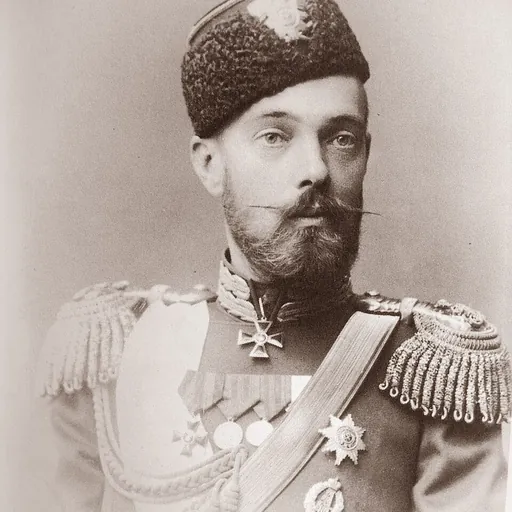
Grand Duke Sergei Mikhailovich of Russia
Russian grand duke (1869-1918); sixth child and fifth son of Grand Duke Michael Nikolaevich of Russia and Princess Cecilie of Baden
About Grand Duke Sergei Mikhailovich of Russia
Lived 1869 – 1918 (aged 48). Grand Duke Sergei Mikhailovich of Russia was a Russian politician, military personnel and military officer.
Grand Duke Sergei Mikhailovich of Russia (; 7 October 1869 – 18 July 1918) was the fifth son and sixth child of Grand Duke Michael Nikolaievich of Russia and a first cousin of Alexander III of Russia.
He was born and raised in the Caucasus, where his father was viceroy. In 1881 the family moved to Saint Petersburg. He became a close friend of the then Tsarevich Nicholas. They grew apart upon Nicholas II's marriage and accession to the throne. Grand Duke Sergei remained a bachelor living at his father's palace in the imperial capital. He had a long affair with the famous ballerina Mathilde Kschessinska, who had previously been the mistress of Nicholas II. She was also later involved with Grand Duke Andrei Vladimirovich. Sergei recognized Mathilde's son as his own and remained their protector until his death.
Following family tradition, Grand Duke Sergei pursued a military career. He served as General Inspector of the Artillery with the rank of Adjutant General. During World War I he was chief of the artillery department, a position he was forced to resign amid controversy. He was then appointed Field Inspector General of Artillery at Stavka. After the fall of the monarchy, he remained in the former Imperial capital keeping a low profile. With the ascension of the Bolsheviks to power, he was sent to internal Russian exile.
He was murdered by the Bolsheviks along with several other Romanov relatives and his personal secretary at Alapayevsk on 18 July 1918, one day after the murder of Tsar Nicholas II and his immediate family at Yekaterinburg.
Early life
Grand Duke Sergei was born on , at Borjomi, his father's estate from Tiflis. He was the fifth son and sixth child of the seven children of Grand Duke Michael Nicolaievich of Russia and his wife Grand Duchess Olga Feodorovna, born Princess Cecile of Baden. Named Sergei after St. Sergius of Radonezh, Grand Duke Sergei Mikhailovich spent his early years in the Caucasus, until 1881 when his family moved to Saint Petersburg. Raised in strict and militaristic environment, he received little affection from his parents. His father, occupied in military and governmental endeavors, remained a distant figure. His demanding mother was a strict disciplinarian and cold towards her children.
Like his brothers, Sergei Mikhailovich was destined from birth to follow a military career. He was two weeks old when he was enrolled in a military unit that was named after him: the 153rd Infantry Vakusnkii Regiment of HIH Grand Duke Sergei Mikhailovich.
A Russian Grand Duke
Sergei Mikhailovich loved the military life and served in a number of regiments. Like his father, he was drawn towards ordnance and artillery. After graduating from the Mikhailovsky Artillery School, he started his military service in the Life Guard of the Cavalry Artillery Brigade. Widely considered rude and moody, he was at the same time sincere, affectionate, loved simplicity and was easily accessible without class distinction.
Grand Duke Sergei Mikhailovich was, unlike his brothers, interested in mathematics and physics, which coincided with his fondness for artillery. She chose his brother over Sergei and married Alexander in 1894. During the last year of Tsar Alexander III's reign, Sergei and his brothers Alexander and George Mikhailovich were constant companions of the future Tsar, Nicholas II. Their closeness ended with Nicholas' ascension to the throne and marriage.
When Nicholas II, then the Tsarevich, broke off with his mistress, the famous ballerina Mathilde Kschessinska, he asked Sergei to take care of her. From 1894, Grand Duke Sergei, who was then 25 years old, became Kschessinska's protector. He provided generously for his mistress. In 1895, the grand duke bought a dacha for her in Strelna. Kschessinska, who was ambitious, used her connections to the Romanovs to promote her career. Grand Duke Sergei tolerated their affair remaining a close and loyal friend to the famous ballerina, but the relationship between the two Grand Dukes was tense. They tried to avoid each other while sharing the same woman for almost two decades.
The ménage à trois became more complicated when on 18 June 1902, Mathilde gave birth to a son. Both Grand Dukes were at first convinced they were the child's father. left After the Revolution, both Kschessinska and Grand Duke Andrei maintained that Andrei was the father, but it was Grand Duke Sergei who looked after Mathilde and her son while he was alive. The child, who became known within the family by his nickname Vova, received the name and patronymic of Vladimir Sergeivich, although no surname was made public until 1911. The birth certificate showed Sergei as the father, and he was devoted to the child. The question of Vladimir's paternity remains unresolved. However, most sources attribute the paternity to Grand Duke Andrei Vladimirovich, who the child resembled. The father of Alexander seems to have been Grand Duke Sergei Mikhailovich. Alexander (1908, Switzerland – 1979, New York) was adopted by a friend of his mother, Sophia Vladimirovna Dehn, whose grandmother was a daughter of Tsar Nicholas I. He spent his childhood in Italy where his adopted father was on naval service. Alexander was a well-known artist and often showed his watercolors at American galleries. He married twice and died in the U.S. in 1979. and Germany in 1913 Sergei Mikhailovich reported to the Government of the feverish work of military factories of the central European powers, but his warning about an imminent war was not heeded by the Russian ministers. In the summer of 1914 just before the outbreak of World War I, Grand Duke Sergei was traveling near Lake Baikal when he fell ill with rheumatic fever in Chita. At his return to Mikhailovskoe, during the first days of autumn, his illness, complicated with pleurisy took a severe form. He spent five months confined to bed before being pronounced fit enough to resume his duties. He was appointed inspector general of Artillery and was attached to the general headquarters, once making a trip to Arkhangelsk to check on the munitions sent there by the allies. He was then appointed Field Inspector General of Artillery at Stavka.
He was in a position to deal with Nicholas II every day, living in the same headquarters train with the Tsar.
At the fall of the monarchy, Grand Duke Sergei was at Mogilev in the company of Nicholas II when he had to abdicate. During the first months of the provisional government, Grand Duke Sergei remained in Mogilev in voluntary exile on the advice of his brother Grand Duke Nicholas Mikhailovich, because of the cloud of corruption that hung over him as a result of the Ksehesinskaya scandal. However, after twenty-two years of having a substitute of a family life with his mistress, he resisted pressure from his brother to break off all relations with Mathilde and her son.
Sergei Mikhailovich returned to Petrograd at the beginning of June 1917. He remained in the former Imperial capital during the period of the constitutional government, living with his brother Nicholas Mikhailovich in the New Michaelovsky Palace. Grand Duke Sergei proposed to Kschessinskaya. She, although caring for him, did not love him and refused. Instead, she decided to join Grand Duke Andrei in the Caucasus. On 13 July, Grand Duke Sergei went to the Nicholas Railway Station to say goodbye to Mathilde and her son.
Captivity After the successful Bolshevik coup of November 1917, the Petrograd newspapers published a decree summoning all male Romanovs to report to the dreaded Cheka, the secret police. Initially they were just required not to leave the city. In March 1918, the Romanovs who registered were summoned again, now to be sent away into internal Russian exile. Sergei Mikhailovich was sent to Viatka, a small town in the foothills of the Ural Mountains. With suitcases in hand, the grand duke arrived at the Nicholas railway station on the afternoon of 4 April 1918. Sergei's personal secretary, Fedor Remez (1878–1918), followed him in his exile. At seven that evening, the train pulled out of Petrograd headed east to Siberia. Grand Duke Sergei departed to his destiny in the company of his secretary, three sons of Grand Duke Konstantine Kosntantinovich (Princes: Ivan, Konstantine and Igor Konstantinovich) and Prince Vladimir Paley, the son of the morganatic marriage of Grand Duke Paul Alexandrovich. In Viatka, the Grand Duke was lodged in a different house from his much younger relatives. Although they all were virtually prisoners, they were allowed to walk freely around town, and could attend services at a local church. However, their situation changed after only eleven days.
On 30 April, Grand Duke Sergei, his secretary, and the other Romanovs with them were transferred to Yekaterinburg by order of the Ural Regional Soviet. The journey lasted for three days through the forest of the Urals. On 3 May 1918, the prisoners arrived in Yekaterinburg. They were housed at the Palace Royal Hotel on the city's Voznesensky Prospekt. A few days later, Grand Duchess Elizabeth Feodorovna, sister of the Tsarina, joined them and they were all allowed a certain amount of freedom. Although the Tsar and Tsarina with their children were there nearby at the Ipatiev House, they were unable to make contact. After two weeks, the Ural Regional Soviet decided once again to transfer Grand Duke Sergei and the other Romanovs in his group. On 18 May 1918, they were told that they were to be taken to the town of Alapayevsk, in the northern Urals, from Yekaterinburg, and ordered to quickly pack. That same afternoon, they boarded a train and, two days later, arrived at their destination.
The Romanovs were placed in the Napolnaya School, on the fringe of the town. The school was small, consisting of only six rooms, the furniture basic but scanty. Although the captives were under the strict guard of the Red Army soldiers, they were allowed to walk in town, to talk to people and to go to church on feasts days. Preparing to spend a long time in Alapayevsk, they planted flowers and vegetable gardens near the school and spent many hours working there.
At shaft # 7, the deepest and longest unused mine shaft, the carriages stopped. The mouth of the mine was filled with dry brushwood and set it alight until there were no signs of life beneath the earth.
Aftermath
On 28 September 1918, the White Army captured Alapayevsk, hoping to rescue the prisoners from the school building. The corpse of Grand Duke Sergei Mikhailovich was recovered two days later.
Identification of the Romanovs was made based on the clothing worn and by papers found in their pockets. The White Army investigators had no medical or dental records, and eleven weeks in the mine had substantially altered the victims' physical appearance. There was a gold pendant in the shape of a potato on a gold chain, the emblem of the "Potato club which Tsarevich Nicholas, Sergei, some of his brothers and friends had formed in the days of their youth. There was also a small gold medallion with an emerald in the middle, which had been a present to Sergei from Mathilde many years earlier. It contained her portrait; a ten kopek piece minted in 1869, the year of Sergei's birth, and was engraved with the words: 21 August Mala – 25 September. The significance of the dates is not known. There was a funeral service for them on 19 October when the coffins were placed in the crypt of the cathedral of the Holy Trinity in Alapayevsk where they remained until July 1919. Then, as Alapayevsk, was about to be retaken by the Red Army, the coffins were moved to Irkutsk. There the coffins rested for less than six months, before the advance of the Red army forced their removal eastward. Early in 1920, the coffins with the remains of Grand Duke Sergei and those killed with him, were taken out of Russia by train through Harbin. By April 1920 the coffins were in Beijing, where they were placed in the crypt of the chapel attached to the Russian Mission. They remained there until 1957 when they were buried at the Russian Orthodox cemetery as the chapel was demolished. The government of the USSR did not have any interest in the preservation of the Russian cemetery in Beijing and in the late 1980s the Chinese authorities converted it into a park. It is believed that the coffins are still in place, now buried beneath a parking area. After the Communist regime collapsed, the mineshaft where the Grand Duke was killed with his relatives became a site of religious pilgrimage and an Orthodox chapel was built there.
Ancestry
Don’t just read it —
keep it.
Full-length biographies made to live with: read them, listen on the way to work, watch them tonight.
- E-book
- Audio
- Video
Instant download · yours to keep · every purchase keeps this site free
Important facts
more
Sergey RomanovFamily & relationships
People in Grand Duke Sergei Mikhailovich of Russia's life
Named in this biography and alive at the same time
Related people
Same field, nearest in time


Contemporaries
People whose lives overlapped Grand Duke Sergei Mikhailovich of Russia's


Frequently asked questions
Who was Grand Duke Sergei Mikhailovich of Russia?
Russian grand duke (1869-1918); sixth child and fifth son of Grand Duke Michael Nikolaevich of Russia and Princess Cecilie of Baden
When was Grand Duke Sergei Mikhailovich of Russia born?
Grand Duke Sergei Mikhailovich of Russia was born on 25 September 1869 in Borjomi.
When did Grand Duke Sergei Mikhailovich of Russia die?
Grand Duke Sergei Mikhailovich of Russia died on 18 July 1918 in Alapayevsk.
What was Grand Duke Sergei Mikhailovich of Russia's occupation?
Grand Duke Sergei Mikhailovich of Russia was a politician, military personnel and military officer.
What nationality was Grand Duke Sergei Mikhailovich of Russia?
Grand Duke Sergei Mikhailovich of Russia was Russian.
Sources & further reading
· Wikipedia: Grand Duke Sergei Mikhailovich of Russia
· DBpedia: Grand Duke Sergei Mikhailovich of Russia
Cite this page
APA: Biography.guide. (2026). Grand Duke Sergei Mikhailovich of Russia. https://biography.guide/grand-duke-sergei-mikhailovich-of-russia/
MLA: "Grand Duke Sergei Mikhailovich of Russia." Biography.guide, https://biography.guide/grand-duke-sergei-mikhailovich-of-russia/.
Chicago: "Grand Duke Sergei Mikhailovich of Russia." Biography.guide. https://biography.guide/grand-duke-sergei-mikhailovich-of-russia/.
Data last updated: 2026-09-27 · Spot an error? Report a correction.
Portrait: Wikimedia Commons · author & licence
Page generated 2026-10-05 02:12 UTC