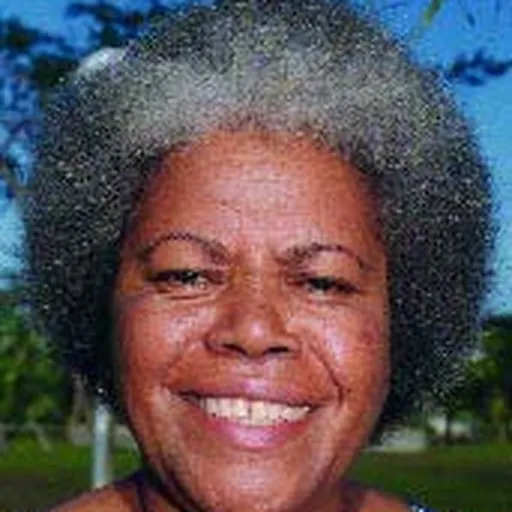
About Grace Mera Molisa
Lived 1946 – 2002 (aged 55). Grace Mera Molisa was a poet, writer and politician.
Grace Mera Molisa (17 February 1946, Aoba Island – 4 January 2002, Port Vila) was a Ni-Vanuatu politician, poet and campaigner for women's equality in politics. The Australian described her as "a vanguard for Melanesian culture and a voice of the Vanuatuans, especially women". She has also been described as one of the Pacific's "leading public intellectuals and activists".
Molisa's education began at her village school on Aoba Island, and continued at the Mission School at Torgil. From there, she went on to attend Queen Victoria Māori Girls' School in Auckland, Aotearoa New Zealand. After leaving school, Molisa attended Auckland Teachers' College and returned to her old school at Torgil as a teacher. She became the first Ni-Vanuatu woman to head a large, senior co-educational boarding school when she was appointed Headmistress of Ombabulu School. Later, Molisa was the first woman from her country to gain a university degree, a Bachelor of Arts degree at the University of the South Pacific in 1977.
Political career In 1979, in the lead-up to Vanuatu's independence, and as a member of the Vanua'aku Pati, Molisa became second secretary of the Ministry of Social Affairs.
She contributed a chapter on postcolonial politics to the scholarly compendium Remembrance of Pacific Pasts: An Invitation to Remake History, edited by Robert Borofsky and published in 2000. Other contributors included Albert Wendt, Vilsoni Hereniko, Marshall Sahlins, James Belich, Gyan Prakash, Edward Said and Epeli Hauʻofa.
Literary career Molisa published Blackstone, a collection of her poems, in 1983. In 1987, she published Colonised People : Poems. The Australian has described her poems as "a biting social commentary on life in patriarchal, post-colonial Vanuatu."
Selina Tusitala Marsh, former New Zealand Poet Laureate and Professor of English at the University of Auckland, has described her as one of the three "foremothers of Pasifika poetry", along with Konai Helu Thaman of Tonga and Haunani-Kay Trask of Hawaii. Marsh's extensive research essay has been published in Cordite Poetry Review.
Poetry by Molisa was included in UPU, a curation of Pacific Island writers’ work which was first presented at the Silo Theatre as part of the Auckland Arts Festival in March 2020. UPU was remounted as part of the Kia Mau Festival in Wellington in June 2021.
Don’t just read it —
keep it.
Full-length biographies made to live with: read them, listen on the way to work, watch them tonight.
- E-book
- Audio
- Video
Instant download · yours to keep · every purchase keeps this site free
Important facts
People in Grace Mera Molisa's life
Named in this biography and alive at the same time




Related people
Same field, nearest in time
Contemporaries
People whose lives overlapped Grace Mera Molisa's

Frequently asked questions
Who was Grace Mera Molisa?
Vanuatuan poet, politician, activist
When was Grace Mera Molisa born?
Grace Mera Molisa was born on 17 February 1946 in Aoba Island.
When did Grace Mera Molisa die?
Grace Mera Molisa died on 4 January 2002 in Port Vila.
What was Grace Mera Molisa's occupation?
Grace Mera Molisa was a poet, writer and politician.
What nationality was Grace Mera Molisa?
Grace Mera Molisa's recorded nationality: Vanuatu.
Sources & further reading
· Wikipedia: Grace Mera Molisa
Cite this page
APA: Biography.guide. (2026). Grace Mera Molisa. https://biography.guide/grace-mera-molisa/
MLA: "Grace Mera Molisa." Biography.guide, https://biography.guide/grace-mera-molisa/.
Chicago: "Grace Mera Molisa." Biography.guide. https://biography.guide/grace-mera-molisa/.
Data last updated: 2026-09-21 · Spot an error? Report a correction.
Portrait: Wikimedia Commons · author & licence
Page generated 2026-09-27 05:01 UTC