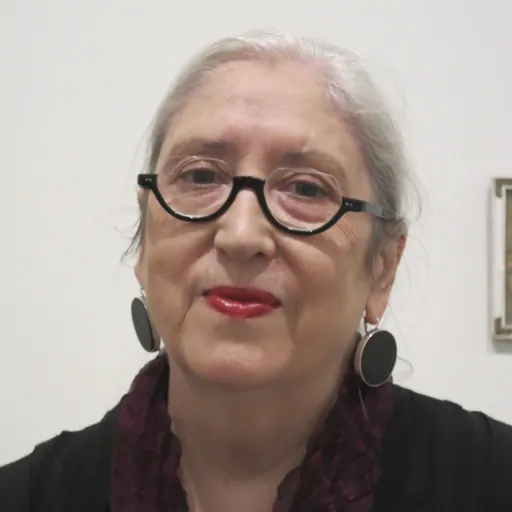
About Graça Morais
Born 1948. Graça Morais is a Portuguese painter and artist.
Graça Morais GOIH (born 1948) is a Portuguese artist. A member of the (National Academy of Fine Arts) of Portugal, she was made a Grand Officer of the Order of Prince Henry in 1997. She is married to the musician Pedro Caldeira Cabral.
Early life and education Maria da Graça Pinto de Almeida Morais was born on 17 March 1948 in the small village of Vieiro, in Freixiel, in the Trás-os-Montes region of northeast Portugal. She was the daughter of Alda Pinto and Jaime Morais, the second of six children. In 1957 and 1958 she lived in Mozambique, which is where her parents gave her a first box of watercolour paints. She first experimented with oil painting in 1964, copying paintings by Gustave Courbet. Morais attended schools in Vila Flor and Bragança before entering the (School of Fine Arts of Porto - ESBAP) in 1971, where she studied painting. In 1971 she married , who was on the same course. They separated in 1985, having one daughter. From 1976 to 1979, she lived and studied in Paris, with a scholarship from the Calouste Gulbenkian Foundation.
Career In 1974 Morais held her first solo exhibition, at the in the town of Guimarães. This was the beginning of a career that has included more than one hundred individual and collective exhibitions. While in Paris she founded the Puzzle Group, together with eight artists and an art critic, which, for two years, presented numerous exhibitions of paintings, installations and performances, including at the in Paris, in 1977. While in Paris she got to know the painters Eduardo Arroyo and Bernard Rancillac, among others. In May 1978 she held a solo exhibition in Paris, entitled A Caça (The Hunt), at the Portuguese Cultural Centre. In the same year, she was the guest in London of the Portuguese-British artist, Paula Rego and her husband, Victor Willing, where she worked in a studio next to Rego's. She represented Portugal in the "Eighty" exhibition, which toured several European cities, and her works formed part of the Arte Contemporáneo Português exhibition at the Museo de Arte Contemporáneo (Madrid), the 70/80 Arte Portuguesa, in São Paulo and Rio de Janeiro, and the Five Portuguese Artists showing at the Art Society of the International Monetary Fund in Washington, D.C. In 2004 she illustrated O Segredo da Mãe, by Nuno Júdice. In 2005, she published a book about her work, Uma Geografia da Alma, with contributions by Júdice, Fernando Pernes, Maria Velho da Costa, and others. During this period, she continued to exhibit on a regular basis, including at the Cascais Cultural Centre. In 2006 she collaborated with the Portuguese poet Sophia de Mello Breyner Andresen on an exhibition held in Lisbon. In 2006, a retrospective of her work was held at the Cordoaria Nacional in Belém, near Lisbon, while in 2007 she held exhibitions in Porto and Coimbra. In 2008, the Centro de Arte Contemporânea Graça Morais (CACGM) was opened in Bragança. Similar to the Casa das Histórias Paula Rego in Cascais, this gallery exhibits pieces from a permanent collection of the work of Morais, together with rotating exhibitions by other artists.
Several wall tapestries of the work of Morais have been made by the Manufactura de Tapeçarias de Portalegre. They can be found in the Assembly of the Republic in Lisbon, at Lisbon City Council, at the Technical University of Lisbon, at the Mário Soares and Maria Barroso Foundation in Lisbon, and elsewhere.
Morais continued to exhibit in Portugal and elsewhere. From 2017 to 2019 she presented at the Champalimaud Foundation in Lisbon, at the Calouste Gulbenkian Foundation in Paris, and at the National Museum of Contemporary Art in Lisbon, among others. In July 2018, the tenth anniversary of the CACGM was celebrated with the establishment of the Laboratory of Arts in the Mountain – Graça Morais (LAM – GM) to promote opportunities for teaching and research activities based on the practice of arts in a mountain context. In 2021 her work was included in an exhibition of the work of 40 Portuguese women at the Calouste Gulbenkian Museum entitled All I Want (Tudo O Que Eu Quero)
Films about Morais The life and work of Graça Morais have been the subject of the film documentaries As Escolhidas (The Chosen - 1997) by Margarida Gil, Na Cabeça de uma Mulher está a História de uma Aldeia (In the Head of a Woman is the Story of a Village - 1999) by Joana Morais, and Graça Morais e os Escritores (Graça Morais and the Writers - 2017) by Luís Alves de Matos. In 2017, she received the Gold Medal of Cultural and Scientific Merit, from the town of Vila Nova de Gaia and, in 2018, she was the recipient of the Medal of Honour of the (IPB). In March 2019, she was awarded the Portuguese .
Don’t just read it —
keep it.
Full-length biographies made to live with: read them, listen on the way to work, watch them tonight.
- E-book
- Audio
- Video
Instant download · yours to keep · every purchase keeps this site free
Important facts
Family & relationships
People in Graça Morais's life
Named in this biography and alive at the same time





Related people
Same field, nearest in time

Contemporaries
People whose lives overlapped Graça Morais's


Frequently asked questions
Who is Graça Morais?
Portuguese painter
When was Graça Morais born?
Graça Morais was born on 17 March 1948 in Trás-os-Montes.
What is Graça Morais's occupation?
Graça Morais is a painter and artist.
What nationality is Graça Morais?
Graça Morais is Portuguese.
Sources & further reading
Cite this page
APA: Biography.guide. (2026). Graça Morais. https://biography.guide/graca-morais/
MLA: "Graça Morais." Biography.guide, https://biography.guide/graca-morais/.
Chicago: "Graça Morais." Biography.guide. https://biography.guide/graca-morais/.
Data last updated: 2026-09-23 · Spot an error? Report a correction.
Portrait: Wikimedia Commons · author & licence
Page generated 2026-09-27 05:05 UTC