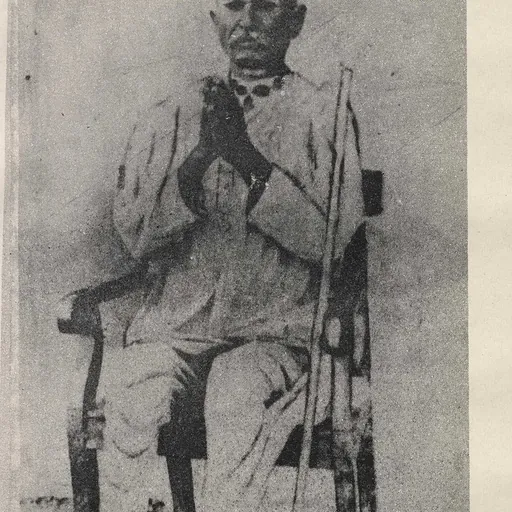
Govindgiri
Social and religious reformer
About Govindgiri
Lived 1858 – 1931 (aged 72–73). Govindgiri was an Indian social reformer.
Govindgiri, also known as Govind Guru Banjara, (1858–1931) was a social and religious reformer in the early 1900s in the tribal border areas of present-day Rajasthan and Gujarat states in India. He is seen as having popularized the Bhagat movement, which was first started in the 18th century.
Early life Govindgiri was born in a Banjara family in the village of Bansiya (Hindi: बाँसिया) in Dungarpur State (now in Rajasthan). to have been a hali (a 'hali has been described as a worker "not employed at their own convenience but maintained as permanent estate servants, and not regarded to be in a position to resign services)." His wife and child reportedly died in the famine of 1900, after which he moved into the neighbouring Sunth State. There, Govindgiri married his brother's widow and, soon after, became the disciple of a Hindu monk (gosain) Rajgiri; in honor of Rajgiri, Vinda changed his name into Govindgiri. Around 1909 he returned to Dungarpur State with his wife and children, to the village of Vedsa. He organized the sampa sabha (Hindi: सम्प सभा) with the intent of serving the tribal people. Govindgiri preached monotheism, observance of temperance, forsaking crimes, following agriculture, giving up beliefs in superstition, etc. Drawing on the ritual practices of the Shaivite sect Dashanami Panth, Govindgiri encouraged his followers to tend a dhuni (fire pit) and hoist a nishan (flag) outside their houses. He declared Rajputs and Brahmins inferior in this respect because they degraded women, citing the Rajput custom of female infanticide and the Rajput and Brahmin prohibition against widow remarriage. He faced active opposition from the rulers of the states in which he preached. The state accused him of deceiving his followers, confiscated his savings and pressured him to stop his movement by imprisoning his wife and child (or children).
On 31 October 1913, Govindgiri adherents captured a couple of police personnel of the Sunth State who were sent up the hill for reconnaissance.
Aftermath Those arrested at Mangadh were tried on 2 February 1914 before a special tribunal consisting of one Major Gough and one Major Allison, I.C.S. He was also prohibited from entering several princely states.
Recognition Govind Guru Samadhi Mandir, a memorial shrine at Kamboi, is visited by his followers.
Shri Govind Guru University in Godhra, established in 2015, and Govind Guru Tribal University (established in 2012, renamed in 2016) in Banswara are named after him.
Don’t just read it —
keep it.
Full-length biographies made to live with: read them, listen on the way to work, watch them tonight.
- E-book
- Audio
- Video
Instant download · yours to keep · every purchase keeps this site free
Important facts
Related people
Same field, nearest in time



Contemporaries
People whose lives overlapped Govindgiri's


Frequently asked questions
Who was Govindgiri?
social and religious reformer
When was Govindgiri born?
Govindgiri was born in 1858 in Dungarpur State.
When did Govindgiri die?
Govindgiri died on 30 October 1931 in Gujarat, Panchmahal district.
What was Govindgiri's occupation?
Govindgiri was a social reformer.
What nationality was Govindgiri?
Govindgiri was Indian.
Sources & further reading
Cite this page
APA: Biography.guide. (2026). Govindgiri. https://biography.guide/govindgiri/
MLA: "Govindgiri." Biography.guide, https://biography.guide/govindgiri/.
Chicago: "Govindgiri." Biography.guide. https://biography.guide/govindgiri/.
Data last updated: 2026-09-23 · Spot an error? Report a correction.
Portrait: Wikimedia Commons · author & licence
Page generated 2026-09-27 05:07 UTC