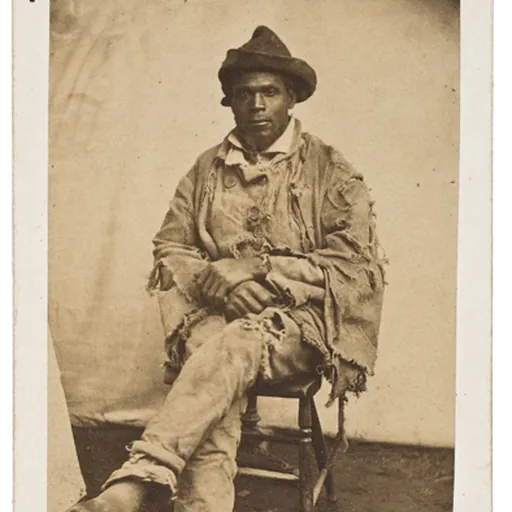
About Gordon
Gordon was a soldier.
Peter (also known as Gordon, "Whipped Peter", or "Poor Peter") was an escaped American slave who was the subject of photographs documenting the extensive keloid scarring of his back from whippings received in slavery. Although keloid scarring was not a usual consequence of whipping, the "scourged back" photo became one of the most widely circulated photos of the abolitionist movement during the American Civil War and remains one of the most notable photos of the 19th-century United States.
The photo of the scourged back "spurred a number of different narratives, all of which were intended to illustrate the meaning of his portrait, and privilege his photograph as a means by which to picture slavery and dramatize the need for abolition". In 2013, Joan Paulson Gage wrote in The New York Times that "The images of Wilson Chinn in chains, like the one of Gordon and his scarred back, are as disturbing today as they were in 1863. They serve as two of the earliest and most dramatic examples of how the newborn medium of photography could change the course of history."
Many historians have repeated the account presented in an 1863 Harper's Weekly article which consisted of a triptych of illustrations (all said to be of Gordon) and a narrative describing Gordon's escape from slavery and enlistment in the Union Army as factual.
Gallery
Background
Map of the Atchafalaya Basin produced 1863 for the Army of the Gulf: John Lyons' plantation was on the west bank of the Atchafalaya River; Baton Rouge and Port Hudson are to the east along the Mississippi River. (U.S. National Archives and Records Administration, item 77-CWMF-M99) On January 29, 1863, Union Major General Nathaniel P. Banks issued his General Order 12, which affirmed that the Emancipation Proclamation applied in Louisiana, except in 12 parishes that had been specifically exempted. However, for the time being at least, the U.S. Army did not intend to interfere with specific plantations. and in some cases thousands-strong columns of freed slaves followed U.S. Army troop movements through the South. Contrabands were ultimately recruited in large numbers to the U.S. Colored Troops. USCT units constituted approximately 10 percent of the Union Army manpower by war's end.
Peter Peter departed for freedom on March 24, 1863, at midnight. The Lyons plantation was located along the west bank of the Atchafalaya River, between present-day Melville and Krotz Springs, Louisiana. As it happens, this was not far from the Red River district of Louisiana, which was the setting of both Tom's final dwelling place in the fictional Uncle Tom's Cabin, and the site of the Eppes plantation described by Solomon Northup in Twelve Years a Slave. A newspaper writer of the 1850s commented on the tortures described by Northrup: "the nearest plantation was distant ... a half-mile, and of course there could be no interference on the part of neighbours in any punishment, however cruel, or however well disposed to interfere they might be."
John Lyons, St. Landry Parish, 1860 slave schedule; Peter (or "Gordon") is likely one of the 38 slaves enumerated as property of Lyons In this transcript Peter mentions "salt brine, which Overseer put in my back". Other substances, including turpentine, hot-pepper juice, and dripping candle wax, were also used. An interview with a man named Andrew Boone for the WPA's Slave Narratives project in the 1930 matter-of-factly described the practice: "By dis time de blood sometimes would be runnin' down dere heels. Den de next thing was a wash in salt water strong enough to hold up an egg. Slaves wus punished dat way fer runnin' away an' sich."
Under the imprint "McPherson & Oliver, Baton Rouge", Louisiana photographers William D. McPherson and J. Oliver produced the original photos of Peter showing his back. There are three variations of the "scourged back" picture, showing minor adjustments, which indicates that the photographers or their patrons were aware of the impact of the image and "revised" the pose to improve it.
Samuel Knapp Towle, Surgeon, 30th Regiment of Massachusetts Volunteers, wrote in a letter about meeting Gordon. He had expected him to be vicious due to the whip scars on his back. Instead, he said "he seems INTELLIGENT and WELL-BEHAVED" [Towle's emphasis]. Other physicians, like J. W. Mercer, Asst. Surgeon 47th Massachusetts Volunteers as well as a surgeon of the First Louisiana regiment (colored), said in 1863 that they had seen many backs like this,
Gordon "Gordon" (Harper's Weekly)
Union Army service
According to one study of images of African-Americans during the American Civil War,
[The] photographically mediated before and after narrative quickly became a popular means by which White Northern cultural producers framed the social, cultural, and political meanings of emancipation. Formally, the genre consists of two or more photographs or photographically inspired drawings that were more often than not annotated with typed or hand-written captions. In this way, the written word borrowed from the evidentiary authority of the photograph so as to produce a new kind of slave narrative, one capable not only of telling slavery's story to the eye, but also capable of doing so without the aid of the speaking Black narrator. In other words, the before and after narrative, White writers' written 'philosoph[ies]' and the visual 'facts' of injured Black bodies, effaced the narrative authority of formerly enslaved African-American narrators, and supplanted the former slave's written and spoken testimony with a picture. According to Harper's Weekly, Gordon joined the Union Army as a guide three months after the Emancipation Proclamation allowed for the enrollment of freed slaves into the military forces. On one expedition, he was taken prisoner by the Confederates; they tied him up, beat him, and left him for dead. He survived and once more escaped to Union lines. The siege was the first time that African-American soldiers played a leading role in an assault during the American Civil War. There were five regiments known as the Corps D'Afrique Engineers, recruited by Gen. Daniel Ullman, that participated in the Port Hudson campaign, primarily digging trenches and contributing to the force strength of the 20,000 Union troops facing the 12,000 Confederates.
Timeline Military map of a part of Louisiana compiled at the U.S. Coast Survey Office, 1863; Peter lived in approximately the upper left corner of the map, near Bayou Beouf and Bayou Cocodrie; the raiders that killed Lyons reportedly rode from Morganzia; Port Hudson is almost directly east of the vicinity of the Lyons plantation; the Amite River (which drains from Lake Maurepas) and Baton Rouge both lie on the east side of the Mississippi River Late October 1862 – Peter whipped by overseer "Artayon Carrier" Christmas 1862 – Begins to "recover senses", told that he had attempted to "shoot everybody" – Emancipation Proclamation in effect in St. Landry Parish – General Order 12: Promulgation of the Emancipation Proclamation – Peter departs for Baton Rouge – Peter makes statement at Provost-Marshal's office in Baton Rouge April or May 1863 – Peter photographed by McPherson & Oliver – Siege of Vicksburg begins – Siege of Port Hudson begins June 1863 – "Bostonian" takes copies of McPherson & Oliver's of Peter and Gordon to New York – Etchings of Peter, Gordon and a third individual appear as illustrations of "A Typical Negro" article in Harper's Weekly – Peter's former owner John Lyons is killed at his plantation by pro-Union raiders
Influence The third version of the Scourged Back was used as a title-page illustration for this edition of Fanny Anne Kemble's 1863 memoir of living on a Sea Islands cotton plantation in 1838. Theodore Tilton, editor of The Independent in New York stated in 1863:
Five or six months after the scourging ... the frightful laceration was partially healed, and only scars remained. But what must the whipping have been to leave such scars! The back looks like a plate of iron, eaten by acids and corroded by rust; or like a walnut-table honey-combed by worms ... Bits as big as the hand seem to have been cut out of the flesh. No wonder that, at this distance of time, the man looks thin and ghastly, though he was a strong man, and must be a man of fine physique and presence.
This card-photograph should be multiplied by the hundred thousand, and scattered over the states. It tells the story in a way that even Mrs. Stowe cannot approach; because it tells the story to the eye. If seeing is believing—and it is in the immense majority of cases—seeing this card would be equivalent to believing things of the slave states which Northern men and women would move heaven and earth to abolish.
In 2015, Frank Goodyear, a former curator of photographs at the Smithsonian National Portrait Gallery said, "Photography mediates our understanding of the world ... many Americans had never seen what a beating literally looked like." The Atlantic editor-in-chief James Bennet in 2011 noted, "Part of the incredible power of this image I think is the dignity of that man. He's posing. His expression is almost indifferent. I just find that remarkable. He's basically saying, 'This is a fact.
On September 15, 2025, The Washington Post reported that the Trump administration has ordered the removal of the "scourged back" photo from Fort Pulaski National Monument along with other signs and exhibits related to slavery at multiple national park sites.
In popular culture In the 2012 film Lincoln, Abraham Lincoln's son Tad views a glass plate of Gordon's medical examination photo by candlelight. American artist Arthur Jafa recreated the iconic image of Gordon as a sculpture titled Ex-Slave Gordon (2017). The work is made of vacuum-formed plastic and depicts Gordon's back from the waist up. Emancipation, a 2022 film based on Peter and Gordon's escape, starring Will Smith and directed by Antoine Fuqua, went into production in 2021, and was made available for streaming on December 9, 2022 on Apple TV+.
Don’t just read it —
keep it.
Full-length biographies made to live with: read them, listen on the way to work, watch them tonight.
- E-book
- Audio
- Video
Instant download · yours to keep · every purchase keeps this site free
Important facts
Related people
Same field, nearest in time




Frequently asked questions
Who was Gordon?
American enslaved man
When did Gordon die?
Gordon died in 1900.
What was Gordon's occupation?
Gordon was a soldier.
Sources & further reading
· DBpedia: Peter (enslaved man)
Cite this page
APA: Biography.guide. (2026). Gordon. https://biography.guide/gordon-soldier/
MLA: "Gordon." Biography.guide, https://biography.guide/gordon-soldier/.
Chicago: "Gordon." Biography.guide. https://biography.guide/gordon-soldier/.
Data last updated: 2026-09-22 · Spot an error? Report a correction.
Portrait: Wikimedia Commons · author & licence
Page generated 2026-09-27 05:01 UTC