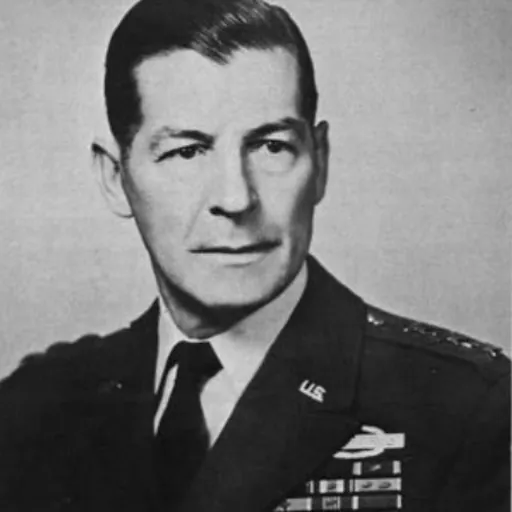
About Gordon Byrom Rogers
Lived 1901 – 1967 (aged 65). Gordon Byrom Rogers was an American military personnel and NATO.
Gordon Byrom Rogers (22 August 1901 – 3 July 1967) was a United States Army lieutenant general who served in several command positions during World War II and the Korean War, including the United States Military Advisory Group to the Republic of Korea and the 3rd Armored Division.
Early life Rogers was born in Manchester, Tennessee. He attended the University of Tennessee for a year.
Start of military career
He graduated from the United States Military Academy in 1924, and was commissioned a second lieutenant of cavalry. After graduation, Rogers was assigned to the 1st Cavalry Regiment.
In 1929 he completed the Cavalry Officer Course and in 1930 he graduated from the Advanced Equitation Course, both at Fort Riley, Kansas.
For several years, Rogers played on the Army polo team. In 1930, he was a member of the U.S. Olympic Equestrian Team.
During the 1930s, Rogers served with the 10th and 2nd Cavalry Regiments.
In 1939, he graduated from the Army Command and General Staff College. He was then assigned to the 6th Cavalry at Fort Oglethorpe, Georgia, where he commanded a cavalry troop and then a cavalry squadron.
World War II In February 1942, he joined the 3rd Cavalry Regiment at Fort Benning, Georgia, and soon advanced to regimental commander. He was the final commander of the regiment as a horse cavalry formation, and in the summer of 1942 it fielded tanks and was reorganized as the 3rd Armored Regiment.
In July 1942, Rogers was named deputy chief of staff for intelligence, G-2 at I Corps, during training and mobilization in South Carolina, remaining with the corps during its move to Australia and subsequent combat in the Pacific Ocean Theater.
General Rogers was next assigned as G-2 for Army Ground Forces, serving in this post until September 1945.
Post-World War II After the war, Rogers was assigned to the War Department General Staff as chief of the Training Branch in the Office of the Director of Intelligence.
Beginning in September 1946, Rogers took part in the post-war occupation of Japan as commander of the 12th Cavalry Regiment and the 5th Cavalry Regiment.
In July 1949, Rogers was appointed director of intelligence for the Command and General Staff College.
Rogers graduated from the Army War College in 1951, afterwards remaining at the college as a member of the faculty and acting deputy commandant.
Korean War In June 1952, General Rogers went to Korea as assistant division commander of the 40th Infantry Division.
After briefly serving as deputy commander, in May 1953 Rogers was named commander of the United States Military Advisory Group to the Republic of Korea, where he served until October 1953. In this assignment, Rogers was responsible for providing training and logistics support to the Republic of Korea Army.
Post-Korean War Following that assignment, he was appointed commanding general of the 3rd Armored Division, based at Fort Knox, Kentucky. Under his command, the division was reorganized from a training unit to a deployable one and plans were made to relocate it to West Germany.
Following his division command, Rogers served in Munich, West Germany, as commander of the Southern Area Command and deputy commander of the Seventh Army. In 1958, he became commander of VII Corps.
From 1959 until his 1961 retirement, Rogers was deputy commander of the Continental Army Command at Fort Monroe, Virginia. In this position, he chaired the Army Aircraft Requirements Review Board (or Rogers Board), which made recommendations contained in the Army's long-term Aircraft Development Plan, as well as recommendations for the creation of air assault units.
Post-military career After his retirement from the Army General Rogers served as Director of the NATO Mutual Weapons Development Team.
Awards and decorations General Rogers' awards included: the Distinguished Service Cross (two awards); Distinguished Service Medal; Silver Star (two awards); Legion of Merit (three awards); Purple Heart; Bronze Star Medal (two awards); and Combat Infantryman's Badge.
Retirement and death In retirement, Rogers resided in Severna Park, Maryland. Rogers died at Walter Reed Hospital on July 3, 1967, and was buried with his wife at Arlington National Cemetery.
Family In 1934, Rogers married Mary Louise Watson (1910–1963) in Washington, DC. One of their children, Gordon Byrom Rogers Jr. (born October 21, 1934) graduated from the United States Military Academy in 1957. The younger Rogers was a career Army officer who served in the Vietnam War and attained the rank of brigadier general.
In 1964, Rogers married Mildred Montague Kimball at her ranch in Sedalia, Colorado.
Other In his memoir, David Hackworth cites Rogers as an example of Korean War senior officers who received undeserved awards for valor. According to Hackworth, Rogers received the Silver Star for nothing more than spending a short time at a forward command post while serving as assistant division commander of the 40th Infantry Division. Hackworth indicated that his perception of this incident led him to decide that the military's awards process had become devalued, and that senior officers should almost never be recommended for valor medals.
Don’t just read it —
keep it.
Full-length biographies made to live with: read them, listen on the way to work, watch them tonight.
- E-book
- Audio
- Video
Instant download · yours to keep · every purchase keeps this site free
Important facts
People in Gordon Byrom Rogers's life
Named in this biography and alive at the same time




Related people
Same field, nearest in time





Contemporaries
People whose lives overlapped Gordon Byrom Rogers's



Frequently asked questions
Who was Gordon Byrom Rogers?
United States Army lieutenant general (1901-1967)
When was Gordon Byrom Rogers born?
Gordon Byrom Rogers was born on 22 August 1901 in Manchester.
When did Gordon Byrom Rogers die?
Gordon Byrom Rogers died on 3 July 1967 in Washington, D.C..
What was Gordon Byrom Rogers's occupation?
Gordon Byrom Rogers was a military personnel and NATO.
What nationality was Gordon Byrom Rogers?
Gordon Byrom Rogers was American.
Sources & further reading
· Wikipedia: Gordon Byrom Rogers
· DBpedia: Gordon Byrom Rogers
Cite this page
APA: Biography.guide. (2026). Gordon Byrom Rogers. https://biography.guide/gordon-byrom-rogers/
MLA: "Gordon Byrom Rogers." Biography.guide, https://biography.guide/gordon-byrom-rogers/.
Chicago: "Gordon Byrom Rogers." Biography.guide. https://biography.guide/gordon-byrom-rogers/.
Data last updated: 2026-09-21 · Spot an error? Report a correction.
Portrait: Wikimedia Commons · author & licence
Page generated 2026-09-27 04:59 UTC