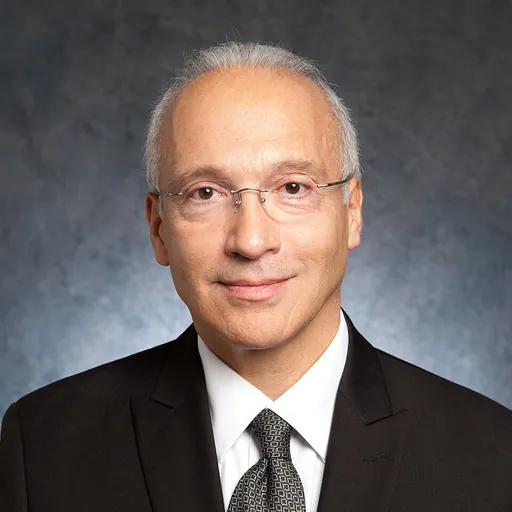
About Gonzalo P. Curiel
Born 1953. Gonzalo P. Curiel is an American lawyer and judge.
Gonzalo Paul Curiel (born September 7, 1953) is a Senior United States district judge of the United States District Court for the Southern District of California.
Early life and education Curiel was born in East Chicago, Indiana, the youngest of four children. His parents, Salvador and Francisca, had emigrated from Mascota, a small Mexican town near Puerto Vallarta in the state of Jalisco. Salvador worked as a laborer in Arizona before moving to Indiana where he worked in the steel mills. (It has been reported that Salvador came to the U.S.) through the Bracero program which was established in 1942; Gonzalo's brother Raul says their father became a legal resident prior to the arrival of their mother Francisca in 1946.
Curiel graduated from high school at the Bishop Noll Institute.
Pre-judicial career Curiel worked in private practice, first at James, James & Manning from 1979 to 1986 and then at Barbosa & Vera from 1986 to 1989. The two men objected to extradition by arguing that the information used to track them down had been obtained in Mexico via torture. Curiel argued: "The [U.S.] Government is not here to deny there is a possibility of torture. ... There are serious allegations of torture. But the forum for those allegations to be aired is the Government of Mexico." The extradition case went up to a federal appeals court, with Curiel arguing the case. The appeals court decided that the extradition could proceed, saying that there was enough evidence to support it without using the evidence allegedly obtained via torture.
Curiel then worked as an assistant United States attorney in the Central District of California from 2002 to 2006. He held that position until his appointment to the federal bench.
Curiel received a hearing before the Senate Judiciary Committee on March 28, 2012, which reported his nomination to the Senate on April 26, 2012, by voice vote. In the early hours of September 22, 2012, on what was officially still the legislative day of September 21, the Senate confirmed Curiel by voice vote. He received his commission on October 1, 2012. He assumed senior status on September 7, 2023. In October 2014, Curiel certified Cohen v. Trump as another national class action against then-entrepreneur Donald Trump. In March 2016, Curiel allowed Makaeff to withdraw her name from the first lawsuit, and the case was retitled Low v. Trump University.
In May 2016, Curiel granted a request by The Washington Post for public release of certain Trump University documents and depositions that had been filed in the case. Curiel scheduled a trial to begin in the Low case on November 28, 2016, in San Diego. He had planned to start the trial in the summer of 2016, but postponed it until after the 2016 Presidential election because of concerns that jurors would be affected by a "media frenzy" if the trial took place before the election. On November 18 a $25 million settlement of all three pending cases (Curiel's two class-action suits plus a suit filed by the attorney general of New York) was announced and was certified by Curiel. Implementation of the settlement was delayed because one individual claimant wished to pursue a separate lawsuit. A district court and an appeals court rejected that individual's claim, and Curiel finalized the settlement in April 2018. Former students can now get a refund of up to 90% of the money they spent on courses.
During the campaign Trump repeatedly criticized Curiel in campaign speeches and interviews, calling him a "hater of Donald Trump", saying his rulings have been unfair, and that Curiel "happens to be, we believe, Mexican, which is great. I think that's fine", while suggesting that the judge's ethnicity posed a conflict of interest in light of Trump's proposal to build a wall on the U.S.-Mexican border. Curiel wrote in court papers that Trump has "placed the integrity of these court proceedings at issue", On June 7, 2016, Trump issued a lengthy statement saying that his criticism of the judge had been "misconstrued" and that his concerns about Curiel's impartiality were not based upon ethnicity alone, but also upon rulings in the case. In reply, Cato Institute fellow Nat Hentoff wrote that thus far in the case, Curiel had ruled in Trump's favor far more often than not, including granting his motion to delay the trial until after the 2016 presidential election, and concluded that "Donald Trump has an odd way of showing his appreciation for a trial judge who, as his attorney said, is just 'doing his job'." In November 2017 at an appeals court hearing, one of Trump's attorneys said that Trump had changed his opinion of Curiel and now regarded his actions as a "textbook example of a district court properly administering a settlement".
U.S.–Mexico border wall case Curiel also heard a case brought by the State of California and California Coastal Commission, a number of environmentalist groups, and U.S. Representative Raúl Grijalva (Democrat of Arizona) that challenged waivers issued in 1996 and 2005 that allowed the federal government to bypass some federal and state environmental laws to promote border security. These waivers were granted under a 1996 immigration law. Three separate lawsuits were initially brought, challenging the U.S. Department of Homeland Security's power to waive these laws to construct a border wall. Curiel consolidated these into a single case, In re Border Infrastructure Environmental Litigation.
The plaintiffs argued that the waivers were ultra vires and not authorized by the 1996 immigration law; they also raised constitutional challenges grounded in the Nondelegation Doctrine, Take Care Clause, Presentment Clause, First Amendment and Tenth Amendment.
Curiel is a member of American Bar Association, and served on the ABA's Hispanic Advisory Committee of the Commission on Public Understanding about the Law from 1993 to 1998. Neither these groups nor Curiel are affiliated with the National Council of La Raza (NCLR), an unrelated advocacy group.
Don’t just read it —
keep it.
Full-length biographies made to live with: read them, listen on the way to work, watch them tonight.
- E-book
- Audio
- Video
Instant download · yours to keep · every purchase keeps this site free
Important facts
People in Gonzalo P. Curiel's life
Named in this biography and alive at the same time


Related people
Same field, nearest in time


Contemporaries
People whose lives overlapped Gonzalo P. Curiel's

Frequently asked questions
Who is Gonzalo P. Curiel?
United States District Judge
When was Gonzalo P. Curiel born?
Gonzalo P. Curiel was born on 7 September 1953 in East Chicago.
What is Gonzalo P. Curiel's occupation?
Gonzalo P. Curiel is a lawyer and judge.
What nationality is Gonzalo P. Curiel?
Gonzalo P. Curiel is American.
Sources & further reading
· Wikipedia: Gonzalo P. Curiel
Cite this page
APA: Biography.guide. (2026). Gonzalo P. Curiel. https://biography.guide/gonzalo-p-curiel/
MLA: "Gonzalo P. Curiel." Biography.guide, https://biography.guide/gonzalo-p-curiel/.
Chicago: "Gonzalo P. Curiel." Biography.guide. https://biography.guide/gonzalo-p-curiel/.
Data last updated: 2026-09-22 · Spot an error? Report a correction.
Portrait: Wikimedia Commons · author & licence
Page generated 2026-09-27 05:01 UTC