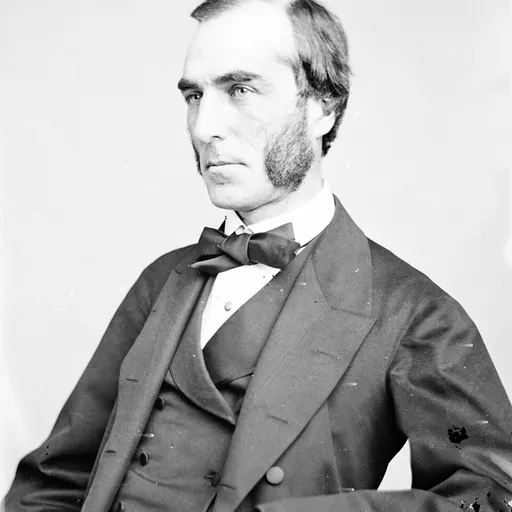
About Goldwin Smith
Lived 1823 – 1910 (aged 86). Goldwin Smith was a British historian, journalist, university teacher, pamphleteer and writer.
Goldwin Smith (13 August 1823 – 7 June 1910) was a British-born academic and historian who was active in both Great Britain and North America. From 1856 to 1866, he was a professor of modern history at the University of Oxford. Smith taught at Cornell University from 1868 to 1872, and was instrumental in establishing the university's international reputation, but left when it began admitting female students. He is the namesake of Goldwin Smith Hall at Cornell University, and was outspoken regarding his often controversial political views. Smith was a supporter of the Union during the American Civil War and a critic of imperialism. He was also opposed to the Irish Home Rule movement and women's suffrage, along with holding Anglo-Saxonist and antisemitic views.
Early life and education Smith was born at Reading, Berkshire. He threw his energy into the cause of university reform with another fellow of University College, Arthur Penrhyn Stanley. On the royal commission of 1850 to inquire into the reform of the university, of which Stanley was secretary, Smith served as assistant-secretary; and he was then secretary to the commissioners appointed by the Oxford University Act 1854. His position as an authority on educational reform was further recognised by a seat on the Popular Education Commission of 1858. In 1868, when the question of reform at Oxford was again growing acute, he published a pamphlet, entitled The Reorganization of the University of Oxford.
In 1865, he led the University of Oxford opposition to a proposal to develop Cripley Meadow north of Oxford railway station for use as a major site of Great Western Railway (GWR) workshops. His father had been a director of GWR. Instead the workshops were located in Swindon. He was public with his pro-Northern sympathies during the American Civil War, notably in a speech at the Free Trade Hall, Manchester in April 1863 and his Letter to a Whig Member of the Southern Independence Association the following year.
Besides the Universities Tests Act 1871, which abolished religious tests, many of the reforms suggested, such as the revival of the faculties, the reorganisation of the professoriate, the abolition of celibacy as a condition of the tenure of fellowships, and the combination of the colleges for lecturing purposes, were incorporated in the Universities of Oxford and Cambridge Act 1877, or subsequently adopted by the university. Smith gave the counsel of perfection that "pass" examinations ought to cease; but he recognised that this change "must wait on the reorganization of the educational institutions immediately below the university, at which a passman ought to finish his career." His aspiration that colonists and Americans should be attracted to Oxford was later realised by the will of Cecil Rhodes. On what is perhaps the vital problem of modern education, the question of ancient versus modern languages, he pronounced that the latter "are indispensable accomplishments, but they do not form a high mental training" – an opinion entitled to peculiar respect as coming from a president of the Modern Language Association.
Oxford years
He held the Regius professorship of Modern History at Oxford from 1858 to 1866, that "ancient history, besides the still unequalled excellence of the writers, is the 'best instrument for cultivating the historical sense." As a historian, indeed, he left no abiding work; the multiplicity of his interests prevented him from concentrating on any one subject. His chief historical writings – The United Kingdom: a Political History (1899), and The United States: an Outline of Political History (1893) — though based on thorough familiarity with their subject, make no claim to original research, but are remarkable examples of terse and brilliant narrative. He was elected as a member of the American Philosophical Society in 1865.
The outbreak of the American Civil War proved a turning point in his life. He quickly began championing the Union cause, and his pamphlets, especially one entitled Does the Bible Sanction American Slavery? (1863), played a prominent part in hardening British public opinion against the Confederate States of America. Visiting America on a lecture tour in 1864, he received an enthusiastic welcome, and was entertained at a public banquet in New York. Andrew Dickson White, president of Cornell University at Ithaca, New York, invited him to take up a teaching post at the newly founded institution. But it was not until a dramatic change in Smith's personal circumstances that led to his departure from England in 1868, that he took up the post. He had resigned his chair at Oxford in 1866 in order to attend to his father, who had suffered permanent injury in a railway accident. In the autumn of 1867, when Smith was briefly absent, his father took his own life. Possibly blaming himself for the tragedy, and now without an Oxford appointment, he decided to move to North America.
Cornell years
Smith's time at Cornell was brief, but his impact there was significant. He held the professorship of English and Constitutional History in the Department of History at Cornell University from 1868 to 1872. The addition of Smith to Cornell's faculty gave the newly opened university "instant credibility." During Smith's time at Cornell he accepted no salary and provided much financial support to the institution. He lived at Cascadilla Hall among the students, and was much beloved by them.
On 19 June 1906, Goldwin Smith Hall was dedicated, at the time Cornell's largest building and its first building dedicated to the humanities, as well as the first home to the College of Arts and Sciences. Smith personally laid the cornerstone for the building in October 1904 and attended the 1906 dedication.
While resident in the city he became a prominent man of letters and controversialist: he helped launch and write for the Canadian Monthly and National Review (founded by G. Mercer Adam "with the co-operation of Prof. Goldwin Smith"), issued a one-man monthly, The Bystander (1880–81), and then became part-proprietor and a leading contributor to the weekly The Week (from December 1883).
Alongside his journalism, Smith took part in Toronto's civic and academic life. He advocated university reform, regularly attended University of Toronto functions, and in 1905 accepted appointment to a royal commission on the university; a 1906 act created a new board of governors on which he served.
In 1896 Smith acquired a controlling interest in the Canada Farmers' Sun (Toronto)—often referred to simply as The Farmer's Sun—using it to argue for free trade and other positions he championed in his later years.
He was elected a Foreign Member of the American Antiquarian Society in October 1893. He continued to publish pamphlets and letters (including occasional pieces in the Spectator) and to circulate reminiscences such as My Memory of Gladstone (1904).
Smith died at The Grange on 7 June 1910. and was a strong supporter of Irish Disestablishment, but refused to follow Gladstone in accepting Home Rule. and state socialism, as he discussed in his Essays on Questions of the Day (revised edition, 1894). He also published sympathetic monographs on William Cowper and Jane Austen, and attempted verse in Bay Leaves and Specimens of Greek Tragedy. In his Guesses at the Riddle of Existence (1897), he abandoned the faith in Christianity that he had expressed in his lecture of 1861, Historical Progress, in which he forecast the speedy reunion of Christendom on the "basis of free conviction," and wrote in a spirit "not of Agnosticism, if Agnosticism imports despair of spiritual truth, but of free and hopeful inquiry, the way for which it is necessary to clear by removing the wreck of that upon which we can found our faith no more."
Anglo-Saxonism Smith is considered by historian Edward P. Kohn to be a "devout Anglo-Saxonist", a racial belief system developed by British and American intellectuals, politicians and academics in the 19th century. In his view, Smith defined the "Anglo-Saxon race" as not necessarily being limited to English people, but extended to the Welsh and Lowland Scots, though not the Irish. Speaking in 1886, he proclaimed that he was standing "by the side of John Bright against the dismemberment of the great Anglo-Saxon community of the West, as I now stand against the dismemberment of the great Anglo-Saxon community of the East." These words formed the key to his views of the future of the British Empire and he was a leading member of the anti-imperialist "Little Englander" movement.
Smith thought that Canada was destined by geography to become part of the United States. In his view, separated by artificial north–south barriers, into zones communicating naturally with adjoining portions of the United States, Canada was an artificially constructed and badly-governed nation. In his view, it would eventually break away from the British Empire, and the "Anglo-Saxons" of the North American continent would become one nation. These views are most fully developed in his work Canada and the Canadian Question (1891). Smith's views on the future of Canada–United States relations were criticised by Canadian priest George Monro Grant in the Canadian Magazine.
Imperialism
Smith identified as an anti-imperialist, describing himself as "anti-Imperialistic to the core". Despite this, he admired aspects of the British Empire; speaking on the topic of British rule in India, Smith claimed that "it is the noblest the world has seen.... Never had there been such an attempt to make conquest the servant of civilization. About keeping India there is no question. England has a real duty there." Smith remained resolutely opposed to Britain granting more representative government to India, expressing fear that this would lead to a "murderous anarchy."
When the Second Boer War (1899–1902) broke out, Smith published several articles in the Canadian press and a book In The Court of History: An Apology of Canadians Opposed to the Boer War (1902) expressing his opposition to the war. Arguing against British involvement in the war on pacifist grounds, Smith's views were uncommon among the English Canadian community of the period. Smith published another anti-imperialist work in 1902, Commonwealth or Empire?, arguing against the United States assuming an imperialistic foreign policy in the aftermath of its victory in the Spanish–American War.
Antisemitism Smith held strong antisemitic views. Described by McMaster University professor Alan Mendelson as "the most vicious anti-Semite in the English-speaking world", Smith referred to Jews as "parasites" who absorb "the wealth of the community without adding to it". Research by Glenn C. Altschuler and Isaac Kramnick has studied Smith's writings on Jews, which claimed that they were responsible for a form of "repulsion" they provoked in others, due to his assertion of their "peculiar character and habits", including a "preoccupation with money-making", which made them "enemies of civilization". He also denigrated brit milah, a Jewish ritual of circumcision, as a "barborous rite", and proposed either culturally assimilating Jews or deporting them to Palestine as a solution to the "Jewish problem".
Smith wrote that "The Jewish objective has always been the same, since Roman times. We regard our race as superior to all humanity, and we do not seek our ultimate union with other races, but our final triumph over them." He had a strong influence on William Lyon Mackenzie King and Henri Bourassa. He proposed in other writings that Jews and Arabs were of the same race. He also believed that Islamic oppression of non-Muslims was for economic factors. In December 2020, the Cornell University Board of Trustees voted to remove Smith's name from the honorific titles of twelve professors at Cornell. The Board took this action in recognition of Smith's "racist, sexist and anti-Semitic" views. The Board declined to rename Goldwin Smith Hall.
Antisuffragism Smith was strongly opposed to the women's suffrage movement, both in the United Kingdom and in the United States. In 1874, he published a treatise in Macmillan's Magazine titled Female Suffrage in opposition to a proposed bill on women's suffrage. In the treatise, he explained his view that "The very foundations of society are touched when change is proposed in the relations of the sexes."
Legacy Goldwin Smith is credited with the quote "Above all nations is humanity," an inscription that was engraved in a stone bench he offered to Cornell in May 1871. The bench sits in front of Goldwin Smith Hall, named in his honour. This quote is the motto of the University of Hawaiʻi and other institutions around the world (for example, the Cosmopolitan Club at the University of Illinois at Urbana–Champaign).
Another stone bench inscribed with the motto, sits on the campus of Boğaziçi University in Istanbul. It sits with a clear view down onto the city.
After his death, a plaque in his memory was erected outside his birthplace in the town centre of Reading. This still exists, outside the entrance to the Harris Arcade.
Don’t just read it —
keep it.
Full-length biographies made to live with: read them, listen on the way to work, watch them tonight.
- E-book
- Audio
- Video
Instant download · yours to keep · every purchase keeps this site free
Important facts
People in Goldwin Smith's life
Named in this biography and alive at the same time



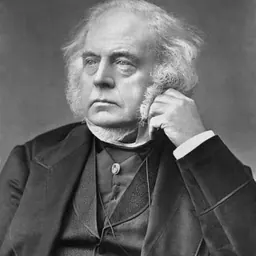

Related people
Same field, nearest in time



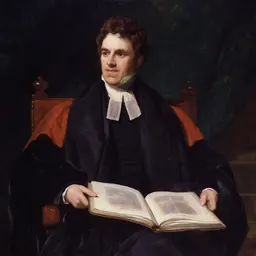

Contemporaries
People whose lives overlapped Goldwin Smith's



Frequently asked questions
Who was Goldwin Smith?
British historian and journalist (1823–1910)
When was Goldwin Smith born?
Goldwin Smith was born on 13 August 1823 in Reading.
When did Goldwin Smith die?
Goldwin Smith died on 7 June 1910 in Toronto.
What was Goldwin Smith's occupation?
Goldwin Smith was a historian, journalist, university teacher, pamphleteer and writer.
What nationality was Goldwin Smith?
Goldwin Smith was British.
Sources & further reading
Cite this page
APA: Biography.guide. (2026). Goldwin Smith. https://biography.guide/goldwin-smith/
MLA: "Goldwin Smith." Biography.guide, https://biography.guide/goldwin-smith/.
Chicago: "Goldwin Smith." Biography.guide. https://biography.guide/goldwin-smith/.
Data last updated: 2026-09-22 · Spot an error? Report a correction.
Portrait: Wikimedia Commons · author & licence
Page generated 2026-09-27 05:01 UTC