About Godred Crovan
Lived 1050 – 1095 (aged 44–45). Godred Crovan was a ruler.
Godred Crovan (died 1095), known in Gaelic as Gofraid Crobán, Gofraid Meránach, and Gofraid Méránach, was a Norse-Gaelic ruler of the kingdoms of Dublin and the Isles. Although his precise parentage has not completely been proven, he was certainly an Uí Ímair dynast, and a descendant of Amlaíb Cúarán, King of Northumbria and Dublin.
Godred first appears on record in the context of supporting the Norwegian invasion of England in 1066. Following the collapse of this campaign, Godred is recorded to have arrived on Mann, at the court of Gofraid mac Sitriuc, King of the Isles, a likely kinsman of his. During the 1070s, the latter died and was succeeded by his son, Fingal. Within the decade, Godred violently seized the kingship for himself, although the exact circumstances surrounding this takeover are uncertain. By 1091, Godred attained the kingship of Dublin, and thereby secured complete control of the valuable trade routes through the Irish Sea region. Godred's expansion may be further perceptible in the Clyde estuary and Galloway, and may well have forced the English to consolidate control of Cumberland in an effort to secure their western maritime flank. Godred appears to have drawn his power from the Hebrides; and archaeological evidence from Mann reveals that, in comparison to the decades previous to his takeover, the island seems to have enjoyed a period of relative peace.
During his reign, Godred appears to have lent military assistance to Gruffudd ap Cynan, King of Gwynedd, a probable kinsman, who was then locked in continuous conflicts with Welsh rivals and encroaching English magnates. The earliest known Bishops of the Isles date from about the time of Godred's reign, although it is almost certain that earlier ecclesiastes held this position. It may have been just prior to Godred's accession in the Isles, whilst Dublin was under the ultimate control of Toirdelbach Ua Briain, King of Munster, that Dublin and the Isles were ecclesiastically separated once and for all. Godred's rule in Dublin came to an abrupt end in 1094 with his expulsion at the hands of Muirchertach Ua Briain, King of Munster, a man who may have even driven Godred from Mann as well. Documentary evidence reveals that the last decade of the eleventh century saw an upsurge in plague and famine. According to Irish sources, one quarter of Ireland perished from pestilence in 1095 alone. One of the fatalities was Godred himself, who died on Islay, an apparent power centre in the Isles.
Godred's greatest impact on history may have been his founding of the Crovan dynasty, his patrilineal descendants who ruled in the Isles for almost two centuries. Godred was an important maternal ancestor of Clann Somairle, a family that held power in the Isles centuries after the final extinction of the Crovan dynasty. As such, he may be identical to Gofraid mac Fergusa, an apparent genealogical construct claimed as a Clann Somairle ancestor. Godred may well be identical to the celebrated King Orry of Manx legend, a figure traditionally credited with instituting the Manx legal system. Godred and King Orry are associated with numerous historic and prehistoric sites on Mann and Islay.
Familial origins
While the familial origins of Godred Crovan are not completely proven, it appears certain that he was a direct descendant of Amlaíb Cúarán, King of Northumbria and Dublin. Although the thirteenth- to fourteenth-century Chronicle of Mann calls him in Latin "... ", implying that his father was named Aralt, the fourteenth-century Annals of Tigernach instead calls him in Gaelic "... ", contrarily implying that it was Godred's grandfather who was named Aralt. nephew, or brother of Ímar mac Arailt, King of Dublin. However, the early-thirteenth-century pedigree Achau Brenhinoedd a Thywysogion Cymru in the Welsh collection of genealogical tracts records "Gwrthryt Mearch" (Godred Crovan) as the son of "Harallt Ddu" (Harald "The Black" of Islay), who in turn was the son of "Ifor Gamle" (Ímar mac Arailt). As such, it appears that Godred was not the son, nephew or brother, but, in fact, the grandson of Ímar mac Arailt, King of Dublin, patrilineal descendant of Amlaíb Cúarán, King of Northumbria and Dublin, and member of the Uí Ímair. The chronicle's passage may further cast light on Godred's familial origins. Although "" may represent Iceland, there is no other evidence linking Godred to this island. where he is otherwise known to have ended his life. Another possibility is that "" represents Ireland, which, if correct, would evidence Godred's close familial links with that particular island. Whatever the case, according to the same source, he had been brought up on Mann.
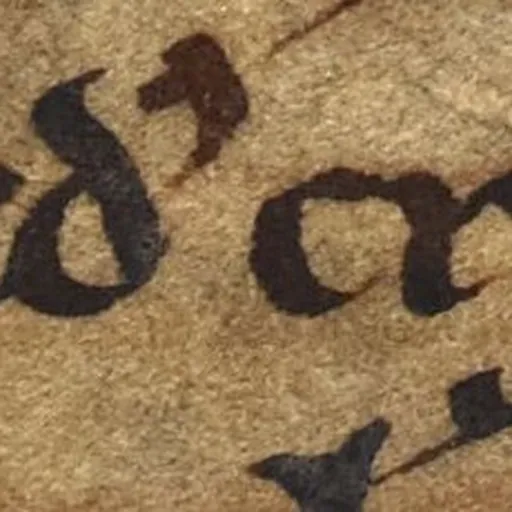
Godred's name as it appears on folio 19v of Oxford Bodleian Library Rawlinson B 488 (the Annals of Tigernach): ""
When Godred is first noted by the Latin Chronicle of Mann, he is accorded the epithet "" or "". The origin and meaning of this name are uncertain. It may well be derived from the Gaelic ("white-handed"). Another Gaelic origin may be ("white-blooded"), in reference to being very pale. Alternately, it could originate from the Gaelic ("claw"). If the epithet is instead Old Norse in origin, it could be derived from ("cripple"). In several Irish annals, Godred is accorded the epithet . This word could represent either the Gaelic ("mad", "confused", "giddy"); or else (which can also be rendered ), a word derived from ("finger" or "toe"). If indeed corresponds to the latter meaning, the epithet would appear to mirror /, and imply something remarkable about Godred's hands. Godred and his patrilineal royal descendants, who reigned in the Isles for about two centuries, are known to modern scholars as the Crovan dynasty, a name coined after Godred himself. The combination of Old Norse personal names and Gaelic epithets accorded to Godred, and his dynastic descendants, partly evidence the hybrid nature of the Norse-Gaelic Kingdom of the Isles.
Background
One of the foremost leaders of the eleventh-century Norse world was Þórfinnr Sigurðarson, Earl of Orkney, a man whose maritime empire, like that of his father before him, stretched from Orkney to the Isles, and perhaps even into Ireland as well. Þórfinnr died in about 1065, and was succeeded by his two sons, Páll and Erlendr. Unfortunately for the brothers, the expansive island empire that their father had forged appears to have quickly disintegrated under their joint rule. Although there is no record of the brothers conducting military operations in the Isles and Ireland, the thirteenth-century Orkneyinga saga states that the peripheral regions of their father's lordship reverted to the control of local leaders. It was into this power vacuum that Godred first emerges into recorded history.
The ruler of the Isles who appears to have suffered from Þórfinnr's southward expansion was Echmarcach mac Ragnaill, King of Dublin and the Isles. The turn of the mid-eleventh century saw the gradual decline of Echmarcach's authority. In 1052, he was driven from Dublin by Diarmait mac Maíl na mBó, King of Leinster. Although there is evidence to suggest that Diarmait reinstated Ímar as King of Dublin, the latter was dead within two years, and at some point Diarmait appears to have placed his own son, Murchad, upon the throne. About a decade after Diarmait's conquest of Dublin, an invasion of Mann by Murchad appears to have resulted in the submission or expulsion of Echmarcach altogether, effectively giving Diarmait control over the Irish Sea region. When Murchad died in 1070, Diarmait assumed control of Dublin and perhaps Mann as well.
The ruler of Mann in about 1066 was Gofraid mac Sitriuc, King of the Isles, a man who appears to have reigned under Diarmait's overlordship. Like Godred himself, Gofraid mac Sitriuc may have been a descendant of Amlaíb Cúarán. On Diarmait's unexpected death in 1072, Toirdelbach Ua Briain, King of Munster invaded Leinster, and acquired control of Dublin. Within a year of gaining lordship over the Dubliners, Toirdelbach appears to have installed, or at least recognised a certain Gofraid mac Amlaíb meic Ragnaill as their king. In fact, this man appears to have been a close kinsman of Echmarcach, possibly his nephew. As such, Gofraid mac Amlaíb meic Ragnaill seems to have been a member of a Norse-Gaelic kindred possessing close marital links with the Uí Briain. Such links may well explain the remarkable rapidity with which the Uí Briain struck out at Dublin and the Isles after Diarmait's demise. Whilst there is reason to suspect that Sitriuc was a brother of Gofraid mac Amlaíb meic Ragnaill, the attack itself was almost certainly a continuation of the Uí Briain's conquest of Dublin the year before.
image1 = Godred Crovan triumph.jpg width1 = image2 = Godred Crovan.jpg width2 =
Godred seems to have spent his early career as a mercenary of sorts. Certainly the Chronicle of Mann states that he took part in the ill-fated Norwegian invasion of England in 1066. This Norwegian campaign culminated in the Battle of Stamford Bridge, a bloody autumn encounter in which Harold Godwinson, King of England utterly destroyed the forces of Haraldr Sigurðarson, King of Norway in north-eastern England. The slaughter at Stamford resulted in the total destruction of Norwegian military power, and it took almost a generation before a king of this realm could reassert authority in the Norse colonies of the British Isles. If the eleventh-century chronicler Adam of Bremen is to be believed, an Irish king was slain during the battle, which could indicate that Godred formed part of the Irish Sea contingent, a host perhaps led by the slain king. At any rate, it was in the aftermath of this defeat that the chronicle first notes Godred: stating that, following his flight from the battle, Godred sought sanctuary from Gofraid mac Sitriuc, and was honourably received by him. Godred's participation in the Norwegian enterprise, which was also supported by the sons of Þórfinnr, partly evidences the far-flung connections and interactions of the contemporary Norse elite.
A depiction of English infantry and Norman cavalry on the eleventh-century Bayeux Tapestry. In the course of his career, Godred appears to have battled both Anglo-Saxon and Anglo-Norman forces. The depicted infantry are shown formed in a shield wall, a tactic employed by the Norwegian-backed forces at Stamford Bridge.
Godred's arrival on Mann, rather than Dublin, may well be explained by the varying political alignments in the Irish Sea region. Whilst he had allied himself to the cause of the invading Haraldr, the cause of the defending Harold was clearly adhered to by Diarmait, the contemporary overlord of Dublin. In fact, the latter seems to have lent Harold's family—the Godwinsons—assistance in the decade before the Norwegian invasion. He later sheltered Harold's sons following the eventual English defeat at the hands of the Normans, and further gave the Godwinsons military assistance in their insurrections against the new Norman regime in 1068 and 1069.
Regardless of Godred's possible ancestral links with Ireland, his political leanings could have meant that Dublin was unsafe for him in 1066. Whatever the case, the former's death is recorded in 1070, after which his son, Fingal, apparently succeeded to the kingship. Possibly in about 1075, or 1079, the chronicle reveals that Godred succeeded in conquering Mann following three sea-borne invasions. On one hand, it is possible that Godred overthrew Fingal, who may have been weakened by the Uí Briain assault on the island in 1073. On the other hand, the amiable relations between Godred and Fingal's father could suggest that, as long as Fingal lived his kingship was secure, and that it was only after his death that Godred attempted to seize control.
Sky Hill, where Godred is said to have vanquished the Manx once and for all. According to the chronicle, some of his troops hid in the wood surrounding the hill, and his victory was achieved when they ambushed the unsuspecting Manx from the rear.
Godred's power base may have been located in the Hebrides, the northern reaches of the realm. After his takeover of Mann, a conquest that culminated in the Battle of Sky Hill, the chronicle claims that Godred offered his followers the choice of either plundering the island or of settling upon it. Only a few of his Islesmen are stated to have remained with him on Mann. According to the chronicle, Godred granted the incomers lands in the south of the island, and allowed the natives lands in the north, on the condition that they give up all heritable rights to this territory. It was through this act, alleges the chronicle, that Godred's later successors owned the entirety of the island. This portrayal of Godred's takeover—in which a conqueror establishes his dynasty's dominance over the traditional rights of a native landholding populace—parallels the traditional mediaeval accounts of Haraldr hárfagri, a king traditionally said to have deprived Norwegian landholders their heritable rights.
Although several place names on Mann appear to date to the tenth- and eleventh-centuries, stemming from direct settlement from Norway or Norwegian colonies in Scotland and the Isles, many Manx place names that contain the Old Norse element - appear to have been coined by later settlers from Denmark or the Danelaw. Some of these settlers would have arrived on the island from the Danelaw in the tenth century, whilst others could have arrived in the course of Godred's conquest. In fact, as late as the sixteenth century some of the island's most considerable lands contained this word element. Further after-effects of Godred's conquest may perceptible by numismatic evidence. Almost twenty mediaeval silver hoards have been uncovered on Mann. Almost a dozen date between the 1030s and the 1070s. The finds seem to suggest that the island suffered from power struggles until the establishment of Godred and his descendants.
Domination of Dublin and the Irish Sea
The Annals of Tigernach and the Chronicle of Mann evidence Godred's conquest of the Kingdom of Dublin in about 1091. Specifically, the former source accords him the title "King of Dublin" that year, whilst the latter source claims that he subjugated all of Dublin and much of Leinster. Although the chronicle's statement regarding Leinster is almost certainly an exaggeration, it may well refer to the seizure of the full extent of Fine Gall, and the extension of royal authority over adjoining regions. Dublin's political affiliation at about this period in time is uncertain. In 1088, Donnchad mac Domnaill Remair, King of Leinster seems to have utilised troops from Dublin in his attack on Waterford. Whilst within the same year, troops from Dublin, Waterford, and Wexford were repulsed in an attack on Cork by the Uí Echach Mumain. The following year, Donnchad is further accorded the title , which suggests that he ruled Dublin by this point. Muirchertach Ua Briain, King of Munster certainly gained authority over Dublin within the year, although the fact that the annal-entry evidencing Godred's kingship there in 1091 contains no verb could suggest that he too reigned in Dublin as early as 1089. Whatever the case, Godred's acquisition of this coastal settlement may well have been a strike of sheer opportunism in which he took advantage of the ongoing conflict between the kingdoms of Munster and Leinster. His probable familial links with Dublin could have contributed to his remarkable success as well, and it is possible that the Dubliners considered this conquest as a restoration of the kingdom's royal family. Certainly his conquests in the Irish Sea region amounted to the reunification of the Uí Ímair imperium,
Viking Age trade routes in north-west Europe. As the ruler of Dublin and the Isles, Godred dominated the routes through the Irish Sea region.
Despite Godred's apparent ancestral connections to the kingdoms of Dublin and the Isles, his rise to power could well have been driven by economic realities as much as royal aspirations. Dublin was one of the wealthiest ports in western Europe. By the end of the eleventh century, it was the most important population centre in Ireland. There appear to have been three main routes in the region: one running from southern Wales to south-eastern Ireland (connecting the settlements of Waterford and Wexford in Ireland, with Bristol and St Davids in Wales); another route running from the river Dee in northern Wales to Mann itself, and to the rivers Liffey and Boyne in Ireland (thereby connecting the ports of Chester and Holyhead in Wales, with those of Dublin and Drogheda in Ireland); the third trade route running perpendicular to the aforementioned, extending south to the Continent and north through the Hebrides to Iceland, Orkney, Shetland, Scandinavia, and the Baltic region. Godred's conquest of Dublin, therefore, could have been undertaken in the context of an Islesman securing possession of the region's southernmost routes, thereby giving him total control of the Irish Sea trade nexus. a statement implying his maritime dominance over contemporaries. The chronicle's record of Godred's death on Islay could indicate that the island formed a secondary power centre in the Isles. The fact that Historia Gruffud vab Kenan notes that Gruffudd travelled into the Isles to obtain military assistance from Gothrei could also be evidence that Godred's headquarters was located there. The record of Godred's death on Islay further suggests that he may well have been buried on the nearby holy island of Iona, the burial place of his like-named grandson, Gofraid mac Amlaíb, King of Dublin and the Isles.
Legacy
Síol nGofraidh and the Crovan dynasty
Godred's greatest impact on history may have been his foundation of the Crovan dynasty, a vigorous family of sea-kings that ruled in the Isles for almost two centuries, until its extinction in the mid-thirteenth century, when the remaining kingdom was annexed by Alexander III, King of Scotland. There is uncertainty concerning the political situation in the Isles in the last decade of the eleventh century. It is apparent, however, that the dynasty descended from him soon turned upon itself. Although Godred's eldest son, Lagmann, appears to have succeeded him during the decade, the latter was soon forced to fend off rivals' factions supporting Godred's younger sons, Aralt in particular. Irish power appears to have encroached into the Isles at about this time as well, and it is evident that the political upheaval and dynastic instability in the wake of Godred's demise eventually provoked Magnús Óláfsson, King of Norway to forcibly take control of the Isles before the century's end. It was not until the about the second decade of the twelfth century that the Crovan dynasty re-established firm control, in the person of Amlaíb, Godred's youngest son.
In the mid-twelfth century, the Isles were partitioned between two rival power blocks. One faction, controlling Mann and the northern Hebrides, was led by the representative of the Crovan dynasty, Gofraid mac Amlaíb, Godred's grandson; the other faction, controlling the southern Hebrides, was ruled by Somairle mac Gilla Brigte, Lord of Argyll, husband of Ragnailt ingen Amlaíb, Godred's granddaughter. Somairle eventually forced his brother-in-law from power, and ruled the entire kingdom for almost a decade before the Crovan dynasty regained control of their permanently partitioned domain. Although the dynasty expired in the mid-thirteenth century, Somairle's descendants—Clann Somairle—held power in the Hebrides for centuries to come. In fact, the later mediaeval Clann Somairle Lordship of the Isles, which survived into the late fifteenth century, was a direct successor of Godred's maritime imperium.
The Chronicle of Mann, Orkneyinga saga, and later tradition preserved in the eighteenth-century Book of Clanranald, reveal that it was through Ragnailt's descent that Clann Somairle, and Somairle himself, claimed kingship in the Isles. Godred's place at the royal apex of the two dynasties who contested the kingship of the Isles in the twelfth and thirteenth centuries suggests that he is identical to the like-named man proclaimed as an eminent ancestral figure in two thirteenth-century poems concerning Clann Somairle dynasts. The professed descendants of this Gofraid were poetically conceptualised as ("the seed of Gofraid"), a Gaelic term that, conceivably, originally applied to both the Crovan dynasty and Clann Somairle. and otherwise only specifically attested in later genealogical accounts concerning Clann Somairle. That being said, Godred is possibly the historical prototype of the celebrated King Orry (Manx Gaelic and ) of Manx folklore. This legendary figure appears in the earliest example of Manx literature, the so-called Manannan Ballad, an eighteenth-century text that appears to contain content of sixteenth-century provenance. This traditional account of Mann asserts that, following King Orry's arrival, and his subsequent introduction of the island's legal system, thirteen of his descendants ruled in turn as king before Alexander III's takeover. In fact, this tally appears to conform to the number of historical Manx rulers during the Crovan dynasty's floruit. King Orry, and thus Godred himself, is seemingly referred to in Manx legislation dating to the early fifteenth century, as the term "in King Orryes Days" was recorded at the 1422 sitting of Tynwald. This phrase likely equates to "time immemorial", a time beyond memory, once defined under English law as the time before the reign of the celebrated Richard I, King of England. The site itself is likely prehistoric, although there is a legitimate late-eleventh-century cross-slab found on the island, near Port Ellen , that appears to contain motifs from contemporary Scandinavian and Irish art. As with Godred on Islay, supposed burial places of King Orry are traditionally marked by prehistoric burial sites on Mann. One such site is the now-mutilated tomb, known as King Orry's Grave , located near Laxey; another is Cashtal yn Ard , also known as Cashtal Ree Gorree, located near Maughold. The so-called Godred Crovan Stone, a massive granite rock, once located in the Manx parish of Malew but destroyed in the nineteenth century, may have owed its name to eighteenth- or nineteenth-century romanticism.
The area surrounding Dùn Ghùaidhre , a ruinous mediaeval fortress on Islay, is traditionally associated with Godred, According to local tradition, Godred slew a dragon at Emaraconart, a site only about from the fortress and ridge. A nearby site is Àiridh Ghutharaidh. The etymology of this place name is uncertain. It could be derived from the Gaelic ("shieling") and * (a hypothesised Gaelic form of the Old Norse personal name ). The fact that this site is only about from Dùn Ghùaidhre could suggest that the names of both locations refer to Godred. On the other hand, it is possible that the names of the fort, ridge, and shieling are merely the result of folk etymology. Another Islay site associated with Godred is Conisby . This place name is derived from the Old Norse * ("king's farm"), a prestigious designation that appears to echo the district's not insignificant size and quality of lands. Whether the site was ever owned by a king is unknown, although local tradition certainly associates it with Godred himself.
The eighteenth-century poet Thomas Chatterton composed Godred Crovan, a poem that appeared in print in 1769, under the full title Godred Crovan. A poem. Composed by Dopnal Syrric, Scheld of Godred Crovan, King of the Isle of Man, published in the Town and Country Magazine. The poem appears to have influenced the work of the contemporaneous poet William Blake, particularly Blake's first piece of revolutionary poetry, Gwin, King of Norway. Whilst Chatterton's composition tells the tale of an invasion of Mann by a tyrannous Norseman named Godred Crovan, Blake's ballad is about a tyrannous Norse king who is slain by a native giant named Gordred. Chatterton's compositions in Town and Country Magazine were strongly influenced by, and imitative of, the so-called Ossianic poetry of the contemporaneous poet James Macpherson. In fact, it was likely through Chatterton's work that Blake was most influenced by Macpherson. Unlike Macpherson, who deceptively insisted that his epic Ossianic corpus was translated from the work of an ancient Celtic bard, Chatterton did not claim his Ossianic inspired compositions were the remnants of ancient literature. #tag:ref|That being said, Chatterton famously forged a corpus of so-called Rowleian poetry that he claimed was the work of a mediaeval monk named Thomas Rowley. Surviving in several eighteenth-century manuscripts, Fin as Oshin tells a tale similar to other poems recounting the story of the burning of Finn's house. A central character in the song is a certain Gorree/Orree/Orree Beg, a hero who corresponds to Garadh/Garaidh in cognate tales. The spelling of this hero's name in Fin as Oshin suggests that he represents Godred himself, thereby giving the story a native slant. Godred's place in this song probably accounts for its survival in local memory. In Vindication of the Celtic Character, the nineteenth-century Gaelic poet William Livingstone offered imaginative accounts of Viking incursions on Islay. One such tale, alleged by Livingstone to have been "handed down from the Danish mythologists of those days", concerns exploits of Godred in the island's Loch Indaal vicinity. Livingstone's versions of such local traditions appear to be the inspiration behind his epic Gaelic battle-poem Na Lochlannaich an Ile ("The Norsemen in Islay"). The Gaelic folk song Birlinn Ghoraidh Chróbhain, sometimes called Birlinn Ghoraidh Chrobhain and Godred Crovan's Galley, was composed by Duncan Johnston, and released in part one of his 1938 book Cronan nan Tonn. Johnston's song describes the journey of Godred's royal birlinn from Mann to Islay, and commemorates the sea-power of the Crovan dynasty.
Due to Godred's place in Manx history, he is given a role in the fictional history of The Island of Sodor in The Railway Series by Wilbert Awdry (the name Sodor itself being a reference to the title of Bishop of Sodor and Man). The station of Crovan's Gate as depicted in the books and the TV adaption Thomas & Friends is the junction of the North Western Railway and the narrow gauge Skarloey Railway, and in Awdry's writing was the site of a battle between Godred Crovan and the Norman army.
Don’t just read it —
keep it.
Full-length biographies made to live with: read them, listen on the way to work, watch them tonight.
- E-book
- Audio
- Video
Instant download · yours to keep · every purchase keeps this site free
Important facts
more
Gofhraidh Meranach, Gofraidh Crobh-bhán, Gofraidh Mérach, Guðrøðr Crobán, Guðrøðr Crovan, Guðrøðr cróvan, Gofraid Meránach, Guðrøð, Godfrey Croven, Godred Crowan, Guðrøð Crovan, Godfrey, Godred, Goffraigh, Gofhraidh, Gofraid, Gofraidh, Goraidh, Goffraigh Meranach, Gofraid Crobhan, Goraidh Crobhan, Goffraid, Guðröðr, Goffraid Méranach, Godred Méránach, Gofraid Croban, Gofraid Meranach, Godred Cro ban, GofraiPeople in Godred Crovan's life
Named in this biography and alive at the same time


Related people
Same field, nearest in time


Contemporaries
People whose lives overlapped Godred Crovan's



Frequently asked questions
Who was Godred Crovan?
King of Dublin and the Isles
When was Godred Crovan born?
Godred Crovan was born in 1050 in Isle of Man.
When did Godred Crovan die?
Godred Crovan died in 1095 in Islay.
What was Godred Crovan's occupation?
Godred Crovan was a ruler.
Sources & further reading
Cite this page
APA: Biography.guide. (2026). Godred Crovan. https://biography.guide/godred-crovan/
MLA: "Godred Crovan." Biography.guide, https://biography.guide/godred-crovan/.
Chicago: "Godred Crovan." Biography.guide. https://biography.guide/godred-crovan/.
Data last updated: 2026-09-20 · Spot an error? Report a correction.
Portrait: Wikimedia Commons · author & licence
Page generated 2026-09-27 04:57 UTC