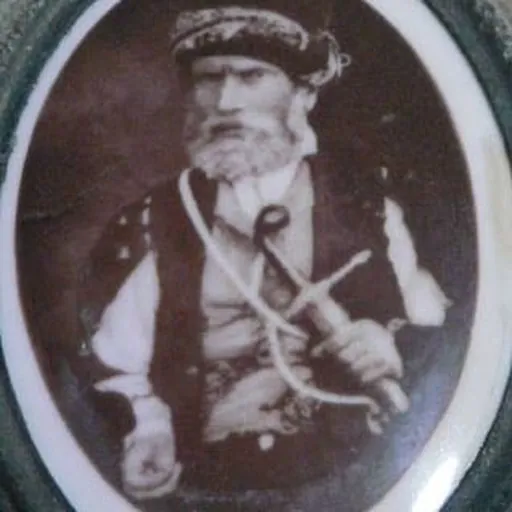
Giuseppe Ferlini
19th-century Italian treasure hunter
About Giuseppe Ferlini
Lived 1797 – 1870 (aged 73). Giuseppe Ferlini was an Italian explorer, anthropologist, archaeologist, surgeon and treasure hunter.
Giuseppe Ferlini (; 23 April 1797 – 30 December 1870 ) was an Italian medical doctor, soldier and treasure hunter. A pioneer in the sale of Kushite antiquities, he is best known for his destruction and dismantling of various Nubian pyramids in the ancient city of Meroë, including that belonging to Kandake Amanishakheto in 1834. Ferlini's archaeological methods have been criticized for focusing on treasure retrieval over scientific and contextual documentation as well as badly damaging the pyramids of Meroë. Spurred by legends from local workers who talked about 40 ardeb of gold hidden in the ancient Nubian ruins, he decided to desert, determined to either "return home penniless, or carrying unprecedented treasures". In 1833 he asked for and obtained from the Governor-General of the Sudan, Ali Kurshid Pasha, the permission to perform excavations in the area around the Kushite city of Meroë, discovered by the French scholar Frédéric Cailliaud a few years earlier. Along with Stefani, Ferlini organized an expedition that left for Meroë on 10 August 1834. He levelled the pyramid, starting from the top, and found a treasure composed of dozens of pieces of gold and silver jewellery located in a chamber a little below the apex. Ferlini's discovery was exceptional, as the treasure had remained undisturbed since the Queen's burial, despite most of the tombs being looted in ancient times.
Ferlini recounts dismantling five, possibly six, pyramids stone by stone: first four smaller ones, then the tallest in the necropolis, that of Queen Amanishakheto. While work was being carried out on the latter pyramid, Ferlini started working on another small pyramid. However, while Ferlini does not appear to have personally destroyed many of these monuments, his actions, especially the discovery of the treasure in Amanishakheto's Pyramid, may have inspired imitators. In his report on his travels in the Meroë region (April 1844), the Prussian archaeologist Karl Richard Lepsius noted that 'the discovery of Ferlini is in everybody's head still, and has brought many a pyramid to ruin.' Lepsius himself had to contend with Osman Bey, an Egyptian military commander who had arrived in Meroë with an army of 5,000 men with the intention of destroying the pyramids in search of treasure.
Return to Italy When Amanishakheto's pyramid had been dismantled, Ferlini began digging a tunnel at its base. He discovered a masonry wall which he believed was part of an even more opulent tomb. Eager to keep his find a secret, he dismissed all the workers he had hired for the excavations and continued on alone. Sensing that an important discovery had been made, the workers rebelled, forcing Ferlini and Stefani to flee the area. The two men slipped away in the middle of the night and travelled upstream on the Nile. Once in Cairo, they set sail for Italy with the treasure.
In 1836, the Bolognese scholar Carlo Pancaldi published a report on Ferlini's discoveries. Encouraged by the positive reception of Pancaldi's work in scholarly circles, Ferlini wrote a report of the expedition containing a catalog of his findings, which was translated to French and republished in 1838. However, the deal was not concluded, and this was the first in a series of failures and disappointments.
Several experts examined the objects, including Luigi Ungarelli, Ippolito Rosellini and Arcangelo Michele Migliarini. Sales negotiations were also held with both the Holy See and the Tuscan government. Part of the treasure was sent to London, where it aroused the interest of the British Museum. However, the museum eventually declined to purchase it after some of its experts concluded that it was fake. The treasures were eventually sold in Germany: a part was purchased by king Ludwig I of Bavaria and it's now in the State Museum of Egyptian Art of Munich, while the remaining – under suggestions of Lepsius and of Christian Charles Josias von Bunsen – was bought by the Egyptian Museum of Berlin where it still located.
Ferlini died in Bologna on 30 December 1870, and was buried in the Certosa di Bologna. He had married twice and had a daughter, Clytemnestra, with his second wife. She inherited his father's collection of antiquities and papers, including a manuscript about his archaeological research in Africa, which was published posthomously.
Works
Don’t just read it —
keep it.
Full-length biographies made to live with: read them, listen on the way to work, watch them tonight.
- E-book
- Audio
- Video
Instant download · yours to keep · every purchase keeps this site free
Important facts
People in Giuseppe Ferlini's life
Named in this biography and alive at the same time


Related people
Same field, nearest in time

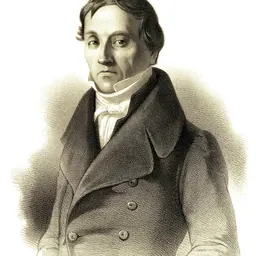
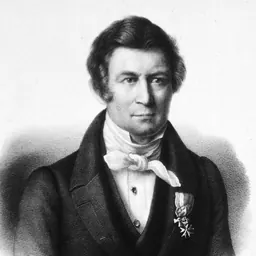
Contemporaries
People whose lives overlapped Giuseppe Ferlini's





Frequently asked questions
Who was Giuseppe Ferlini?
19th-century Italian treasure hunter
When was Giuseppe Ferlini born?
Giuseppe Ferlini was born on 23 April 1797 in Bologna.
When did Giuseppe Ferlini die?
Giuseppe Ferlini died on 29 December 1870 in Bologna.
What was Giuseppe Ferlini's occupation?
Giuseppe Ferlini was an explorer, anthropologist, archaeologist, surgeon and treasure hunter.
What nationality was Giuseppe Ferlini?
Giuseppe Ferlini was Italian.
Sources & further reading
Cite this page
APA: Biography.guide. (2026). Giuseppe Ferlini. https://biography.guide/giuseppe-ferlini/
MLA: "Giuseppe Ferlini." Biography.guide, https://biography.guide/giuseppe-ferlini/.
Chicago: "Giuseppe Ferlini." Biography.guide. https://biography.guide/giuseppe-ferlini/.
Data last updated: 2026-09-22 · Spot an error? Report a correction.
Portrait: Wikimedia Commons · author & licence
Page generated 2026-09-27 04:59 UTC