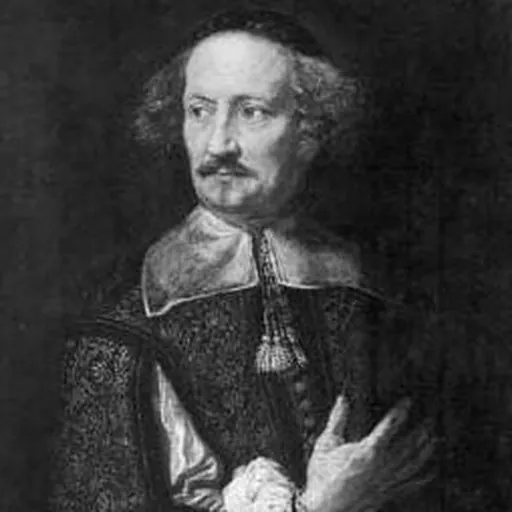
About Girolamo Graziani
Lived 1604 – 1675 (aged 70). Girolamo Graziani was an Italian poet, diplomat, writer and politician.
Girolamo Graziani ( , ; 1 October 1604 – 12 September 1675) was an Italian poet and diplomat. He served as the secretary of state at the Este court of Modena. He helped establish close diplomatic ties with the court of the Kingdom of France, especially during the 1650s, when a niece of the chief minister of France Cardinal Mazarin served as the new Duchess of Modena.
Graziani was one of the most famous poets of the 17th century, but his fame didn't survive him. During his life, he was appreciated mainly for his epic poems La Cleopatra (1632) and Il Conquisto di Granata (1650).
The latter has been the source for Giacomo Leopardi's Consalvo (1833). In fact, the plot (Love in the imminence of death) and the names of the main characters (Consalvo and Elvira) of Leopardi's Consalvo seem to come from Graziani's poem.
Biography
Girolamo Graziani (1604–1675) was born in Pergola, near Urbino, but he spent most of his life in Modena. His father was a law attendant in the Sacra Rota Romana. Graziani earned a degree in Arts and Law from the University of Bologna.
Graziani spent most of his life at the Este court of Modena, as State Secretary. In his diplomatic career, he helped establish close diplomatic ties with the court of France, especially as of the 1650s, when the niece of Cardinal Mazarin, Laura Martinozzi, became the new Duchess of Modena. In the same year, Graziani published his tragedy Il Cromuele, expressly unrespectful of Aristotle's rules. It deals with the theme of the dark, cruel tyrant (Oliver Cromwell) and the royalty profanation (Charles I of England's martyrdom).
Graziani published his first book of poetry at the age of sixteen, and was a member of the Accademia degli Incogniti of Venice and the Accademia dei Gelati of Bologna. His published works include poetry, political writings, panegyrics, laudatory and love sonnets, and two epic poems, La Cleopatra (Venice: Sarzina, 1632) and Il Conquisto di Granata, which had five editions in the seventeenth century. Il Conquisto di Granata is considered the masterpiece of seventeenth-century epic poetry and the third peak of the Italian heroic tradition, besides the Orlando Furioso and the Jerusalem Delivered.
According to some of his contemporary biographers, he also made every effort in order to publish a "Historia" about the period between the end of Castro's War and the Treaty of the Pyrenees, but the "Historia" was not published and has since been lost.
Don’t just read it —
keep it.
Full-length biographies made to live with: read them, listen on the way to work, watch them tonight.
- E-book
- Audio
- Video
Instant download · yours to keep · every purchase keeps this site free
Important facts
People in Girolamo Graziani's life
Named in this biography and alive at the same time


Related people
Same field, nearest in time



Contemporaries
People whose lives overlapped Girolamo Graziani's






Frequently asked questions
Who was Girolamo Graziani?
poet and writer from Italy
When was Girolamo Graziani born?
Girolamo Graziani was born on 1 October 1604 in Pergola.
When did Girolamo Graziani die?
Girolamo Graziani died on 12 September 1675 in Pergola.
What was Girolamo Graziani's occupation?
Girolamo Graziani was a poet, diplomat, writer and politician.
What nationality was Girolamo Graziani?
Girolamo Graziani was Italian.
Sources & further reading
· Wikipedia: Girolamo Graziani
Cite this page
APA: Biography.guide. (2026). Girolamo Graziani. https://biography.guide/girolamo-graziani/
MLA: "Girolamo Graziani." Biography.guide, https://biography.guide/girolamo-graziani/.
Chicago: "Girolamo Graziani." Biography.guide. https://biography.guide/girolamo-graziani/.
Data last updated: 2026-09-22 · Spot an error? Report a correction.
Portrait: Wikimedia Commons · author & licence
Page generated 2026-09-27 05:04 UTC