
Giovanni Tirinnanzi
Italian prelate of the Catholic Church
About Giovanni Tirinnanzi
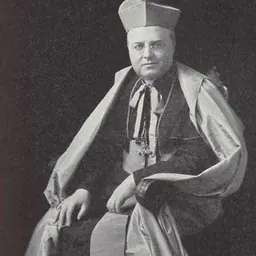
Lived 1869 – 1949 (aged 79). Giovanni Tirinnanzi was an Italian catholic priest and catholic bishop.
Giovanni Battista Tirinanzi OFM Cap. (March 26, 1869 – January 27, 1949) was an Italian Bishop and Missionary who served as the Apostolic Vicar of Arabia from 2 July 1937 to 21 October 1948 as well as the Titular Bishop of Gaza.
Life Giovanni Battista Tirinnanzi was born in Florence on 26 March 1869. He entered the novitiate on 4 January 1887, made his solemn profession on 20 February 1891, and was ordained a priest on 11 October of the same year. He left for Agra on 25 December 1894 and was immediately admired and esteemed for his spirit of initiative and versatile resourcefulness. After having been in charge of various missionary stations, he was nominated as superior of the capuchin province in Sardhana and played a large part in setting up and opening the Capuchin Novitiate in Sardhana (Meerut).
When he was nominated bishop, he was Vicar General of the Archdiocese of Agra. Appointed titular bishop of Gaza and Apostolic Vicar of Arabia on 2 July. On 28 October 1937, he was ordained bishop by Archbishop of Agra Evangelista Latino Enrico Vanni, OFM Cap, and the co-consecrators were Giuseppe Angelo Poli, OFM Cap. Bishop of Allahabad and Mathurin-Pie Le Ruyet, OFM Cap. Bishop of Ajmer and Tirinnanzi arrived in Aden on 7 November 1937. In Arabia Despite the hostile climatic conditions, they were improved by the fact that the government had opened some wells in Shaykh'Uthman (an oasis 10 miles from the city of Aden), the activity of Msgr. Tirinnanzi was actively ruined. His first concern was the school through which - he wrote - "missionaries can obtain in Aden that respect and attention that bring people closer to the truths of the faith, primarily when other means cannot be used."
He, therefore, increased the male attendance at St Anthony's Boys' School at Steamer Point, directed by three Marist Brothers, who were esteemed for the seriousness of teaching and discipline. Recognized and financed by the government to be open to anyone who requested it, as it could not satisfy all admission requests, and an expansion wasn't possible, as the Marist Brothers were unable to provide additional personnel. Other Vicariate schools were that of Crater, were reserved for orphans and directed by a priest, and the female ones (from Stramer Point and Crater) directed by the Franciscan Tertiary Sisters of Calais. These acts were also praised by the Jewish community in a letter addressed to the bishop on the occasion of Pius XI's death and the election of Pius XII. found an almost insurmountable obstacle in the lack of personnel: in fact, he had only 4 priests available. However, his greatest desire was to resume his activity outside Aden: he was confident that much could still be done, despite a common belief to the contrary, based on the widespread opinion that the Vicariate should only take care of Catholics, most of them who came from India. He continually requested to be able to go into the Arabian Peninsula and to be able to obtain the continuous residence of a missionary in Somalia, together with the possibility of building a church. his challenges in 1939 to Cardinal Tisserant, in which he outlined the characteristics of the Muslim faith. Msgr. Tirinnanzi, made a historic step by visiting Bahrain in 1939 when he heard of the presence of Catholics on the island nation, In an audience with the ruler H.H. Hamad ibn Isa Al Khalifa; the catholic church was granted a plot of land to build a church and Sacred Heart Church, the first church in the Persian Gulf region was built and blessed on 8 March 1940. World War II As the world was on the brink of another worldwide conflict in 1939, The occupying British forces in Yemen were not pleased with an Italian in their colony; Msgr. Tirinnanzi hence had to return to Italy in 1940. Travel and mission work during World War II was considered dangerous and hazardous, and Msgr. Tirinnanzi could only return to Aden in 1947. On 21 October 1948, Pius XII accepted his resignation from the pastoral care of the Vicariate due to poor health.
Death He retired to the convent of Montughi, Florence, in whose infirmary he died on 27 January 1949, at the age of 79.
Don’t just read it —
keep it.
Full-length biographies made to live with: read them, listen on the way to work, watch them tonight.
- E-book
- Audio
- Video
Instant download · yours to keep · every purchase keeps this site free
Important facts
People in Giovanni Tirinnanzi's life
Named in this biography and alive at the same time

Related people
Same field, nearest in time

Contemporaries
People whose lives overlapped Giovanni Tirinnanzi's





Frequently asked questions
Who was Giovanni Tirinnanzi?
Italian prelate of the Catholic Church (1869–1949)
When was Giovanni Tirinnanzi born?
Giovanni Tirinnanzi was born on 28 March 1869 in Florence.
When did Giovanni Tirinnanzi die?
Giovanni Tirinnanzi died on 27 January 1949 in Florence.
What was Giovanni Tirinnanzi's occupation?
Giovanni Tirinnanzi was a catholic priest and catholic bishop.
What nationality was Giovanni Tirinnanzi?
Giovanni Tirinnanzi was Italian.
Sources & further reading
· Wikipedia: Giovanni Tirinnanzi
· DBpedia: Giovanni Battista Tirinnanzi
Cite this page
APA: Biography.guide. (2026). Giovanni Tirinnanzi. https://biography.guide/giovanni-tirinnanzi/
MLA: "Giovanni Tirinnanzi." Biography.guide, https://biography.guide/giovanni-tirinnanzi/.
Chicago: "Giovanni Tirinnanzi." Biography.guide. https://biography.guide/giovanni-tirinnanzi/.
Data last updated: 2026-09-20 · Spot an error? Report a correction.
Page generated 2026-09-27 05:12 UTC