
About Giovanni Mangone
Lived 1401 – 1543. Giovanni Mangone was an Italian architect.
Giovanni Mangone (born towards the end of 15th century, died 25 June 1543) was an Italian artist active almost exclusively in Rome during the Renaissance. Mangone's skills were manifold: he worked as sculptor, architect, stonecutter and building estimator. Moreover, he was a keen antiquarian and among the founders of the Academy dei Virtuosi al Pantheon. As military engineer, he was renowned among his contemporaries.
Life and works
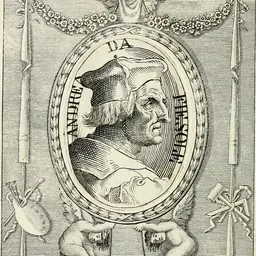
Born around the end of the fifteenth century by Francesco, a native of Caravaggio in Lombardy, according to Giorgio Vasari he studied under sculptor and architect Andrea Ferrucci from Fiesole. In Rome, where he lived in a palace in via delle Coppelle, between Sant'Agostino and palazzo Baldassini, at the beginning of his career had several assignments; from 1527 to 1532 he was superintendent to the spring of S. Peter; until 1541, he was curator of the gold-leaf ceiling of the Basilica of Santa Maria Maggiore; since 1528 and until his death, he was architect of the apostolic Chamber. The building, which in 1537 had been completed until its piano nobile, was erroneously named after king Pyrrhus of Epirus because of a statue (actually of Mars) once on display on a yard's niche and now at the Musei Capitolini.
Based on stylistic analysis, have been attributed to him also the palazzo Alicorni in Borgo Vecchio (later piazza Rusticucci) in Borgo (demolished in 1931 and later rebuilt) and – more doubtfully – the Palazzetto De Vellis in Piazza Santa Maria in Trastevere.
As a sculptor, only two works have been attributed to him: well-done appears to be the funerary monument to Cardinal Willem van Enckevoirt (dead in 1534) in Santa Maria dell'Anima, where is evident an influence from Michelangelo, while that of the bishop of Chiusi and Governor of Bologna Gregorio Magalotti in Santa Cecilia in Trastevere, engraved in 1538, radiates a cold feeling.
As a military architect, in 1542 Mangone was summoned together with other architects by Paul III, who wanted to enhance the fortifications of Borgo, and in that occasion he presented a project. The following year he was active in Sermoneta, working at the town's walls. Mangone was also a keen antiquarian, and collected in his palace a good deal of architectural and sculptural pieces. In 1543, defining himself as a sculptor, he was among the founding members of the Congregation of "St. Joseph in the Holy Land at the Rotonda", later known as the Accademia dei Virtuosi al Pantheon, one of the main centers of discussions about antiquities and architecture in Rome.
On 25 June 1543 he made his will, dying perhaps on the same day.
Significance
As a sculptor, Mangone followed Andrea Sansovino, reaching mixed results.
As an architect, his former education as a sculptor and stonemason in the design of moldings allowed him to reach a remarkable equilibrium of proportions. Moreover, Mangone was among the first to spread the "severe" style initiated by Antonio da Sangallo the Younger. With the Palazzo di Pirro, he designed a good example of "everyday" architecture which found many imitators in the second part of 16th century. As a military architect, although he was praised by the military engineer Francesco De Marchi, the absence of extant works which can be attributed to him makes difficult to assess its real contribution to this field.
Don’t just read it —
keep it.
Full-length biographies made to live with: read them, listen on the way to work, watch them tonight.
- E-book
- Audio
- Video
Instant download · yours to keep · every purchase keeps this site free
Important facts
People in Giovanni Mangone's life
Named in this biography and alive at the same time




Related people
Same field, nearest in time
Contemporaries
People whose lives overlapped Giovanni Mangone's





Frequently asked questions
Who was Giovanni Mangone?
Italian architect
When was Giovanni Mangone born?
Giovanni Mangone was born in 1401 in Caravaggio.
When did Giovanni Mangone die?
Giovanni Mangone died on 25 June 1543 in Rome.
What was Giovanni Mangone's occupation?
Giovanni Mangone was an architect.
What nationality was Giovanni Mangone?
Giovanni Mangone was Italian.
Sources & further reading
Cite this page
APA: Biography.guide. (2026). Giovanni Mangone. https://biography.guide/giovanni-mangone/
MLA: "Giovanni Mangone." Biography.guide, https://biography.guide/giovanni-mangone/.
Chicago: "Giovanni Mangone." Biography.guide. https://biography.guide/giovanni-mangone/.
Data last updated: 2026-09-20 · Spot an error? Report a correction.
Page generated 2026-09-27 05:09 UTC