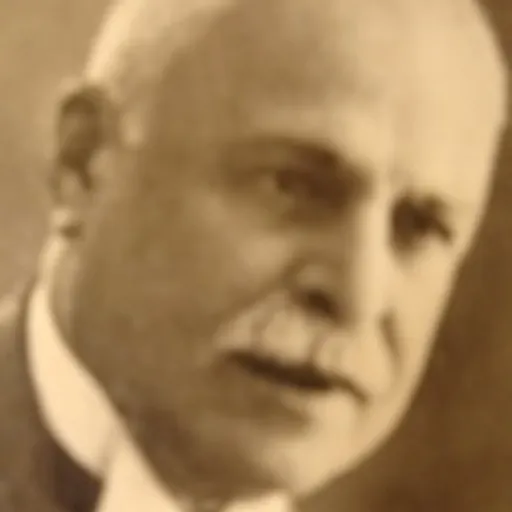
About Giovanni Giorgi
Lived 1871 – 1950 (aged 78). Giovanni Giorgi was an Italian electrotechnician, physicist, mathematician and university teacher.
Early life Giovanni Giorgi was born in Lucca on November 27, 1871.
Career Giorgi studied engineering at the Institute of Technology of Rome, he worked at Fornaci Giorgi in Ferentino, then was the director of the Technology Office of Rome between 1905 and 1924. He also taught at the University of Rome between 1913 and 1939. During World War II he moved to Ferentino. He was an Invited Speaker of the ICM in 1924 in Toronto, in 1928 in Bologna, and in 1932 in Zurich.
Personal life He was engaged to Laura Pisati, his former master's student who became the first woman invited to deliver a lecture at the fourth International Congress of Mathematicians (ICM), but she died in 1908 shortly before both her talk and their intended wedding.
Death Giorgi died on August 19, 1950, in Castiglioncello, Livorno at the age of 78.
The Giorgi system Toward the end of the 19th century, after James Clerk Maxwell's discoveries, it was clear that electric measurements could not be explained in terms of the three base units of length, mass and time, and that some irrational coefficients appeared in the equations without any logical physical reason. In 1901, Giorgi proposed to the (AEI) that the MKS system (which used the metre, kilogram and second as its base units) should be extended with a fourth unit to be chosen from the units of electromagnetism, solving also the presence of the irrational coefficients.
In 1935 this was adopted by the International Electrotechnical Commission (IEC) as the M.K.S. System of Giorgi without specifying which electromagnetic unit would be the fourth base unit. In 1946 the International Committee for Weights and Measures (CIPM) approved a proposal to use the ampere as that unit in a four-dimensional system, the MKSA system.
The Giorgi system was thus the precursor of the International System of Units (SI) adopted in 1960, which was based on six base units: metre, kilogram, second, ampere, kelvin, and candela.
Works
Don’t just read it —
keep it.
Full-length biographies made to live with: read them, listen on the way to work, watch them tonight.
- E-book
- Audio
- Video
Instant download · yours to keep · every purchase keeps this site free
Important facts
People in Giovanni Giorgi's life
Named in this biography and alive at the same time


Related people
Same field, nearest in time





Contemporaries
People whose lives overlapped Giovanni Giorgi's

Frequently asked questions
Who was Giovanni Giorgi?
Italian physicist and engineer (1871–1950)
When was Giovanni Giorgi born?
Giovanni Giorgi was born on 27 November 1871 in Lucca.
When did Giovanni Giorgi die?
Giovanni Giorgi died on 19 August 1950 in Castiglioncello.
What was Giovanni Giorgi's occupation?
Giovanni Giorgi was an electrotechnician, physicist, mathematician and university teacher.
What nationality was Giovanni Giorgi?
Giovanni Giorgi was Italian.
Sources & further reading
Cite this page
APA: Biography.guide. (2026). Giovanni Giorgi. https://biography.guide/giovanni-giorgi-electrotechnician/
MLA: "Giovanni Giorgi." Biography.guide, https://biography.guide/giovanni-giorgi-electrotechnician/.
Chicago: "Giovanni Giorgi." Biography.guide. https://biography.guide/giovanni-giorgi-electrotechnician/.
Data last updated: 2026-09-21 · Spot an error? Report a correction.
Portrait: Wikimedia Commons · author & licence
Page generated 2026-09-27 04:59 UTC