
Giorgio de Santillana
American historian and philosopher
About Giorgio de Santillana
Lived 1902 – 1974 (aged 72). Giorgio de Santillana was an Italian and American historian, university teacher and philosopher.
Giorgio Diaz de Santillana (30 May 1902 – 8 June 1974) was an Italian-American philosopher and historian of science, particularly of ancient science and of the Renaissance science of Galileo Galilei. He was a professor of the History of Science at the Massachusetts Institute of Technology best known for his books The Crime of Galileo and Hamlet's Mill (1969).
Early life and education Giorgio de Santillana was born in Rome, Italy on 30 May 1902 into a Sephardic Jewish family, which traced its roots through Tunisia and Livorno back to the Iberian peninsula. His father was the Tunisian-Italian jurist and expert on Islamic Law David Santillana.
In 1925, he graduated from the Università di Roma alla Sapienza with a degree in physics. He then spent two years in philosophy in Paris, followed by another two years in physics at the Università degli studi di Milano.
Work Together with Edgar Zilsel, Santillana contributed a 1941 entry to the Vienna Circle history and philosophy of science project International Encyclopedia of Unified Science (1938–1969) titled "Development of Rationalism and Empiricism" consisting of two separate essays: Santillana's own essay was "Aspects of Scientific Rationalism in the Nineteenth Century," while Zilsel's was "Problems of Empiricism."
In 1953, Santillana published an annotated edition of a prior translation of Galileo Galilei's Dialogue on the Great World Systems, which appeared within five months of another major edition of Galileo's work, Stillman Drake's new translation from the Italian, Dialogue Concerning the Two Chief World Systems (1953). The two were sometimes reviewed together, with one such reviewer, Stanford University historian of Renaissance science Francis R. Johnson, concluding "one might suggest that the modem scientist who prefers his Galileo in twentieth-century dress would incline to Mr. Drake's volume. On the other hand, the more historically minded reader who prefers to view Galileo in the literary and intellectual costume of his own century would vote for Professor de Santillana's edition." though Drake later wrote an article in defense of the Salusbury translation and in criticism of Salusbury's contemporary printers, who introduced numerous errors not in the translation manuscript, and of his modern editor, Santillana, who could have caught these errors.
Santillana's work on Galileo next led him to write and to publish The Crime of Galileo in 1955, a study of Galileo's trial for heresy by the Catholic Church that lay the blame for Galileo's guilty verdict substantially on political intrigue rather than on properly doctrinal issues. Reviewers recognized its topicality in reference to contemporary American McCarthyism,
In 1961, he published The Origins of Scientific Thought: From Anaximander to Proclus, 600 BC to 300 AD, which also appeared in paperback. Reviewers noted this as a development of his earlier work in Italian with Federigo Enriques This book covered possible connections between the mythological stories of Ancient Egypt, Babylon, Ancient Greece, Christianity, etc. and ancient observations pertaining to the stars, planets, and, most notably, the 26,000-year precession of the equinoxes, now categorized into the fields of ethnoastronomy and archaeoastronomy. Santillana's colleague Nathan Sivin described the book as "an end run around those scholarly custodians of the history of early astronomy who consider myths best ignored, and those ethnologists who consider astronomy best ignored, to arouse public enthusiasm for exploration into the astronomical content of myth." and "the Fecundity-Trust" and calling Ernst Cassirer "blinded by condescension,"
Personal life and death In 1948, Santillana married Dorothy Hancock Tilton (1904–1980), a descendant of John Hancock and particularly for her effort to publish American chef, cooking author, and television personality Julia Child; she is depicted in the film Julie & Julia.
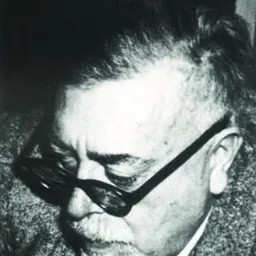
During his time at the Massachusetts Institute of Technology, Santillana was noted for his personal friendships with founding figures of cybernetics including Norbert Wiener, Jerome Lettvin, Warren McCulloch, and Walter Pitts, as well as the astronomer and nuclear scientist Philip Morrison. A colorful anecdote describes him as Wiener's personal Tarot reader.
Santillana died after a long illness beginning in the mid-1960s and a couple of years in Beverly Farms, Massachusetts, on 8 June 1974 in Dade County, Florida.
Selected publications
Articles
"Galileo and J. Robert Oppenheimer". The Reporter, December 26, 1957. pp. 10–18; reprinted in Reflections on Men and Ideas (1968, below). "The Seventeenth-Century Legacy: Our Mirror of Being". Daedalus, vol. 87, no. 1 (Winter, 1958), pp. 35–56; with Stillman Drake, "Review: Arthur Koestler and His Sleepwalkers". Isis, vol. 50, no. 3 (September, 1959), pp. 255–260;
Books with Edgar Zilsel, "Development of Rationalism and Empiricism". In International Encyclopedia of Unified Science: Foundations of the Unity of Science; vol. 2, no. 8, University of Chicago Press, 1941. Dialogue on the Great World Systems: In the Salusbury Translation; Revised and Annotated with an Introduction by Giorgio de Santillana. The University of Chicago Press, 1953. The Crime of Galileo. University of Chicago Press, 1955. . Leonardo Da Vinci. Reynal & Company, 1956. The Mentor Philosophers: The Age of Adventure: Renaissance Philosophers. New American Library, 1956. The Origins of Scientific Thought: From Anaximander to Proclus, 600 BC to 300 AD. University of Chicago Press, 1961. Reflections on Men and Ideas. MIT Press, 1968. . with Hertha von Dechend, Hamlet's Mill: An Essay on Myth and the Frame of Time. Gambit Inc., 1969. .
Don’t just read it —
keep it.
Full-length biographies made to live with: read them, listen on the way to work, watch them tonight.
- E-book
- Audio
- Video
Instant download · yours to keep · every purchase keeps this site free
Important facts
People in Giorgio de Santillana's life
Named in this biography and alive at the same time


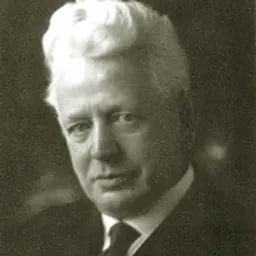
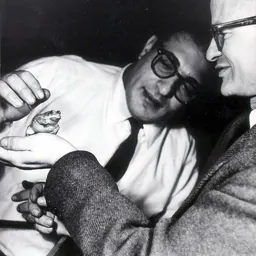
Related people
Same field, nearest in time
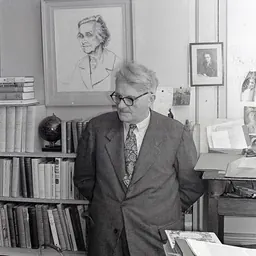
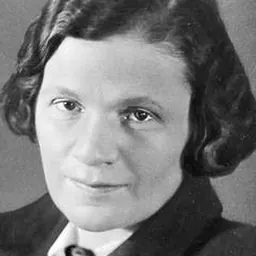

Contemporaries
People whose lives overlapped Giorgio de Santillana's




Frequently asked questions
Who was Giorgio de Santillana?
American historian and philosopher
When was Giorgio de Santillana born?
Giorgio de Santillana was born on 30 May 1902 in Rome.
When did Giorgio de Santillana die?
Giorgio de Santillana died on 8 June 1974 in Beverly.
What was Giorgio de Santillana's occupation?
Giorgio de Santillana was a historian, university teacher and philosopher.
What nationality was Giorgio de Santillana?
Giorgio de Santillana was Italian and American.
Sources & further reading
· Wikipedia: Giorgio de Santillana
· DBpedia: Giorgio de Santillana
Cite this page
APA: Biography.guide. (2026). Giorgio de Santillana. https://biography.guide/giorgio-de-santillana/
MLA: "Giorgio de Santillana." Biography.guide, https://biography.guide/giorgio-de-santillana/.
Chicago: "Giorgio de Santillana." Biography.guide. https://biography.guide/giorgio-de-santillana/.
Data last updated: 2026-09-20 · Spot an error? Report a correction.
Page generated 2026-09-27 05:02 UTC