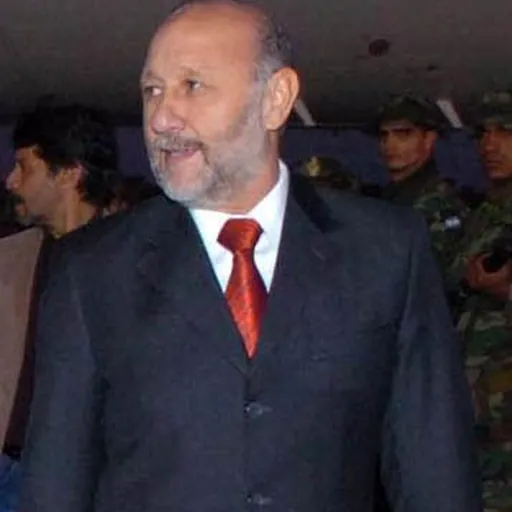
About Gildo Insfrán
Born 1951. Gildo Insfrán is an Argentine politician and veterinarian.
Gildo Insfrán (born 19 January 1951) is an Argentine Justicialist Party (PJ) politician, who has been Governor of Formosa Province since 1995.
Having been close to former President Carlos Menem, Insfrán later became close to President Néstor Kirchner.
In 1999 he arranged to have Formosa's provincial constitution revised to allow him to be reelected indefinitely. Insfrán has been the target of numerous corruption allegations by journalists, activists and politicians like Jorge Lanata. He has also been criticized for the length of his tenure as governor of Formosa. His tenures as governor have been regarded favorably by inhabitants of Formosa.
Under his leadership the Justicialist Party has won eight consecutive gubernatorial elections in Formosa since 1995.
Early life and education Insfrán comes from a family of Paraguayan immigrants and is the youngest among his siblings. His father, who had fought in the Chaco War, died when Gildo was young, and his brother Miguel took on the responsibility of managing the family's finances.
Thanks to Miguel's support, Gildo was able to pursue his university education in Corrientes Province, where he successfully completed his studies and earned a degree in veterinary science at the National University of the Northeast, where he completed his studies and became a veterinarian. It was during his time in college that he first became involved in politics.
Early career During his time at university in the late 1960s and early 1970s, Insfrán began his political activism in the Revolutionary Communist Party (PCR), a minority Maoist party. However, before completing his studies, he had already joined the recently legalized Justicialist Party (PJ). Prior to formally engaging in institutional political activities, he practiced as a veterinarian.
In the provincial elections of 1983, he ran as a candidate for provincial deputy in the Formosa legislature on the Justicialist Party ticket, occupying the fifth position on the list. The Justicialist Party emerged victorious with 42.83% of the votes, and Insfrán was elected as a deputy. Due to the staggered system used in the election of provincial legislators, Insfrán would only serve half of a constitutional legislative term until the partial renewal in 1985.
Governor In 1995, he formed his own party affiliated with the Justicialist Party and ran for governor of the province. It is said that Vicente Joga and Gildo Insfrán had made a pact to alternate in the positions of governor and vice governor. Insfrán was elected governor for a four-year term thanks to the "Ley de Lemas" (Law of Party Slates), which had been established in 1987.
From the beginning of his government, Insfrán focused on the construction of public infrastructure, such as the "blue roofs" throughout the province, which were implemented in schools, colleges, hospitals, police stations, and other government offices. In late November 1998, the provincial court allowed Insfrán to run for governor again. This decision was made after Joga and the Radical Civic Union presented a declaratory action to the court to disqualify Insfrán as a gubernatorial candidate. Joga requested that the court interpret Article 129 of the provincial constitution, which states that a formula for the governorship of Formosa can only be reelected once.
At the beginning of 1999, provincial deputy Armando Cabrera accused Carlos Gerardo González, a judge of the Superior Court of Justice of Formosa, after tensions erupted within the Justicialist Party during the first week of March when Insfrán's collaborators accused González of stealing the judicial record.
On March 3, penal judge Ceferino Arroquigaray ordered the arrest of Judge Carlos González and the search of his offices to seize the record. González was arrested in the morning near his house while driving his car, which was intercepted by the police and taken to the central fire station in Formosa. This incident was considered an "institutional scandal" since a judge can only be arrested if he is previously removed through impeachment or caught in the act of committing a crime.
Approximately one month before the September 26 elections, a brawl broke out between those supporting Insfrán and those supporting Joga within the Formosa Legislature. As a result, Governor Insfrán closed the Legislature, which also helped him avoid a possible impeachment trial that would have ruined his chances of being a candidate.
During his administration, a water treatment plant was inaugurated, increasing irrigation capacity for the towns of El Potrillo and El Favorito community in Tronquito 1. Furthermore, all indigenous and creole populations in that part of the Bermejo department, as well as those in Ramón, were connected to the integrated provincial electricity service, ensuring they have 24-hour access to electricity.
In the 2007 elections, he was reelected again with 75% of the votes. On December 12, at 10:46 am, Insfrán was sworn in as governor for the next four years. During his new term, two new hospitals were built in the interior of Formosa, including the one in Laguna Blanca (15 kilometers from the Paraguayan border and over 200 kilometers from the capital of Formosa) and the Hospital El Espinillo.
On June 30, 2011, Gildo Insfrán changed the Law of Party Slates. The project to eliminate the sub-ticket system only for the Governor category was presented by deputy Alberto Sánchez in the Legislature, arguing that this change responded "to the society's request to clarify the electoral system." However, candidates competing against Insfrán claimed that the reform of the Law of Party Slates, far from favoring pluralism, facilitated Governor Gildo Insfrán's re-election because he didn't want to risk losing the provincial elections to the rival Frente Amplio party. Ricardo Buryaile stated, "The government was clearly weakened: it reformed the law of party slates because it was losing the elections." Despite protests from opposition members, the project was approved by the majority of the ruling party in just half an hour.
On October 23, Insfrán won for the fifth consecutive time in the general elections with 76% of the votes. Some media outlets in the province reported a series of incidents in the area of Ingeniero Juárez before the elections. The news portal Opinión Ciudadana reported that José Palma's van, an associate of Francisco Nazar, the Catholic priest who competed against Insfrán for the governorship, was set on fire.
On 12 October, the candidate for mayor José Luis Maldonado from the Frente Amplio party and a companion of Nazar, was attacked with a knife by a political operative. This tragic event was condemned by the Permanent Assembly for Human Rights.
However, it was also reported that the members of the Wichí Barrio Viejo community were detained and forced to vote. In parallel, the AMRA-Foro Médico Ciudadano de Formosa, accredited to participate in the elections as one of the observers, released a report revealing that a total of 10,000 Paraguayans (including a Paraguayan government official) crossed into Formosa's territory to vote in the elections, using only two border crossings, without including the Friendship Bridge, where pedestrians enter without any controls. People close to Insfrán's circle claimed that the elections were conducted normally and that 67.3% of the electoral roll participated.
Insfrán was re-elected in 1999, 2003, 2007, 2011, 2015, 2019 and 2023.
Boudougate
On March 30, 2015, Carlos Rívolo, federal prosecutor in the Ciccone Case, also known as Boudougate, asked Judge Sebastian Casanello to investigate the participation of Insfrán as well as various other persons, including Vice President Amado Boudou, in a maneuver related to the restructuring of the public debt of the province of Formosa with the help of a shell company called The Old Fund.
The case against Insfrán was dismissed by a provincial court in May 2022. The judge in charge of the case justified his ruling by stating that there were no irregularities in the debt restructuring process and that the company "The Old Fund" had never been contracted by the provincial government to act as an intermediary between the province and the national government.
Controversies Treatment of indigenous people On 23 November 2010 a Toba man and a police officer died when the government ordered the police to clear a camp of indigenous Toba protesters who were blocking National Route 86 in response to the government's decision to build an agricultural research institute on land that had been granted to the Colonia La Primavera community by the Territorial Emergency Law 26.160, which prevented the expulsion of indigenous communities from their ancestral lands.
The minister of government of Formosa, Jorge Gonzáles, claimed that the police were attacked by the protesters when they entered a property that had been occupied by a group of Toba protesters, and that said group had stolen a police officers service weapon that had been thrown onto the ground and abandoned by accident. While the activist and INADI functionary Félix Díaz claimed that the police and a group of unidentified civilians attacked the protesters without provocation and planted a gun to blame the indigenous protesters for the death of the police officer. His detention was denounced by the local branch of Amnesty International and numerous Argentine human rights organizations. He was released on 25 October 2017 after the appeals court of Formosa freed him after analysing the case and finding no evidence that he had actually committed any crime.
Personal life Insfrán has two daughters with Teresa Baldus, Sofia and Yanina. The couple also had a son, Gildo Miguel Insfrán, who committed suicide on August 5, 2003, at the age of seventeen. He shot himself in the right temple with a 9mm pistol. The motive for the suicide has never been publicly clarified.
Don’t just read it —
keep it.
Full-length biographies made to live with: read them, listen on the way to work, watch them tonight.
- E-book
- Audio
- Video
Instant download · yours to keep · every purchase keeps this site free
Important facts
People in Gildo Insfrán's life
Named in this biography and alive at the same time






Related people
Same field, nearest in time






Contemporaries
People whose lives overlapped Gildo Insfrán's


Frequently asked questions
Who is Gildo Insfrán?
Argentine politician
When was Gildo Insfrán born?
Gildo Insfrán was born on 19 September 1951 in Laguna Blanca (Formosa - Argentina).
What is Gildo Insfrán's occupation?
Gildo Insfrán is a politician and veterinarian.
What nationality is Gildo Insfrán?
Gildo Insfrán is Argentine.
Sources & further reading
Cite this page
APA: Biography.guide. (2026). Gildo Insfrán. https://biography.guide/gildo-insfran/
MLA: "Gildo Insfrán." Biography.guide, https://biography.guide/gildo-insfran/.
Chicago: "Gildo Insfrán." Biography.guide. https://biography.guide/gildo-insfran/.
Data last updated: 2026-09-22 · Spot an error? Report a correction.
Portrait: Wikimedia Commons · author & licence
Page generated 2026-09-27 05:02 UTC