
About Giacomo Balla
Lived 1871 – 1958 (aged 86). Giacomo Balla was an Italian painter, sculptor, composer, draftsperson, teacher and ceramicist.
Giacomo Balla (18 July 1871 – 1 March 1958) was an Italian painter, art teacher and poet best known as a key proponent of Futurism. In his paintings, he depicted light, movement and speed. He was concerned with expressing movement in his works, but unlike other leading futurists he was not interested in machines or violence with his works tending towards the witty and whimsical.
Biography Giacomo Balla was born in Turin, in the Piedmont region of Italy, on 18 July 1871. He was the son of Giovanni Balla, a chemist with an interest in photography, and Lucia Balla. His father died in 1878, after which Balla went to work in a lithography shop to help support his mother.
By age 20, his interest in visual art had developed to such a level that he decided to study painting at local academies, and several of his early works were shown at exhibitions. Following academic studies at the University of Turin, Balla moved to Rome in 1895, where he met and later married Elisa Marcucci. For several years he worked in Rome as an illustrator, caricaturist and portrait painter. In 1899, his work was exhibited at the Venice Biennale, and in the ensuing years, his art was shown at major exhibitions in Rome and Venice, as well as in Munich, Berlin and Düsseldorf, at the Salon d'Automne in Paris, and at galleries in Rotterdam.
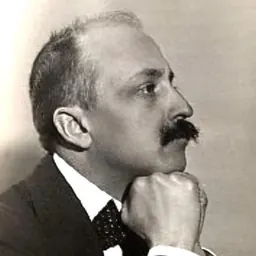
Around 1902, he taught Divisionist techniques to Umberto Boccioni and Gino Severini. Influenced by Filippo Tommaso Marinetti, Giacomo Balla adopted the Futurism style, creating a pictorial depiction of light, movement and speed. He was a signatory of the Futurist Manifesto in 1910. When he joined the futurist movement, he was already an established artist, and was older by a decade than the other signatories of the futurist manifesto. Typical for his new style of painting is Dynamism of a Dog on a Leash (1912) and his 1914 work Abstract Speed + Sound .
He authored the "Futurist Painting: Technical Manifesto", where he argued that one should attempt to capture "the dynamic sensation itself". Balla also began working as a sculptor, creating, in 1915, the well-known work titled Boccioni's Fist, based on 'lines of force' .
While initially sympathetic to fascism, he changed his mind, leading him to be shunned by the Italian regime and culture which had once appreciated him, though his works were positively reevaluated after the end of the war. In the 1930s, he renounced Futurism as well as abstraction, and returned to a naturalistic style.
Balla's most famous works, such as his 1912 Dynamism of a Dog on a Leash, aim to express movement – and thus the passage of time – through the medium of painting. His approach of portraying motion is demonstrated in this work by concurrently displaying various aspects of a moving object. Balla accurately captures the motion of a dog straining to keep up with its owner by painting numerous legs, tails, and leashes. Cubism inspired this fascination with preserving a single instant in an assortment of planes. The approach also pays homage to chronophotography, which was an early method of taking pictures of many stages of movement.
Balla's 1912 The Hand of the Violinist depicts the frenetic motion of a musician playing, and draws on inspiration from Cubism and the photographic experiments of Marey and Eadweard Muybridge.
In his abstract 1912–1914 series Iridescent Interpenetration, Balla attempts to separate the experience of light from the perception of objects as such.
Abstract Speed + Sound (1913–14) is a study of speed symbolised by the automobile. Originally, it may have been part of a triptych.
Legacy In 1987, some of his artworks were exhibited at documenta 8, an exhibition of modern art and contemporary art which takes place every five years in Kassel, Germany.
He was concerned with expressing movement in his works, but unlike other leading futurists he was not interested in machines or violence with his works tending towards the witty and whimsical.
Don’t just read it —
keep it.
Full-length biographies made to live with: read them, listen on the way to work, watch them tonight.
- E-book
- Audio
- Video
Instant download · yours to keep · every purchase keeps this site free
Important facts
People in Giacomo Balla's life
Named in this biography and alive at the same time



Related people
Same field, nearest in time


Contemporaries
People whose lives overlapped Giacomo Balla's

Frequently asked questions
Who was Giacomo Balla?
Italian artist (1871-1958)
When was Giacomo Balla born?
Giacomo Balla was born on 18 July 1871 in Turin.
When did Giacomo Balla die?
Giacomo Balla died on 1 March 1958 in Rome.
What was Giacomo Balla's occupation?
Giacomo Balla was a painter, sculptor, composer, draftsperson, teacher and ceramicist.
What nationality was Giacomo Balla?
Giacomo Balla was Italian.
Sources & further reading
Cite this page
APA: Biography.guide. (2026). Giacomo Balla. https://biography.guide/giacomo-balla/
MLA: "Giacomo Balla." Biography.guide, https://biography.guide/giacomo-balla/.
Chicago: "Giacomo Balla." Biography.guide. https://biography.guide/giacomo-balla/.
Data last updated: 2026-09-20 · Spot an error? Report a correction.
Page generated 2026-09-27 05:15 UTC